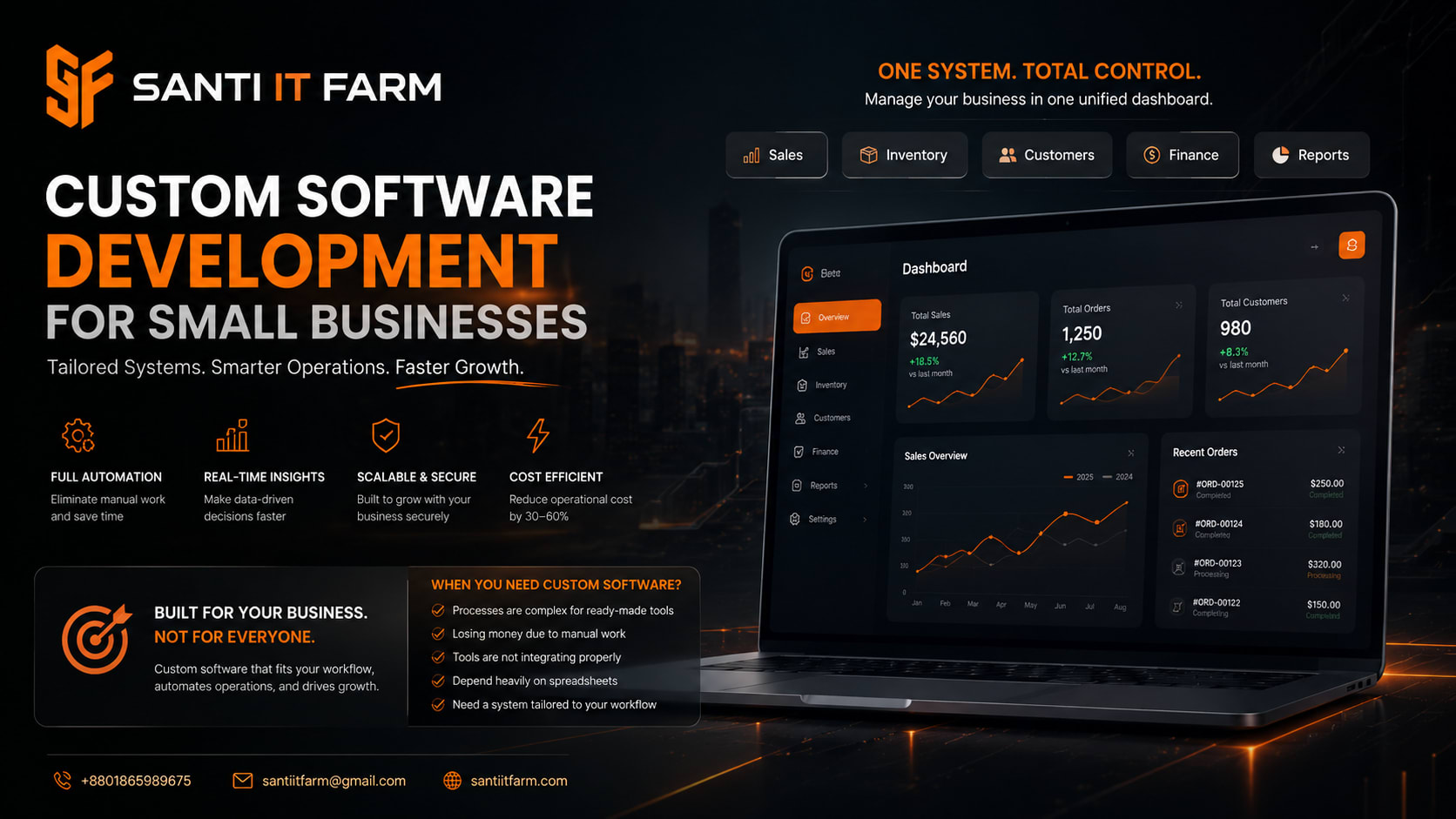
Why Most Small Businesses Waste Money on the Wrong Tools
Most small businesses do not fail because of bad ideas. They fail because their systems become inefficient as operations grow.
At first, spreadsheets, WhatsApp orders, and generic SaaS tools feel good enough. But over time, businesses start facing operational chaos, manual bottlenecks, and data confusion.
Orders get lost, employees repeat the same work manually, customers experience delays, and reporting becomes unreliable.
Many business owners react by purchasing random software subscriptions without solving the core operational problem.
This is where custom software development becomes essential. The right system eliminates inefficiency, automates operations, and creates scalable business infrastructure.
In this guide, you will learn when small businesses actually need custom software, what benefits it creates, and how modern businesses use custom systems to scale faster in 2026.
Quick Answer: When Do Small Businesses Need Custom Software?
- When business processes become too complex for ready-made tools
- When manual work wastes time and reduces efficiency
- When multiple software tools fail to integrate properly
- When employees heavily depend on spreadsheets and manual tracking
- When the business requires workflows that generic tools cannot support
- When scaling operations becomes difficult with existing systems
If your business faces 2–3 of these problems consistently, custom software is no longer optional — it becomes a growth requirement.
What is Custom Software Development?
Custom software development means creating a fully tailored digital system designed specifically around your business operations and workflow.
Unlike generic SaaS platforms, custom software is built to solve your exact operational problems instead of forcing your business to adapt to limited features.
Custom systems are scalable, flexible, and fully controlled by the business owner.
For example, instead of using separate tools for inventory, billing, CRM, reporting, and customer management, a business can operate everything inside one centralized system.
Why Custom Software Matters in 2026
- Businesses now compete on automation, speed, and operational efficiency
- Manual systems slow down growth and increase operational costs
- Subscription-based SaaS stacks become expensive as teams scale
- Custom systems provide better control over data and workflows
- Automation allows businesses to grow without increasing staff proportionally
- Scalable software infrastructure creates long-term competitive advantage
In 2026, the quality of your business systems directly affects your growth ceiling, operational efficiency, and profitability.
Key Benefits of Custom Software Development
Business Process Automation
Automate repetitive tasks like billing, inventory tracking, notifications, and reporting to reduce manual work.
Centralized Operations
Manage sales, customers, operations, inventory, and finance from one unified dashboard.
Scalable Infrastructure
Custom software grows with your business without forcing you to switch platforms later.
Competitive Advantage
Operate with systems specifically designed for your workflow instead of relying on generic tools like competitors.
Long-Term Cost Reduction
Reduce dependency on expensive monthly subscriptions and inefficient processes.
Real Business Use Case: Retail Business Automation
Before
- — Uses Excel spreadsheets for inventory management
- — Accepts orders through WhatsApp manually
- — Relies on manual billing processes
- — Frequently faces stock tracking confusion
- — Employees waste time preparing reports
After
- One centralized dashboard manages sales and inventory
- Stock updates automatically after every sale
- Billing is generated instantly
- Business owners see real-time analytics and reports
- Operations become significantly faster and more organized
- Customer satisfaction improves due to faster service
Many small businesses discover that operational inefficiency costs far more money than building the right system.
Step-by-Step Process of Building Custom Software
Step 1: Business Requirement Analysis
- › Analyze workflows and operational bottlenecks
- › Identify manual processes and inefficiencies
- › Define business goals and automation requirements
Step 2: System Architecture Planning
- › Plan system features and user roles
- › Design scalable backend structure
- › Define automation logic and integrations
Step 3: UI/UX Design
- › Create user-friendly interfaces
- › Ensure simple navigation for employees
- › Optimize workflows for faster operations
Step 4: Development Phase
- › Develop frontend and backend systems
- › Implement database and APIs
- › Build scalable and secure architecture
Step 5: Testing & Optimization
- › Fix bugs and improve performance
- › Test security and scalability
- › Ensure stable business operations
Step 6: Deployment & Maintenance
- › Launch the system live
- › Train staff to use the software
- › Provide long-term updates and technical support
Technologies Used for Modern Custom Software
The right technology stack depends entirely on the business model, scalability goals, and operational complexity.
Common Mistakes Small Businesses Make
- Building software without clearly defining business requirements
- Hiring the cheapest developer instead of focusing on scalability and architecture
- Copying another business system without considering unique workflows
- Ignoring future business growth during development planning
- Using too many disconnected SaaS tools instead of creating centralized systems
- Avoiding long-term maintenance and technical support
FAQ: Custom Software Development for Small Businesses
Custom Software is a Business Growth System
Custom software is not simply about using technology.
It is about reducing operational chaos, eliminating manual inefficiency, and creating scalable business infrastructure.
As businesses grow, relying on spreadsheets and disconnected tools becomes increasingly expensive and risky.
The companies scaling fastest in 2026 are not necessarily the biggest companies — they are the businesses operating with smarter systems.
If your current workflow slows down growth, the problem is usually not your team. It is your system architecture.
Build a Smarter Business System with Santi IT Farm
Santi IT Farm helps startups, SMEs, and growing businesses build custom software systems designed for automation, scalability, and operational efficiency.
We develop business-focused software solutions that eliminate manual bottlenecks and improve long-term growth potential.
Our goal is not just to build software — it is to engineer systems that increase speed, control, and profitability.
- Custom business software development
- Business automation systems
- CRM & ERP development
- Inventory and billing systems
- Scalable web application development
- Long-term technical support and maintenance
Ready to replace inefficient workflows with a scalable business system? Contact Santi IT Farm today and build software designed specifically for your growth.
Get Started