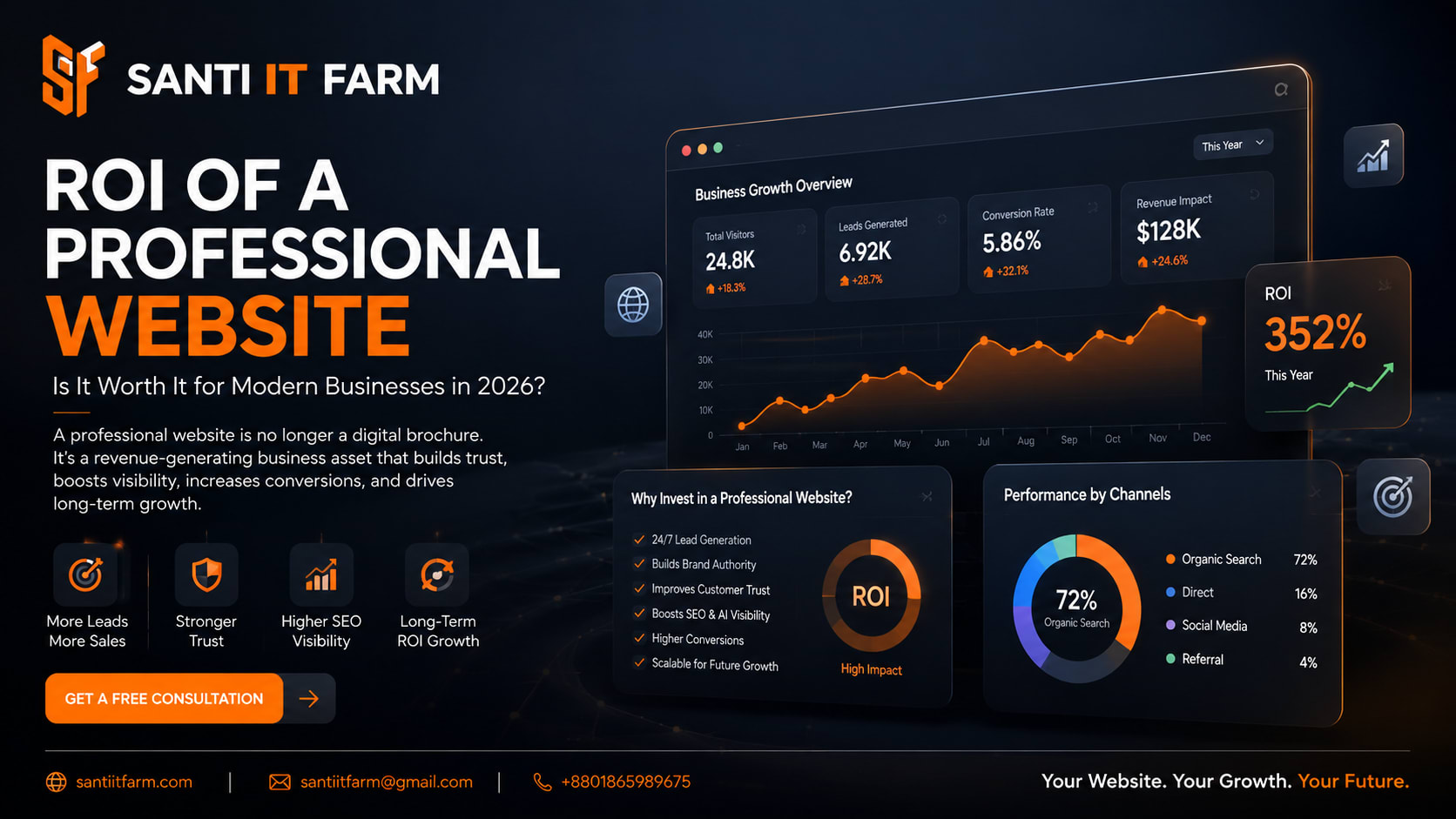
Why Digital Marketing ROI Matters More Than Ever
Many businesses invest in SEO, social media marketing, Google Ads, Shopify development, or website redesigns without truly understanding what returns those investments generate. The result is often wasted budgets, unclear performance, and frustration about whether digital marketing is actually helping the business grow.
ROI, or Return on Investment, is one of the most important metrics in modern business growth. It helps companies understand whether their marketing efforts are producing measurable profits or simply generating vanity metrics like likes, impressions, or website traffic without conversions.
In competitive markets like Bangladesh, India, Pakistan, the USA, the UK, and Canada, businesses can no longer rely on guesswork. Smart companies use ROI tracking to identify profitable channels, improve campaigns, reduce acquisition costs, and scale sustainable growth.
At Santi IT Farm, we regularly work with businesses that initially struggled to measure marketing performance properly. Once accurate ROI systems were implemented, many discovered which channels were generating revenue and which campaigns were quietly draining budgets.
This guide explains how to calculate ROI from digital marketing in a practical, business-focused way that both small businesses and enterprise brands can apply immediately.
Quick Answer: How Do You Calculate ROI From Digital Marketing?
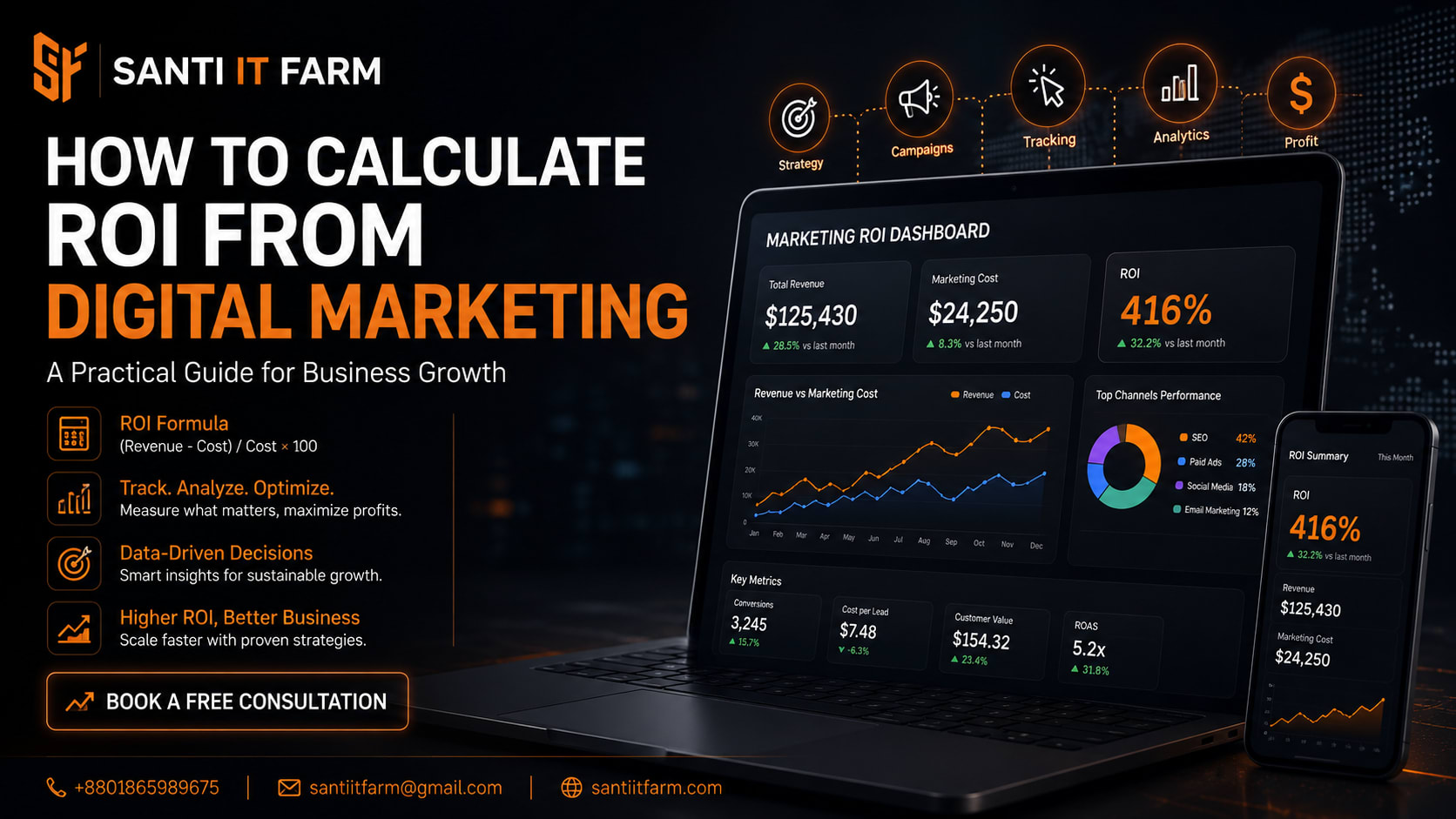
- Digital Marketing ROI Formula: ((Revenue - Marketing Cost) / Marketing Cost) × 100
- If you spend $1,000 on marketing and generate $5,000 in revenue, your ROI is 400%.
- Track both direct and assisted conversions using analytics tools.
- Include all marketing costs such as ads, software, agency fees, content creation, and staff time.
- Measure channel-specific ROI for SEO, paid ads, email marketing, and social media campaigns.
- Use attribution models to understand which touchpoints influence conversions.
- Focus on profit-driven metrics instead of vanity metrics like impressions or followers.
High ROI does not always mean high revenue. A smaller campaign can produce better ROI percentages than a larger campaign with lower profit margins.
What Is Digital Marketing ROI?
Digital marketing ROI measures how much profit or value your business earns compared to how much you spend on marketing activities. It shows whether your campaigns are financially effective and helps guide smarter business decisions.
Unlike traditional marketing methods where tracking was often difficult, digital marketing provides measurable data across SEO, Google Ads, Facebook Ads, email campaigns, content marketing, e-commerce sales funnels, and customer journeys.
ROI is not only about revenue generation. In many cases, businesses also evaluate lead quality, customer lifetime value, retention, brand growth, and conversion efficiency. For example, an SEO campaign may take longer to produce results than paid ads, but it often generates lower long-term acquisition costs and stronger sustainable ROI.
Businesses that consistently measure marketing ROI are usually better positioned to scale because they understand exactly where growth is coming from.
Why Measuring Marketing ROI Is Critical for Business Growth
- It helps businesses stop wasting money on ineffective marketing channels.
- It improves decision-making by using real performance data instead of assumptions.
- It reveals which campaigns generate profitable customers.
- It helps justify marketing budgets to stakeholders and investors.
- It improves customer acquisition strategies.
- It allows businesses to scale successful campaigns faster.
- It strengthens long-term financial forecasting.
- It helps agencies and clients maintain transparent performance reporting.
- It improves conversion optimization and sales funnel efficiency.
- It creates accountability across marketing teams and vendors.
Companies that fail to measure ROI often continue investing in low-performing campaigns for months or even years without realizing the true cost of ineffective marketing.
Benefits of Tracking Digital Marketing ROI
Smarter Budget Allocation
ROI tracking helps businesses invest more confidently in channels that consistently generate profits while reducing spending on underperforming campaigns.
Better Lead Quality
By analyzing ROI alongside conversion data, businesses can identify which traffic sources bring serious buyers instead of low-intent visitors.
Improved Marketing Strategy
Accurate ROI analysis reveals patterns in customer behavior, seasonal trends, and campaign effectiveness that support long-term strategic planning.
Higher Conversion Rates
Businesses that track ROI often uncover weak landing pages, slow websites, or ineffective messaging that reduce conversions.
Stronger Competitive Advantage
Companies that understand their numbers can adapt faster, optimize campaigns more effectively, and outperform competitors in crowded markets.
Better Client and Stakeholder Reporting
ROI-focused reporting creates transparency and trust between agencies, business owners, investors, and internal teams.
Scalable Business Growth
When businesses know their acquisition costs and profitability metrics, scaling becomes more predictable and less risky.
Realistic ROI Example for a Growing E-commerce Business
Before
- — An online fashion store invested in Facebook Ads without proper tracking.
- — The business focused mostly on likes, engagement, and website traffic.
- — Monthly ad spending reached $3,000 with inconsistent sales performance.
- — The website lacked conversion tracking and attribution setup.
- — The business owner believed the campaigns were profitable but had no actual data.
After
- Conversion tracking and analytics were implemented properly.
- Landing pages were optimized for mobile conversions.
- Retargeting campaigns were introduced to recover abandoned carts.
- The business identified high-performing customer segments.
- Revenue from campaigns increased to $15,000 monthly from a $3,000 ad spend.
- The calculated ROI reached 400%, while customer acquisition costs dropped significantly.
Many businesses discover that tracking accuracy alone can dramatically improve marketing profitability because it reveals where money is being wasted.
Step-by-Step Guide to Calculating Digital Marketing ROI
Identify Total Marketing Costs
- › Include advertising spend across all platforms.
- › Calculate software and tool expenses.
- › Include agency or freelancer fees.
- › Add content production and design costs.
- › Factor in employee salaries related to marketing activities.
- › Consider website development and optimization expenses.
Track Revenue Generated
- › Use Google Analytics and conversion tracking tools.
- › Track online sales and lead conversions.
- › Monitor CRM data for customer acquisition.
- › Separate direct revenue from assisted conversions.
- › Use e-commerce analytics for Shopify or WooCommerce stores.
Apply the ROI Formula
- › Subtract total marketing costs from total revenue.
- › Divide the result by marketing costs.
- › Multiply by 100 to calculate percentage ROI.
- › Compare ROI across channels and campaigns.
Measure Channel-Specific Performance
- › Analyze SEO ROI separately from paid advertising.
- › Track social media conversion performance.
- › Review email marketing revenue.
- › Evaluate influencer and affiliate marketing effectiveness.
- › Compare organic versus paid customer acquisition costs.
Use Attribution Models
- › Understand first-click and last-click attribution.
- › Track multi-touch customer journeys.
- › Measure how multiple channels contribute to conversions.
- › Avoid crediting all revenue to a single marketing source.
Optimize Based on Data
- › Pause low-performing campaigns.
- › Increase budgets for profitable channels.
- › Improve landing pages and conversion funnels.
- › Refine audience targeting.
- › Test new creative strategies and offers regularly.
Best Tools for Measuring Marketing ROI
The best ROI tracking system combines analytics, CRM data, attribution modeling, and conversion tracking together rather than relying on a single platform.
Common ROI Calculation Mistakes Businesses Make
- Ignoring hidden marketing costs like design, software subscriptions, and staff time.
- Tracking traffic instead of revenue-driven conversions.
- Using inaccurate attribution models.
- Failing to track phone calls and offline conversions.
- Measuring short-term results only while ignoring customer lifetime value.
- Comparing channels with different conversion cycles unfairly.
- Not optimizing landing pages before increasing ad budgets.
- Relying on vanity metrics instead of profit-focused metrics.
- Ignoring mobile conversion performance.
- Making decisions without statistically meaningful data.
Frequently Asked Questions About Digital Marketing ROI
ROI-Driven Marketing Creates Sustainable Business Growth
Digital marketing without ROI tracking is essentially guesswork. Businesses that focus only on traffic, followers, or impressions often miss the bigger picture: profitability and sustainable growth.
Accurate ROI calculation helps companies understand where revenue comes from, which campaigns deserve more investment, and how to improve conversion performance across every stage of the customer journey.
Whether you run an e-commerce store, startup, corporate brand, or local business in Bangladesh, India, Pakistan, the USA, Canada, or the UK, understanding your marketing ROI is essential for long-term success.
The businesses that consistently win online are usually not the ones spending the most money. They are the ones measuring performance correctly, optimizing strategically, and making data-driven decisions faster than competitors.
At Santi IT Farm, we help businesses build ROI-focused digital ecosystems through SEO, web development, conversion optimization, automation, analytics, and growth-driven marketing strategies designed for measurable business outcomes.
Ready to Improve Your Marketing ROI?
If your business is spending money on digital marketing without clear visibility into performance, it may be time to build a smarter growth strategy.
Santi IT Farm helps businesses worldwide develop high-converting websites, advanced tracking systems, SEO strategies, e-commerce growth campaigns, and AI-powered marketing solutions focused on measurable ROI.
Our team works with startups, local businesses, international brands, and e-commerce companies looking to scale profitably instead of relying on guesswork.
- SEO Services
- Website Development
- Shopify Development
- WordPress Development
- Conversion Optimization
- Digital Marketing
- Business Automation
- AI-powered Systems
- Custom Software Development
- UI/UX Design
Talk to Santi IT Farm today and discover how data-driven digital strategies can turn your marketing investment into sustainable business growth.
Get Started