Introduction
If your website isn't generating consistent traffic or leads, you're likely asking the same question every business owner asks:
"Should I focus on on-page SEO or off-page SEO?"
In 2026, the answer isn't as simple as choosing one.
Search engines are smarter. AI-driven ranking systems now evaluate content quality, authority, user intent, and trust signals together. That means businesses relying on outdated SEO tactics are losing visibility—and revenue.
This guide breaks down what truly matters in 2026, with actionable strategies you can implement immediately to grow traffic, authority, and conversions.
Quick Answer
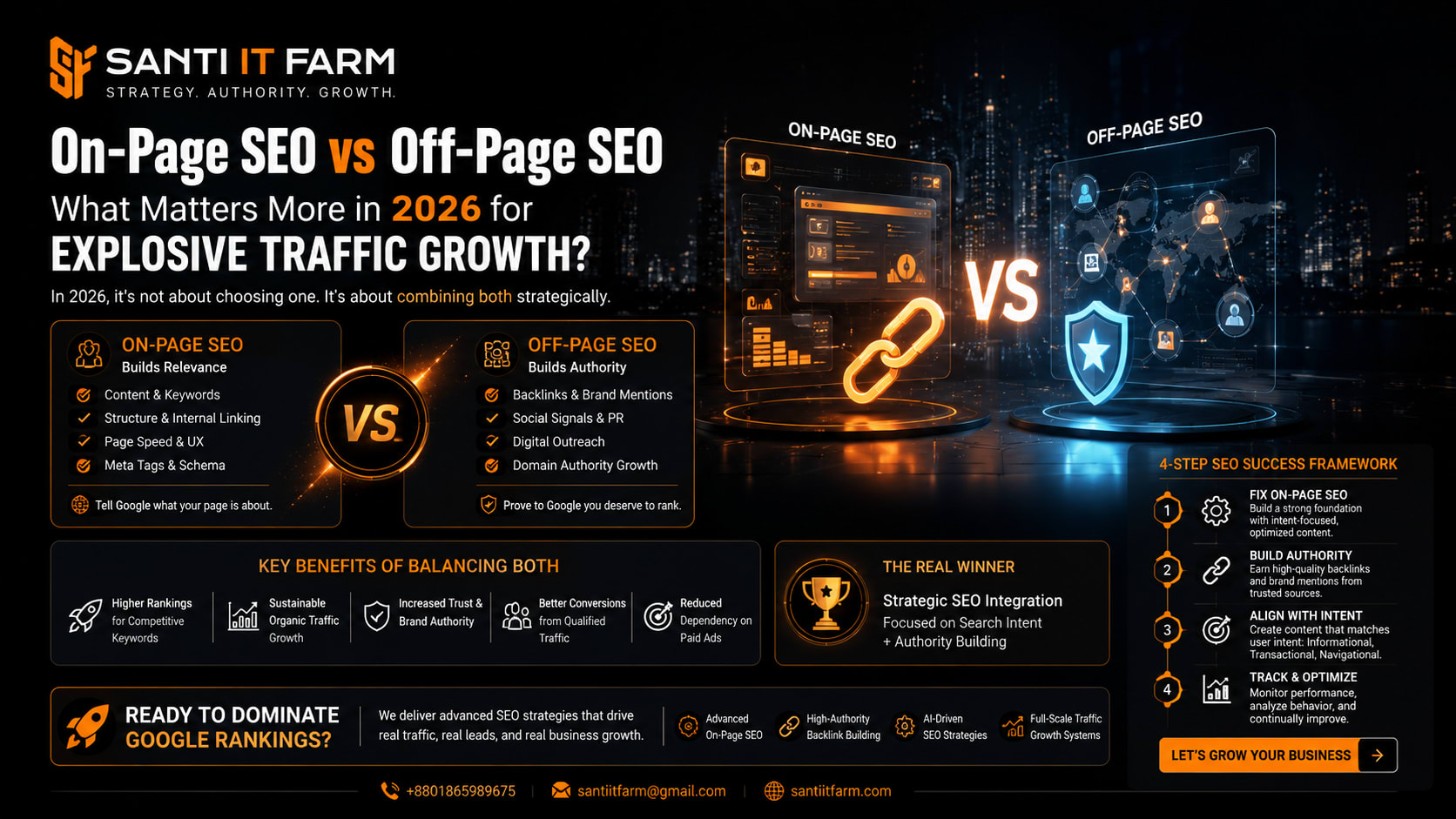
- On-page SEO builds relevance (content, keywords, structure)
- Off-page SEO builds authority (backlinks, brand signals, trust)
- In 2026, on-page SEO is the foundation—but off-page SEO drives competitive rankings
- You need both working together, not one over the other
The real winner: Strategic SEO integration focused on search intent + authority building
What is On-Page SEO vs Off-Page SEO?
On-Page SEO: On-page SEO refers to everything you control on your website. Key elements include keyword optimization, content quality and depth, internal linking, page speed and UX, meta tags and headings, and schema markup. Think of on-page SEO as "telling Google what your page is about."
Off-Page SEO: Off-page SEO focuses on signals outside your website that build trust and authority. Key elements include backlinks from authoritative sites, brand mentions, social signals, PR and digital outreach, and domain authority growth. Think of off-page SEO as "proving to Google your website deserves to rank."
Why It Matters in 2026
- Search engines in 2026 are powered by advanced AI models that understand search intent deeply.
- AI models evaluate content usefulness, not just keywords.
- AI models measure brand credibility and trust signals.
- AI models prioritize real-world authority over manipulated links.
- Thin content no longer ranks—even with backlinks.
- Backlinks alone won't save weak pages.
- AI favors experience-driven, expert-level content.
- Google rewards entities (brands), not just pages.
You need strong on-page + strong off-page to win.
Key Benefits of Balancing Both
Higher rankings for competitive keywords
Balancing on-page and off-page SEO helps achieve higher rankings for competitive keywords.
Sustainable organic traffic growth
A balanced SEO strategy leads to sustainable organic traffic growth over time.
Increased trust and brand authority
Combining both SEO types increases trust and brand authority in your niche.
Better conversion rates from qualified traffic
Qualified traffic driven by intent-based SEO results in better conversion rates.
Reduced dependency on paid ads
Strong organic SEO reduces the need and cost of paid advertising campaigns.
Lower customer acquisition cost (CAC)
Effective SEO lowers the cost of acquiring new customers over time.
Higher ROI from SEO campaigns
Integrated SEO strategies deliver higher return on investment from campaigns.
Long-term traffic assets instead of short-term wins
Proper SEO builds long-term traffic assets rather than delivering only short-term wins.
Real Business Use Case
Before
- — Scenario: A Startup SaaS Company
- — They invested heavily in backlinks (off-page SEO).
- — But their content was generic and poorly structured.
- — Result: Rankings plateaued.
- — Traffic didn't convert.
After
- After Strategy Shift: Rebuilt on-page SEO by targeting user intent, creating high-value content, and improving UX and speed.
- Combined improved on-page content with authority backlinks.
- Outcome in 6 months: 3X organic traffic growth.
- 2.5X increase in leads.
- Ranked on page 1 for competitive keywords.
Off-page gets you noticed. On-page makes you rank—and convert.
Step-by-Step Implementation Guide
Step 1: Fix On-Page SEO First (Foundation)
- › Perform keyword research based on intent
- › Optimize titles, headings, and content structure
- › Improve page speed and mobile experience
- › Add internal links between related pages
- › Use schema markup for better indexing
Step 2: Build Authority with Off-Page SEO
- › Get backlinks from relevant, high-authority sites
- › Publish guest posts on industry blogs
- › Use digital PR strategies
- › Build brand mentions across platforms
Step 3: Align Content with Search Intent
- › Informational (guides, blogs)
- › Transactional (service pages)
- › Navigational (brand pages)
Step 4: Track & Optimize
- › Monitor rankings
- › Analyze user behavior
- › Update content regularly
- › Scale what works
Tools & Technologies (Used by Experts)
Common Mistakes to Avoid
- Focusing only on backlinks without fixing content
- Keyword stuffing instead of intent-based writing
- Ignoring technical SEO issues
- Buying low-quality backlinks
- Not updating old content
- Treating SEO as a one-time task
- SEO in 2026 is continuous optimization, not a one-time setup.
FAQ Section
Conclusion
In 2026, the debate isn't on-page vs off-page SEO.
The real question is: "How well are they working together?"
On-page SEO ensures your content is relevant and valuable.
Off-page SEO proves your authority and trustworthiness.
Businesses that integrate both strategically are the ones dominating search results.
Ready to Dominate Google Rankings?
If you want real traffic, real leads, and real business growth, you need more than basic SEO—you need a proven strategy.
Santi IT Farm specializes in:
- Advanced on-page optimization
- High-authority backlink building
- AI-driven SEO strategies
- Full-scale traffic growth systems
Stop guessing. Start ranking. Visit santiitfarm.com and book your SEO consultation today to turn your website into a traffic and lead-generation machine.
Get Started