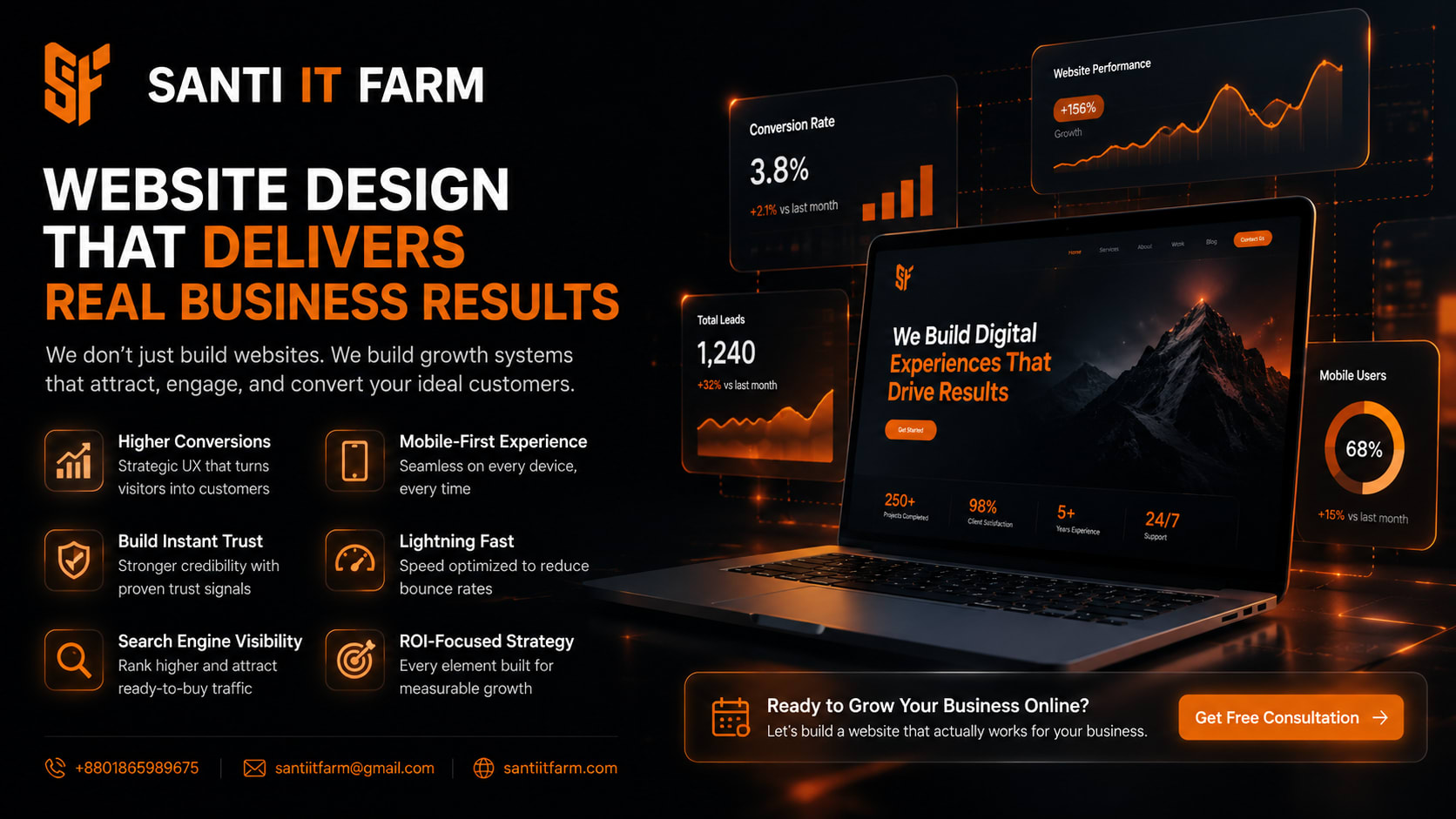
Your Website Looks Good. So Why Isn't Your Business Growing?
You invested time, money, and creative energy into building a website you're proud of. It looks clean. It loads reasonably fast. You've got a homepage, an about page, a services section, and a contact form. By most measures, it looks like a proper business website. And yet — the leads aren't coming. The inquiries are sparse. Sales are underwhelming. You're left wondering what you're doing wrong.
Here's the hard truth that most web designers won't tell you upfront: design and results are not the same thing. A website can be visually stunning and still fail completely as a business tool. In fact, thousands of businesses across Bangladesh, India, Pakistan, the UK, the US, and everywhere in between are sitting on websites that look the part but quietly bleed potential customers every single day.
This isn't about blaming the designer or dismissing the importance of aesthetics. Beautiful design absolutely matters. But design without strategy, trust architecture, and conversion intent is just digital decoration. The businesses that win online understand one thing clearly: your website isn't an art project. It's a growth engine. And if it isn't built to convert visitors into real paying customers, something fundamental is broken.
In this guide, we're going to break down exactly what's missing — the gap between how a website looks and what it actually does for your business — and give you a practical framework to fix it.
Why Does a Well-Designed Website Fail to Produce Business Results?
- The design prioritizes aesthetics over user intent and conversion flow
- There are no visible trust signals like testimonials, certifications, or case studies
- The messaging is vague — visitors don't immediately understand what you do or who you serve
- CTAs (calls to action) are weak, buried, or completely missing
- The site isn't optimized for search engines, so the right people never find it
- The website isn't mobile-optimized, causing high bounce rates from smartphone users
- There's no clear value proposition above the fold
- The site loads too slowly, losing impatient visitors within the first three seconds
- Lead capture mechanisms are absent or poorly placed
- The site hasn't been built with the buyer's journey in mind
Most of these problems are invisible to the business owner. The website looks fine on the surface. The damage happens silently, in the gap between visits and conversions.
What's the Real Difference Between Website Design and Business Results?
Website design refers to the visual and structural elements of a website — the layout, typography, color scheme, imagery, and overall aesthetic presentation. Done well, great design creates a first impression that builds credibility and signals professionalism. It's important. But it's only one layer of the puzzle.
Business results from a website include the actual outcomes your digital presence is supposed to generate: qualified leads, product sales, service inquiries, email signups, phone calls, consultation bookings, and brand trust that converts over time. These are the metrics that actually move your business forward.
The gap between the two is where most businesses get stuck. They invest in design and assume results will follow automatically. They don't. A website produces business results only when design is backed by clear strategy, intentional messaging, technical SEO, conversion optimization, and a deep understanding of the target customer's psychology and decision-making process.
Think of it this way: design is the packaging. Strategy, messaging, and trust architecture are what's inside the box. Customers might pick up a beautifully packaged product — but they buy it because of what's inside. Your website works exactly the same way.
Why This Gap Costs Businesses Real Money Every Month
- Every visitor who lands on your site and leaves without taking action is a lost opportunity — and depending on how much you spend on advertising or SEO, a costly one
- A website with a 1% conversion rate and 1,000 monthly visitors generates roughly 10 leads. Improving that rate to just 3% — through better messaging, trust signals, and UX — triples your leads without spending a single extra dollar on traffic
- In competitive markets like e-commerce, digital services, or B2B consulting in Bangladesh, India, Pakistan, the UK, and North America, your website is often the first and only chance to make a case for your business before a prospect moves on to a competitor
- Poor trust signals — missing testimonials, no privacy policy, unclear contact information, no social proof — cause visitors to question your legitimacy and abandon the site, especially in international markets where buyers are cautious about new vendors
- A website that doesn't rank on Google means you're invisible to buyers who are actively searching for exactly what you offer. Design without SEO is a beautiful shop in a locked basement
- Mobile users represent over 60% of all web traffic globally. A website that isn't optimized for smartphones loses the majority of its potential audience before the page even fully loads
The math is simple and sobering: a website that looks great but converts poorly is not a neutral asset. It's an active liability. Every month it underperforms is a month of revenue, relationships, and growth that you'll never get back.
What Happens When Design and Strategy Work Together
Visitors Become Leads Automatically
When your website is built with a clear conversion architecture — strategic CTAs, well-placed contact forms, lead magnets, and a logical content flow — visitors are naturally guided toward taking action. You stop relying on word-of-mouth alone and start generating consistent inbound interest.
Your Brand Earns Immediate Trust
Trust is built in seconds. When a website features real testimonials, case studies, partner logos, certifications, and transparent pricing or process information, visitors feel safe. That feeling of safety is what transforms a curious browser into a genuine buyer — especially for service businesses or international e-commerce brands.
Search Engines Send You Qualified Traffic
A strategically built website that combines quality content, semantic SEO structure, fast load times, and proper technical optimization ranks for the search terms your ideal clients are typing. This means your website works for you around the clock, attracting buyers from Dhaka, Delhi, Lahore, London, or Los Angeles without paid advertising.
Your Sales Cycle Gets Shorter
When a prospect visits your website and immediately understands your value proposition, sees social proof, reads clear answers to their biggest concerns, and finds it easy to take the next step — the sales conversation starts from a position of trust. You stop having to explain yourself from scratch every call.
You Stand Out in a Crowded Market
In most industries, 80% of competitor websites are mediocre — vague, slow, untrusted, or confusing. A website that's genuinely built to convert becomes a serious competitive advantage. It signals that your business is serious, experienced, and worth the investment.
You Get Better ROI on Marketing Spend
Every dollar spent on Google Ads, Facebook campaigns, or influencer promotions drives traffic to your site. If your site converts that traffic poorly, your ad spend is largely wasted. A conversion-optimized website multiplies the return on every marketing channel you invest in.
Real-World Example: Two E-Commerce Businesses, One Critical Difference
Before
- — A fashion e-commerce brand in Dhaka, Bangladesh launched a Shopify store that looked professionally designed — clean product photos, organized navigation, and a modern layout. After three months of running paid Facebook ads, they were getting decent traffic but their conversion rate hovered below 0.8%.
- — The problems were invisible at first glance: the homepage had no trust signals — no return policy, no customer reviews, no secure payment badges. The product descriptions were generic and failed to address buyer concerns. The mobile checkout experience had a confusing multi-step form. Shipping information was buried in the footer. Every friction point was costing them sales.
After
- After a full conversion audit and redesign by a strategic web partner, the store added visible trust badges, real customer reviews with photos, a prominent return policy, and a simplified one-page mobile checkout. Product descriptions were rewritten to address specific customer pain points and highlight unique benefits.
- Within 60 days, the store's conversion rate climbed to 2.9% — a nearly 260% improvement. The same ad spend that previously produced around 8 sales per 1,000 visitors was now producing over 29. Revenue tripled without increasing the marketing budget by a single taka.
This isn't an extraordinary case. It's a pattern we see repeatedly across industries and markets — from service businesses in Karachi and Bangalore to SaaS companies in Toronto and e-commerce brands in London. The website looked fine. The strategy was missing. The fix was methodical, not magical.
How to Close the Gap Between Design and Real Business Results
Step 1: Audit Your Website With Business Eyes, Not Design Eyes
- › Ask yourself: Does my homepage immediately tell a first-time visitor what I do, who I serve, and why I'm the right choice?
- › Check whether your primary call-to-action is visible within the first screen view without scrolling
- › Identify whether trust signals — testimonials, reviews, client logos, certifications — appear on high-intent pages
- › Review your mobile experience personally on multiple devices — not just your desktop browser
- › Look at your Google Analytics or equivalent data to identify pages with high exit rates and low time-on-page
Step 2: Sharpen Your Value Proposition
- › Your homepage headline should immediately answer: what do you do, for whom, and with what result?
- › Replace vague taglines like 'We deliver excellence' with specific, benefit-focused statements
- › Lead with outcomes your clients care about, not a list of your services
- › Use the language your actual customers use — not industry jargon
- › Test your value proposition by asking someone unfamiliar with your business to read your homepage and summarize what you do in one sentence
Step 3: Build Trust Architecture Into Every Key Page
- › Add verified testimonials with real names, photos, and specific outcomes to your homepage and service pages
- › Display recognizable trust signals: secure payment icons, industry certifications, partner logos, press mentions
- › Create a transparent, detailed About page that shows real people, real experience, and a genuine brand story
- › Include case studies with before-and-after metrics wherever possible — even simple ones build enormous credibility
- › Make sure your contact information — phone number, email, physical address where applicable — is easy to find on every page
Step 4: Optimize Your Conversion Flow
- › Every service page, product page, and blog post needs a clear next action for the reader
- › Reduce the number of steps between interest and inquiry — a contact form with 10 required fields kills conversions
- › Use contextual CTAs that match the content — 'Book a Free Consultation' on a service page converts better than a generic 'Contact Us'
- › Add exit-intent prompts or lead magnets — a free guide, checklist, or audit offer — to capture visitors before they leave
- › Use heatmap tools like Microsoft Clarity or Hotjar to see exactly where visitors click, scroll, and abandon your pages
Step 5: Fix the Technical Foundation
- › Run a Google PageSpeed Insights test — any score below 70 on mobile means you're losing visitors before they even see your content
- › Ensure your website uses HTTPS — browsers flag non-secure sites and visitors notice
- › Fix broken links, missing meta descriptions, and pages with duplicate or missing title tags
- › Make sure your site is properly indexed by Google using Google Search Console
- › Implement structured data markup where relevant — it helps search engines and AI tools understand and surface your content
Step 6: Align Your Content Strategy With Search Intent
- › Identify the specific questions your ideal clients are typing into Google and create content that answers them with authority
- › Optimize existing service pages with long-tail keywords that reflect buyer intent, not just generic industry terms
- › Develop a consistent blog or resource section — not for volume, but for strategic coverage of topics your buyers care about
- › Use internal linking to guide visitors from informational content toward conversion-focused pages
- › Track rankings and organic traffic monthly — SEO is a long game, but the compounding results are significant
Tools That Help You Measure and Improve Website Performance
You don't need all of these at once. Start with Google Analytics, Google Search Console, and Microsoft Clarity — they're all free and will give you more actionable data than most businesses ever act on. Build from there as you identify specific gaps in your conversion funnel.
The Most Common Website Mistakes That Kill Business Results
- Treating the website as a one-time project rather than a living business asset that needs ongoing optimization
- Using stock photos of strangers instead of real photos of your team, workspace, or actual products — it destroys trust instantly
- Writing homepage copy that talks about your business instead of addressing the customer's specific problem or aspiration
- Hiding pricing or making it deliberately vague — modern buyers expect transparency, and avoiding it breeds suspicion
- Having a slow website and justifying it because 'it looks fine on my laptop' — your customers on 4G mobile connections in Dhaka or Delhi will abandon in seconds
- Neglecting the blog or removing it entirely — consistently published, strategically written content is one of the most powerful long-term lead generation assets you have
- Designing for how you want your brand to feel rather than for how your customers need to find and evaluate you
- Ignoring local SEO signals — if you serve clients in specific regions or cities, not optimizing for local search is leaving a significant source of free traffic untapped
- Launching a website and then not tracking anything — no analytics, no heatmaps, no conversion goals — making it impossible to improve what you can't measure
- Over-engineering the design at the expense of clarity — complex animations, oversized headers, and visually busy layouts often hurt conversions more than they help
Frequently Asked Questions About Website Design and Business Performance
Design Earns Attention. Strategy Earns Results.
There's a reason businesses that invest in both design and strategy consistently outperform those that focus on one or the other. Design without strategy is a beautiful dead end. Strategy without design is an idea that nobody takes seriously. The businesses that are genuinely winning online — generating consistent leads, building real trust, converting traffic into revenue — have figured out how to make both work together in service of a single purpose: growth.
The good news is that closing the gap between how your website looks and what it actually achieves for your business is entirely possible. It requires honesty about what's not working, a willingness to make changes based on data rather than personal preference, and a long-term mindset about your website as a business asset rather than a finished product.
Whether you're running a growing startup in Dhaka, an e-commerce brand targeting the UK market, a service firm in Karachi, or a regional business trying to expand internationally — the principles are the same. Clarity of message. Strength of trust. Ease of action. Visibility in search. These are the four pillars of a website that genuinely works. Everything else is details.
You've already built something. Now it's time to make it work the way it should.
Ready to Turn Your Website Into a Real Business Growth Engine?
At Santi IT Farm, we don't just build websites — we build growth systems. Our team of strategists, designers, and SEO specialists works with businesses across Bangladesh, India, Pakistan, the USA, the UK, Canada, and Australia to close the gap between digital presence and real commercial results.
We start every engagement with a deep audit of your current digital assets — identifying exactly where you're losing visitors, where trust is breaking down, and where your biggest growth opportunities lie. Then we build a strategy and execute it with precision.
Whether you need a full website rebuild, a conversion optimization overhaul, an SEO strategy that actually drives qualified traffic, or an e-commerce experience on Shopify or WooCommerce that converts at a premium level — we have the expertise and the track record to deliver.
- Website Design & Development
- Shopify & E-commerce Development
- WordPress Development
- SEO & Content Strategy
- UI/UX Design for Conversion
- Digital Marketing & Lead Generation
- Branding & Visual Identity
- Business Automation & AI-Powered Systems
Stop leaving growth on the table. Book your free consultation with the Santi IT Farm team today and let's build something that actually works for your business.
Get Started

