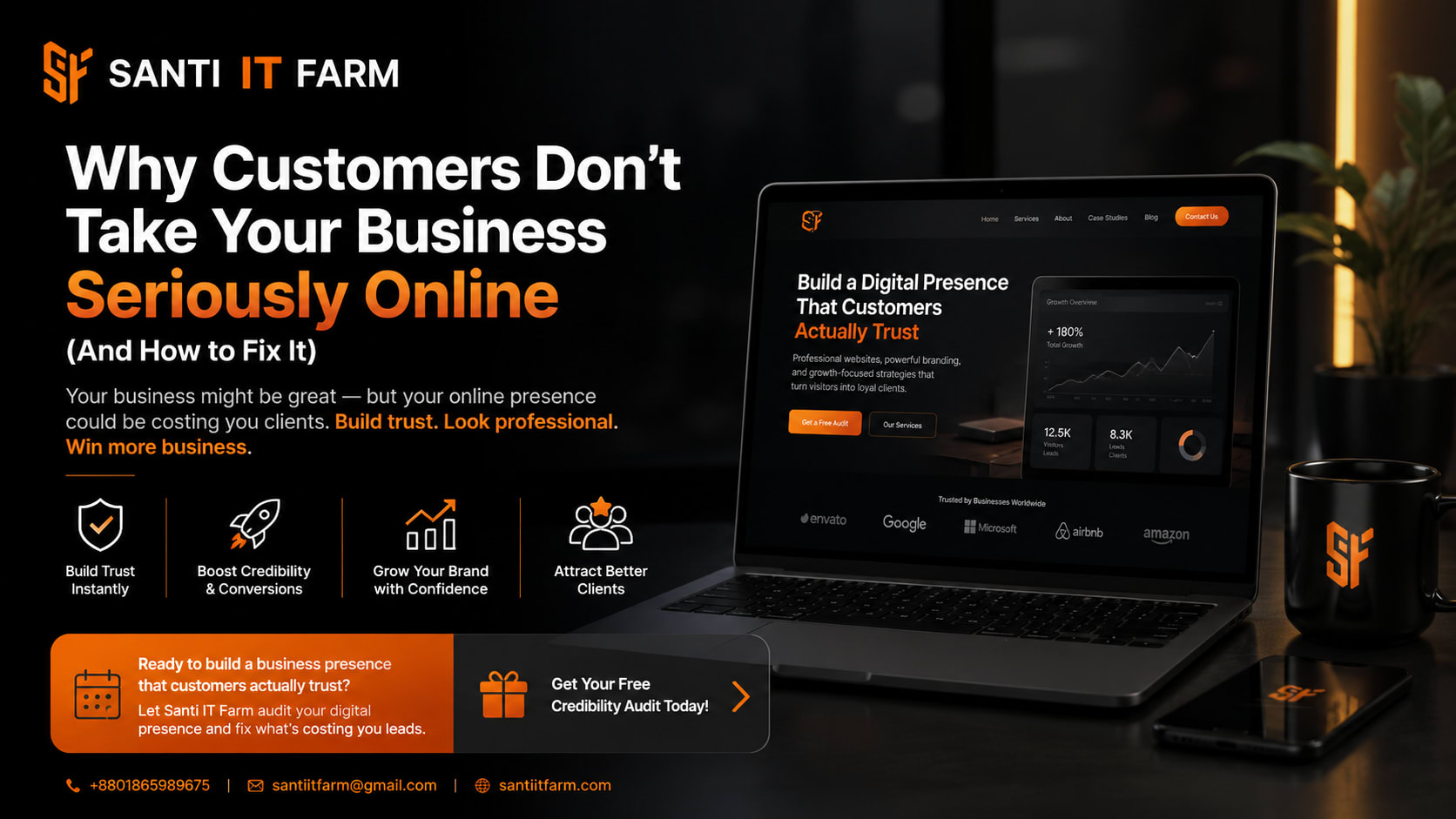
Your Business Is Real. Your Online Presence Might Not Look Like It.
You've invested time, energy, and money into building something real. Your service delivers results. Your product solves a genuine problem. And yet — people visit your website, look at your social media, and quietly move on to a competitor. Not because the competitor is better. But because they look more trustworthy.
This is one of the most painful and underappreciated problems facing small businesses, startups, and even growing brands across Bangladesh, India, Pakistan, the UK, and beyond. The gap between what your business actually is and what it looks like online is costing you real money every single day.
The hard truth? In a digital-first world, perception is your first product. Before a customer reads your pricing, watches your testimonial video, or picks up the phone — they've already made a subconscious judgment about whether you're legitimate. And most of the time, that judgment takes under seven seconds.
This article breaks down exactly why customers don't take businesses seriously online, the specific credibility signals they're looking for, and what you can do right now to start fixing the problem. No vague advice — just business-focused strategies that actually move the needle.
Why Don't Customers Trust Businesses Online? (Quick Answer)
- The website looks outdated, slow, or broken on mobile
- There's no clear professional brand identity or consistent visual style
- Missing or unverifiable social proof — reviews, testimonials, case studies
- No clear contact information or physical presence signals
- Poor copywriting that reads as vague, generic, or unconfident
- No SSL certificate or visible security trust signals
- Inactive or inconsistent social media presence
- No visible team, story, or human element behind the business
- Confusing navigation and unclear calls-to-action
- No content strategy — the business has no visible thought leadership
If your business has even three of these issues, you're likely losing a significant percentage of your potential customers at the awareness stage — before they ever reach out.
What 'Online Credibility' Really Means for a Business
Online credibility isn't about having a flashy website. It's about creating a digital environment where a total stranger — someone who has never heard of you — can arrive at your online presence and immediately feel safe enough to take the next step. That next step might be booking a call, making a purchase, or simply saving your page to return later.
Credibility is built through a combination of design quality, content clarity, social proof, technical performance, and consistency across platforms. None of these elements work in isolation. A gorgeous website with zero reviews feels suspicious. A page covered in five-star reviews but built on a 2010 template raises eyebrows. Customers are doing a holistic evaluation — often without realizing it.
Think of your online presence the same way you'd think about meeting a potential business partner in person. You'd notice how they dress, how they speak, whether they answer questions confidently, and whether their background story checks out. Your digital presence is doing exactly the same job — just automatically, 24 hours a day, across every time zone in the world.
For businesses in competitive markets — whether you're a Dhaka-based digital agency, a Lahore startup, a Mumbai e-commerce brand, or a UK service provider — the businesses that master digital credibility don't just attract more customers. They attract better customers who are already pre-sold on the value of working with a professional.
Why This Problem Is More Expensive Than You Think
- The average user decides whether to stay on a website within 0.05 seconds of landing — that's a visual judgment, not a rational one. If your design signals 'amateur,' the decision is made before your words even load.
- Research consistently shows that 75% of consumers admit to judging a business's credibility based on website design alone. Your site isn't just marketing — it's a trust machine, and it's either working for you or against you.
- In markets like Bangladesh, India, and Pakistan — where digital commerce is growing rapidly but consumer skepticism about online businesses remains high — the credibility gap is even wider. A professional digital presence isn't a luxury here. It's the baseline entry ticket for being taken seriously.
- For e-commerce businesses, the stakes are even higher. A customer who doesn't trust you won't save their card details on your platform. Full stop. Conversion rates on untrustworthy-looking stores are catastrophically low regardless of traffic volume.
- Every month you operate with a credibility problem is a month you're paying for traffic — through ads, SEO, or time — and converting a fraction of what you should. That's the real cost: not what it takes to fix the problem, but what you're losing while it remains unfixed.
Digital credibility isn't a branding exercise. It's a revenue problem. And solving it has a direct, measurable impact on your business growth.
What Happens When Your Business Actually Looks Credible Online
Higher Conversion Rates Without More Traffic
When your website and brand communicate professionalism from the first second, a higher percentage of the people already visiting will take action. Most businesses chase more traffic when the real leverage is in converting the traffic they already have. Fixing credibility is often the highest-ROI move a business can make.
Better Quality Leads and Clients
Professional digital presence naturally filters out low-value inquiries and attracts clients who are already aligned with what you offer. When you look premium, premium clients feel at home. When you look generic, you attract price-sensitive customers who will always push back on your rates.
Stronger Competitive Position
In almost every industry, the majority of businesses have weak online credibility. By raising your digital trust signals above the industry average, you immediately stand out — not through being louder, but through appearing more reliable, established, and authoritative.
Word-of-Mouth and Referral Amplification
Satisfied customers refer others all the time. But a referral visits your website before reaching out. If your site doesn't back up the recommendation, the referral evaporates. A credible online presence turns your existing word-of-mouth into closed business instead of lost opportunities.
Organic Search and AI Search Visibility
Google and AI-powered search engines like ChatGPT and Perplexity increasingly prioritize authoritative, trustworthy sources. Businesses with strong credibility signals — quality content, proper technical setup, positive reviews, and clear expertise — rank higher and get surfaced more often in AI-generated recommendations.
Reduced Dependence on Paid Ads
When organic trust does the heavy lifting, you spend less convincing people you're real. Businesses with strong digital credibility get more inbound requests from content, referrals, and direct search — reducing the percentage of revenue that has to be spent on paid acquisition.
Real-World Example: The Same Business, Two Very Different Outcomes
Before
- — A garment export business in Chittagong had been operating for eight years with a strong product and repeat buyers.
- — Their website was built in 2016, wasn't mobile-responsive, had no SSL, and used a generic contact form with no company address, phone number, or team photos.
- — When they began targeting international buyers in the UK and Canada, they found that many inquiries never converted. Buyers would ask for their website link and then go quiet.
- — The owner assumed the pricing was the issue. It wasn't. The website was failing the credibility check — experienced B2B buyers couldn't verify that the company was legitimate.
After
- After a complete website redesign with SSL, mobile optimization, a clear About page with team photos, a portfolio of past work, verified Google Reviews, and a professional brand identity — results changed significantly.
- The same buyer traffic began converting at a dramatically higher rate. Several buyers specifically mentioned the website as a reason they felt confident placing an order.
- The business didn't change its pricing or its product. It changed how it presented itself — and the market responded.
This pattern repeats across industries and markets. The product or service often isn't the problem. The trust gap is. And it's fixable.
How to Fix Your Online Credibility: A Step-by-Step Business Strategy
Step 1 — Audit Your Digital Presence From a Stranger's Perspective
- › Open your website in an incognito window and ask yourself: if I had never heard of this business, would I trust it within 10 seconds?
- › Check how your site looks on a mobile device — over 60% of web traffic is mobile globally, and poor mobile experience is an immediate credibility killer.
- › Search your business name on Google and evaluate what comes up: reviews, social profiles, news mentions, or nothing at all.
- › Ask a trusted contact outside your industry to evaluate your website honestly — fresh eyes catch problems you've become blind to.
- › List every specific thing that feels unprofessional, unclear, or missing. This becomes your credibility repair roadmap.
Step 2 — Invest in a Professional, Modern Website
- › Your website is your most important business asset online. It should load in under three seconds, be fully mobile-responsive, and have a clean, modern design that reflects your brand positioning.
- › Ensure you have a proper SSL certificate (HTTPS) — the padlock in the browser bar is a basic trust signal that browsers now actively flag when missing.
- › Your homepage should answer four questions immediately: What do you do? Who do you serve? Why should I trust you? What should I do next?
- › Include a clear, detailed About page with real team photos, your company story, and your mission. Businesses without a visible human element are trusted far less than those with one.
- › Every page should have a clear, logical call-to-action — don't make visitors guess what step to take next.
Step 3 — Build and Display Social Proof Systematically
- › Social proof is the most powerful credibility mechanism available to any business. It includes reviews, testimonials, case studies, client logos, industry certifications, and media mentions.
- › Ask every satisfied client for a Google Review — and make it easy for them by sending a direct link. Reviews with specific details about outcomes are far more credible than generic five-star ratings.
- › Create at least two or three case studies that tell the before-and-after story of a client you've helped. These don't need to be long — they need to be honest and specific.
- › If you've worked with recognizable clients or brands, display their logos on your homepage. Brand association is a powerful trust signal.
- › For e-commerce businesses, product reviews are essential — and they should be real, including occasional imperfect ones. Perfect five-star-only review profiles look manufactured and are often trusted less than profiles with a 4.6 average and a spread of authentic feedback.
Step 4 — Develop a Consistent, Professional Brand Identity
- › Your brand is more than a logo. It includes your color palette, typography, tone of voice, and visual style — and all of these should be consistent across your website, social media, email communications, and any printed materials.
- › Inconsistent branding is one of the fastest ways to undermine credibility. A business that looks different on Instagram than it does on its website suggests a lack of organization and professionalism.
- › Invest in a proper logo designed by a professional, not a free online tool. Your logo often appears at a tiny size in a browser tab or social profile — it needs to work at scale and look intentional.
- › Define your brand voice: are you authoritative and formal, friendly and approachable, or bold and direct? Whatever it is, apply it consistently across all written content.
- › Color consistency matters more than most business owners realize. Pick a palette and stick to it. It builds visual recognition over time — the same way you recognize a brand's packaging without reading the label.
Step 5 — Create Content That Demonstrates Real Expertise
- › Content marketing is how businesses demonstrate thought leadership — and thought leadership is one of the most powerful long-term credibility builders available.
- › Start a blog or resource section on your website and publish genuinely useful content aimed at your target clients. Don't write generic summaries — write from real experience and offer specific, actionable insight.
- › Content that answers common questions your ideal clients are asking builds trust before you ever speak with them. When someone reads a piece of your content and thinks 'these people really understand my problem,' they arrive at your sales conversation already predisposed to work with you.
- › In markets like India, Bangladesh, and Pakistan — where digital content in local context is still underserved — publishing authoritative English-language content targeted at international buyers creates a significant credibility advantage for businesses looking to attract global clients.
- › Video content, even simple talking-head videos where a team member shares insight on a relevant topic, adds enormous credibility. Seeing a real person speak knowledgeably about your industry builds more trust than any graphic design element can.
Step 6 — Ensure Your Business Is Findable and Verifiable
- › Claim and fully complete your Google Business Profile — add your address, phone number, business hours, photos, and service descriptions. An empty or unclaimed profile is a credibility gap.
- › Ensure your business name, address, and phone number (NAP) is consistent across every online directory, social profile, and review platform. Inconsistency confuses both customers and search engines.
- › Register your business on relevant industry directories and platforms. Third-party mentions from established platforms act as credibility validators.
- › Make sure your website has a real, accessible contact page — not just a form, but a phone number, an email address, and ideally a physical address or service area. The more ways someone can verify you're real, the more they'll trust you.
- › Link your social profiles from your website and keep those profiles active. A social profile with no posts since 2021 raises questions about whether your business is still operating.
Step 7 — Optimize Your Website for Speed and Technical Trust
- › Page speed is both a user experience issue and a trust issue. A site that takes five or more seconds to load feels unreliable — and in markets where mobile data can be slow, this matters enormously.
- › Use Google PageSpeed Insights or GTmetrix to identify your current performance score and the specific factors dragging it down.
- › Optimize images — oversized image files are the most common and most fixable cause of slow loading times for small business websites.
- › Ensure your website has proper meta descriptions, title tags, and structured data markup. These technical signals tell search engines — and increasingly, AI search systems — what your site is about and that it's a legitimate, organized entity.
- › Remove broken links, missing images, and 404 error pages. Broken elements on a website communicate neglect — even if everything else looks polished.
Tools That Help You Build and Maintain Online Credibility
Tools don't replace strategy. The most important investment is in understanding your audience and building a presence that genuinely serves them — the tools just make execution faster and more measurable.
The Biggest Credibility Mistakes Businesses Make Online
- Treating the website as a one-time project rather than an ongoing business asset — outdated content, old team photos, and broken functionality all signal a business that isn't paying attention.
- Using stock photos that feel generic and impersonal instead of real photos of your team, workspace, or product in action — authenticity is a trust signal that stock imagery can never replicate.
- Writing website copy that talks about the business instead of speaking directly to the customer's problem — 'we are passionate about excellence' says nothing; 'we help e-commerce brands in South Asia increase conversions by 30%' says everything.
- Hiding pricing or being deliberately vague about what you offer — this creates anxiety and suspicion rather than curiosity. Be as transparent as your business model allows.
- Ignoring negative reviews instead of responding to them professionally — a thoughtful response to a negative review actually builds more trust than ignoring it, because it shows accountability.
- Having social media profiles that are either empty or posting irrelevant content — an Instagram grid that looks like a mismatched patchwork damages your brand more than no social media at all.
- Using a free email domain like @gmail.com or @yahoo.com for business communications — this is one of the fastest credibility destroyers for any business claiming to be professional.
- Launching paid advertising campaigns before fixing credibility issues on the website — you can drive all the traffic you want, but you'll be paying to send people to a page that doesn't convert.
- Not having a clear value proposition visible above the fold on your homepage — if someone has to scroll to understand what you do, most won't bother.
- Neglecting mobile experience — a website that looks great on desktop but breaks on mobile tells a mobile visitor that their experience isn't a priority.
Frequently Asked Questions About Online Business Credibility
The Bottom Line: Your Online Presence Is Either Working For You or Against You
There's no neutral position in digital credibility. Every element of your online presence — your website design, your review profile, your social media activity, your content, your response time — is either building trust or eroding it. In a market where customers have infinite choices and almost no patience for ambiguity, the businesses that win are the ones that make it easy and obvious to trust them.
The encouraging reality is that most of your competitors haven't figured this out. Across industries and markets — from Dhaka to Delhi, from Karachi to Calgary — the majority of small and medium businesses are still operating with credibility gaps they don't know are costing them revenue. Fixing yours doesn't require an enormous budget. It requires clarity, consistency, and a commitment to treating your digital presence as seriously as you treat your actual product or service.
Start with an honest audit. Identify the two or three biggest credibility gaps in your current presence. Fix those first. Then build systematically toward a digital footprint that does what the best salespeople do: builds trust before the first conversation, answers objections before they're raised, and makes the decision to work with you feel like the obvious choice.
Your business deserves to be taken seriously. Your online presence should make that effortless for the people you're trying to serve.
Ready to Be the Business That Customers Actually Trust?
At Santi IT Farm, we specialize in helping businesses across Bangladesh, India, Pakistan, and international markets build digital presences that convert skeptical visitors into confident buyers. We understand the trust gap that exists between a great business and a business that looks great online — and we know exactly how to close it.
Whether you need a complete website redesign, a professional brand identity, a conversion-optimized e-commerce store, or a full digital marketing strategy — our team of growth-focused designers, developers, and strategists is ready to help you build something that works.
- Professional Website Design & Development
- WordPress & Shopify Development
- Brand Identity & Visual Strategy
- SEO & Content Marketing
- UI/UX Design for Conversion
- E-commerce Development
- Social Media Marketing
- Business Automation & AI-Powered Systems
Stop losing clients to businesses that look more credible than yours. Let's fix that — starting today. Contact Santi IT Farm and take the first step toward a digital presence that earns trust, generates leads, and grows your business.
Get Started

