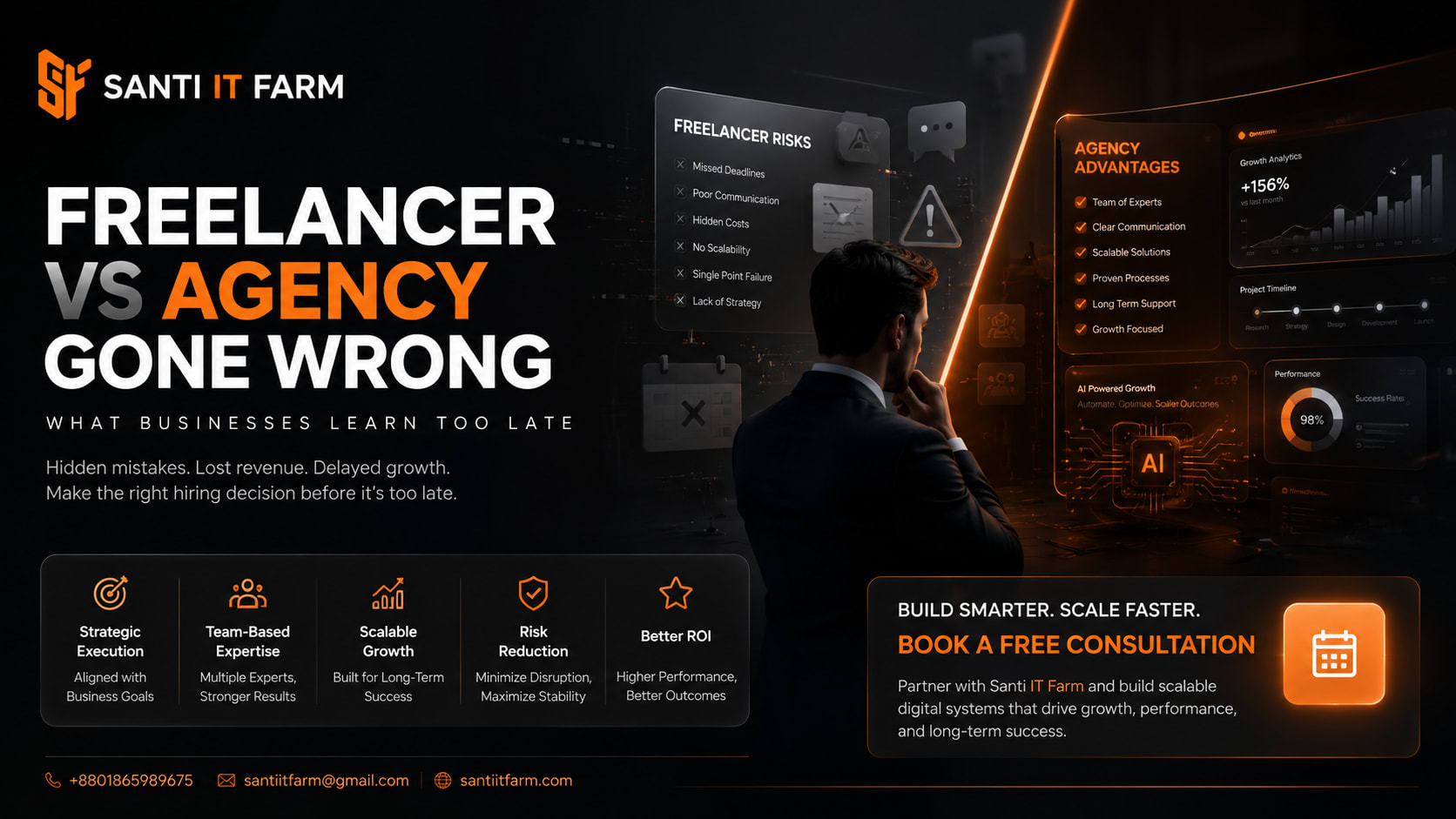
Why So Many Small Businesses Regret Outsourcing
Outsourcing was supposed to make business easier. Lower costs, faster execution, access to global talent, and scalable growth opportunities made outsourcing look like the perfect solution for startups and small businesses. But for many companies, the reality turns into missed deadlines, communication breakdowns, hidden costs, poor-quality work, and damaged customer trust.
Across Bangladesh, India, Pakistan, the USA, the UK, Canada, and Australia, thousands of small businesses outsource web development, SEO, design, software development, and marketing services every year. Some achieve exceptional growth. Others lose months of productivity and significant amounts of money because they choose the wrong outsourcing strategy.
The problem is not outsourcing itself. The real issue is how businesses approach outsourcing. Many small companies hire based only on price, fail to define expectations, ignore communication structures, or work with agencies that lack business understanding.
Experienced business owners eventually realize that outsourcing is not simply about hiring cheaper labor. It is about building reliable systems, partnerships, accountability, and operational clarity. When these foundations are missing, outsourcing becomes a liability instead of a growth engine.
In this guide, we will break down the real reasons outsourcing fails for small businesses, explain how successful companies avoid these mistakes, and show what modern businesses should look for in a trustworthy outsourcing partner.
Quick Answer: Why Does Outsourcing Fail for Small Businesses?
- Businesses choose the cheapest provider instead of the most reliable partner.
- Project goals and expectations are unclear from the beginning.
- Communication systems are weak or inconsistent.
- There is no proper project management process.
- Outsourced teams lack understanding of the business model.
- Business owners expect instant results without long-term planning.
- Low-quality agencies overpromise and underdeliver.
- There is no accountability, reporting structure, or strategic oversight.
- Cultural and timezone differences are ignored.
- Businesses outsource critical operations too early without internal structure.
Successful outsourcing happens when businesses treat outsourcing as a strategic partnership rather than a short-term cost-cutting shortcut.
What Does Outsourcing Actually Mean in Modern Business?
Outsourcing means hiring an external company, agency, freelancer, or specialized team to handle specific business functions instead of managing everything internally. These services may include website development, Shopify management, SEO, customer support, branding, software development, automation, content creation, digital marketing, or business operations.
Modern outsourcing is no longer limited to enterprise corporations. Small businesses now outsource globally to access expert talent, reduce operational costs, speed up execution, and scale efficiently without maintaining large in-house teams.
However, outsourcing today requires far more than assigning tasks. Effective outsourcing depends on strategic alignment, workflow integration, communication transparency, measurable KPIs, and long-term business understanding.
The businesses that succeed with outsourcing typically choose partners who understand growth, customer psychology, scalability, branding, technology, and operational efficiency — not just technical execution.
That is why premium agencies often outperform low-cost outsourcing vendors. The difference is not simply coding or design quality. The difference is strategic business thinking.
Why Understanding Outsourcing Failure Matters
- A failed outsourcing project can cost small businesses far more than the original budget.
- Poor outsourcing decisions often delay business growth for months or years.
- Bad customer experiences caused by weak outsourcing can damage brand reputation permanently.
- Low-quality development or SEO work may create long-term technical and marketing problems.
- Understanding outsourcing risks helps businesses protect cash flow and operational stability.
- Choosing the right outsourcing partner can dramatically improve scalability and profitability.
- Strategic outsourcing allows small businesses to compete with much larger companies globally.
- Businesses that build strong outsourcing systems often achieve faster growth with lower operational overhead.
For modern businesses, outsourcing is no longer optional. The real competitive advantage comes from outsourcing intelligently.
How Smart Outsourcing Helps Businesses Grow
Access to Specialized Expertise
Small businesses gain access to experienced developers, SEO strategists, UI/UX designers, marketers, and automation experts without hiring full-time internal teams.
Lower Operational Costs
Outsourcing reduces recruitment, training, office, software, and infrastructure expenses while allowing businesses to scale more efficiently.
Faster Project Execution
Experienced outsourcing teams already have workflows, systems, and specialists in place, helping businesses launch faster.
Scalable Growth
Businesses can increase or reduce resources based on workload without major operational restructuring.
Global Market Competitiveness
Companies in Bangladesh, India, Pakistan, and other emerging markets can compete internationally through strategic outsourcing partnerships.
Focus on Core Business Operations
Owners can focus on sales, partnerships, customer relationships, and growth while specialists handle technical execution.
Access to Modern Technology
Professional outsourcing agencies often provide access to advanced tools, AI systems, automation platforms, and enterprise-level workflows.
Improved Business Efficiency
Reliable outsourcing creates repeatable systems that improve operational consistency and productivity over time.
Realistic Example of Failed vs Successful Outsourcing
Before
- — A small e-commerce business hires the cheapest freelancer for Shopify development.
- — The project scope is unclear and requirements keep changing.
- — Communication happens randomly through inconsistent messaging.
- — Deadlines are repeatedly missed.
- — SEO structure is ignored during development.
- — The website launches with technical issues and poor conversion rates.
- — The business loses advertising budget because the store performs poorly.
- — The owner eventually hires another agency to rebuild everything.
After
- The business defines clear goals, budget, and KPIs before outsourcing.
- A professional agency creates a structured roadmap and timeline.
- Weekly reporting and project management systems are established.
- SEO, UI/UX, speed optimization, and conversion strategy are integrated from the beginning.
- The website is tested properly before launch.
- The business receives long-term technical support and growth consultation.
- Customer experience improves and ad performance becomes more profitable.
- The outsourcing partnership evolves into a long-term growth relationship.
The biggest difference was not price. It was strategy, communication, accountability, and expertise.
How Small Businesses Can Outsource Successfully
Define Business Goals Before Hiring
- › Clarify what success looks like.
- › Identify measurable KPIs.
- › Separate urgent needs from long-term goals.
- › Understand whether you need execution, strategy, or both.
Choose Value Over Cheap Pricing
- › Extremely cheap providers often create expensive long-term problems.
- › Evaluate expertise, case studies, communication quality, and process maturity.
- › Look for partners who understand business growth, not only technical tasks.
- › Review testimonials and portfolio relevance carefully.
Create Clear Project Documentation
- › Write detailed requirements before starting.
- › Define deadlines, deliverables, revisions, and communication channels.
- › Use project management tools to maintain transparency.
- › Document approvals and workflow processes.
Prioritize Communication Systems
- › Schedule regular progress meetings.
- › Use centralized communication platforms.
- › Set expectations for response times.
- › Ensure language and timezone compatibility are manageable.
Start With Smaller Projects
- › Test reliability before committing to larger contracts.
- › Evaluate consistency, quality, and professionalism.
- › Measure how problems are handled under pressure.
- › Build trust gradually.
Focus on Long-Term Partnerships
- › Reliable outsourcing relationships improve over time.
- › Long-term partners better understand your business model and customers.
- › Strategic agencies provide proactive recommendations instead of reactive fixes.
- › Strong partnerships reduce operational risk significantly.
Monitor Performance Consistently
- › Track KPIs and project milestones.
- › Request transparent reporting.
- › Analyze ROI instead of emotional assumptions.
- › Adjust strategies based on performance data.
Useful Tools That Improve Outsourcing Success
The right tools cannot fix a bad outsourcing partner, but they can dramatically improve collaboration, visibility, and accountability.
The Most Common Outsourcing Mistakes Small Businesses Make
- Hiring based only on the lowest price.
- Failing to define project scope clearly.
- Ignoring communication quality during evaluation.
- Choosing providers without industry experience.
- Expecting immediate results without strategy.
- Skipping contracts and documentation.
- Not checking previous client results.
- Outsourcing critical operations too quickly.
- Micromanaging every small task.
- Giving incomplete information to outsourced teams.
- Ignoring SEO and scalability during development.
- Assuming all agencies provide strategic thinking.
- Failing to measure performance consistently.
- Changing requirements repeatedly without planning.
- Treating outsourcing as disposable labor instead of partnership.
Frequently Asked Questions About Outsourcing Failures
Outsourcing Is Not the Problem — Poor Strategy Is
Outsourcing has helped countless businesses scale faster, reduce costs, access global expertise, and compete in highly competitive markets. Yet many small businesses still fail because they approach outsourcing emotionally instead of strategically.
The cheapest option rarely delivers the best long-term outcome. Sustainable growth comes from working with partners who understand business goals, customer behavior, technology, branding, SEO, scalability, and operational systems together.
In competitive global markets, successful businesses are increasingly built through strategic partnerships rather than isolated internal teams. Smart outsourcing gives businesses flexibility, speed, innovation, and access to world-class expertise without overwhelming operational overhead.
Whether you are launching a startup, scaling an e-commerce brand, improving SEO performance, redesigning your website, or building custom software, the right outsourcing partner can become a major growth advantage instead of a business risk.
The difference between outsourcing success and outsourcing failure almost always comes down to one thing: choosing expertise and strategy over shortcuts.
Need a Reliable Digital Growth Partner?
Santi IT Farm helps businesses avoid the costly outsourcing mistakes that slow growth and damage profitability. Our team focuses on strategy-first execution backed by transparent communication, modern systems, and long-term business thinking.
We work with startups, e-commerce businesses, local brands, agencies, and international companies across Bangladesh, India, Pakistan, the USA, the UK, Canada, and Australia.
Whether you need website development, Shopify solutions, SEO services, branding, digital marketing, automation systems, or custom software development, our goal is simple: help your business grow sustainably with reliable expert support.
- Website Development
- Shopify Development
- SEO Services
- Digital Marketing
- UI/UX Design
- Branding
- Business Automation
- Custom Software Development
Ready to work with a growth-focused digital partner instead of gambling on unreliable outsourcing? Contact Santi IT Farm today and build your business with confidence.
Get Started