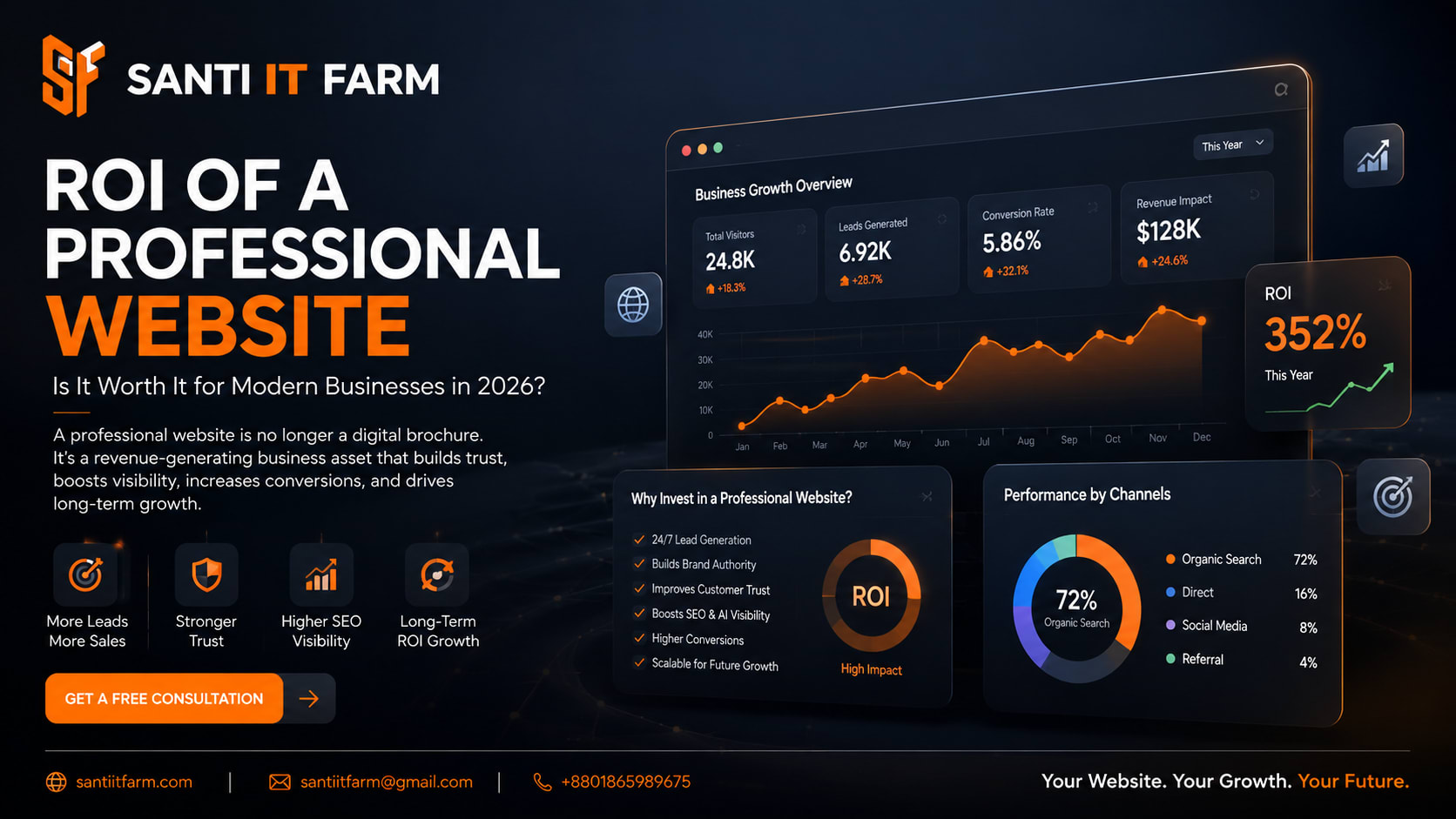
Technology Is No Longer a Cost — It Is a Growth Engine
Many businesses still treat technology like an expense they can delay. The problem is that competitors are no longer waiting. Across Bangladesh, India, Pakistan, the USA, the UK, Canada, and Australia, fast-growing companies are using technology to reduce operational costs, automate repetitive work, improve customer experience, and increase revenue faster than traditional businesses.
The companies winning today are not always the biggest. They are usually the most efficient, data-driven, and digitally prepared. Whether it is a local retailer using e-commerce automation, a startup using AI-powered systems, or a corporate brand investing in scalable web platforms, the pattern is clear: businesses that invest in technology early create long-term advantages that are difficult to copy.
Technology-first businesses make smarter decisions because they have better systems. They respond faster because their operations are streamlined. They grow faster because automation reduces bottlenecks. Most importantly, they become more profitable because technology improves productivity while lowering waste.
This is why smart businesses prioritize digital infrastructure before expanding teams, opening new branches, or increasing ad budgets. Without strong technology foundations, growth often becomes expensive, chaotic, and difficult to sustain.
Quick Answer: Why Do Smart Businesses Invest in Technology First?
- Technology improves operational efficiency and reduces manual work.
- Automation saves time and lowers long-term business costs.
- Modern websites and digital systems increase customer trust and conversions.
- Data-driven decision-making helps businesses scale more strategically.
- AI-powered systems improve productivity, customer support, and lead generation.
- Technology creates competitive advantages that are difficult for slower businesses to catch up with.
- Scalable digital infrastructure supports future growth without constant rebuilding.
- Businesses with strong digital systems adapt faster during market changes and economic uncertainty.
Businesses that invest in technology early often experience stronger ROI, faster scalability, and better customer retention than businesses that delay digital transformation.
What Does Investing in Technology Actually Mean?
Investing in technology is not limited to buying computers or software subscriptions. In modern business, technology investment means building systems that improve efficiency, scalability, communication, customer experience, data management, and revenue generation.
This can include website development, e-commerce platforms, business automation tools, AI-powered customer support systems, SEO infrastructure, CRM integration, custom software development, cloud-based collaboration systems, analytics dashboards, cybersecurity upgrades, and digital marketing automation.
For small businesses and startups, technology investment often begins with a professional website, automated workflows, and digital marketing systems. For larger organizations, it may involve enterprise software, advanced analytics, AI integration, or business intelligence tools.
The key difference between businesses that grow and businesses that struggle is not always budget size. It is how intelligently they use technology to multiply output, reduce inefficiencies, and improve decision-making.
Why Technology-First Companies Consistently Outperform Competitors
- Technology improves speed. Businesses can serve customers faster, launch campaigns quicker, and respond to market changes in real time.
- Automation reduces dependency on repetitive manual tasks, allowing teams to focus on strategy and growth.
- Digital systems improve customer trust. A slow website, outdated branding, or poor user experience damages credibility instantly.
- Technology provides measurable data that helps business owners make better financial and marketing decisions.
- Scalable systems support business growth without creating operational chaos.
- Businesses using AI and automation often reduce customer acquisition costs while improving lead quality.
- Modern digital infrastructure improves collaboration between remote teams, agencies, and departments.
- Technology investments usually compound over time, meaning the long-term ROI becomes significantly higher than the initial cost.
- Businesses with optimized systems can expand internationally more easily through digital channels.
- Companies that delay digital transformation often lose customers to faster and more convenient competitors.
Technology is no longer a support function in business. It has become a central driver of profitability, scalability, customer experience, and long-term survival.
Major Benefits of Investing in Technology Early
Higher Operational Efficiency
Businesses save hundreds of hours annually by automating repetitive tasks such as invoicing, customer communication, appointment scheduling, inventory management, and reporting.
Better Customer Experience
Modern websites, faster response systems, AI chat support, and optimized user experiences help businesses convert more visitors into loyal customers.
Lower Long-Term Costs
Although technology requires upfront investment, automation and efficiency improvements often reduce payroll waste, operational delays, and human errors.
Faster Business Scalability
Businesses with strong digital infrastructure can handle increased demand without constantly rebuilding internal processes from scratch.
Improved Marketing Performance
SEO systems, analytics tools, CRM integrations, and marketing automation platforms help businesses generate higher-quality leads more consistently.
Competitive Market Advantage
Technology-first businesses adapt faster to consumer behavior changes and market disruptions, giving them a major advantage over slower competitors.
Stronger Decision-Making
Analytics and business intelligence tools provide real-time insights into customer behavior, sales trends, and operational performance.
Increased Revenue Opportunities
Technology opens access to online markets, e-commerce growth, international clients, subscription models, and digital service expansion.
Realistic Business Transformation Example
Before
- — A local retail business relied entirely on manual sales tracking and social media messages.
- — Customer inquiries were often missed during busy periods.
- — The company had no professional website or online ordering system.
- — Marketing campaigns were inconsistent and impossible to measure accurately.
- — Staff spent hours handling repetitive administrative tasks manually.
- — The business struggled to compete with digitally advanced competitors.
After
- The company launched a professionally optimized e-commerce website.
- Automated order management and customer communication systems reduced delays significantly.
- SEO and digital marketing strategies increased qualified traffic consistently.
- CRM integration improved customer follow-up and retention.
- Analytics dashboards helped the owner understand which products generated the highest ROI.
- The business expanded beyond local customers and started receiving international inquiries.
- Operational efficiency improved while customer satisfaction increased substantially.
This type of transformation is increasingly common among businesses investing in modern digital infrastructure instead of relying solely on traditional operations.
How Smart Businesses Approach Technology Investment Strategically
Start With Core Business Problems
- › Identify repetitive bottlenecks slowing growth.
- › Analyze where operational inefficiencies are reducing profitability.
- › Prioritize systems that improve customer experience and efficiency first.
Build a Professional Digital Foundation
- › Invest in a fast, mobile-friendly website.
- › Ensure branding reflects credibility and professionalism.
- › Create scalable digital infrastructure for future growth.
Automate Repetitive Operations
- › Use automation tools for customer communication, invoicing, lead tracking, and reporting.
- › Reduce dependency on manual processes that waste time.
- › Improve operational consistency through automated workflows.
Invest in SEO and Digital Visibility
- › Build long-term organic traffic instead of relying only on paid advertising.
- › Optimize for search engines and AI search platforms.
- › Create content that answers customer questions directly.
Use Data to Improve Decisions
- › Track customer behavior, conversion rates, and marketing ROI.
- › Monitor operational performance continuously.
- › Use analytics to guide future investment decisions.
Integrate AI-Powered Systems Carefully
- › Use AI for customer support, workflow automation, content optimization, and business intelligence.
- › Focus on practical business value instead of trends alone.
- › Implement AI solutions that improve productivity measurably.
Choose Scalable Technology Partners
- › Work with experienced digital agencies that understand business growth.
- › Avoid short-term solutions that create technical limitations later.
- › Invest in systems that can evolve alongside the business.
Useful Technology Tools Smart Businesses Commonly Use
The best technology stack depends on business goals, industry requirements, scalability needs, and long-term operational strategy.
Common Technology Investment Mistakes Businesses Make
- Treating technology as an expense instead of a long-term investment.
- Choosing cheap short-term solutions that fail during growth.
- Ignoring website performance and user experience.
- Investing in tools without clear business objectives.
- Failing to integrate systems properly across departments.
- Neglecting cybersecurity and data protection.
- Avoiding SEO and relying entirely on paid advertising.
- Overcomplicating technology stacks unnecessarily.
- Not training teams to use systems effectively.
- Delaying digital transformation until competitors dominate the market.
Frequently Asked Questions
The Businesses That Adapt First Usually Win
The global business landscape has changed permanently. Customers expect speed, convenience, personalization, and seamless digital experiences. Businesses that fail to modernize are not simply falling behind technologically — they are losing customer trust, operational efficiency, and market relevance.
Smart businesses understand that technology is not just about software or automation. It is about building systems that support sustainable growth, improve profitability, and create long-term competitive advantages. From Bangladesh to global markets, technology-first companies are scaling faster because they invest strategically rather than reactively.
The companies that dominate tomorrow are already investing today in digital infrastructure, AI-powered systems, automation, SEO, branding, and scalable web platforms. Businesses that wait too long often spend significantly more later trying to catch up.
Technology investment is ultimately an investment in business resilience, customer satisfaction, and future growth potential.
Build a Smarter, More Profitable Business With Santi IT Farm
At Santi IT Farm, we help businesses transform technology into measurable growth. Whether you need a scalable website, SEO strategy, e-commerce platform, automation system, branding solution, or AI-powered workflow, our team focuses on practical business results — not just technical delivery.
We work with startups, local businesses, growing brands, and international companies looking to improve efficiency, increase visibility, and create stronger digital foundations for long-term growth.
If your business is ready to modernize operations, improve ROI, and compete more effectively in today's digital economy, our team is ready to help you build a scalable strategy tailored to your goals.
- Website Development
- Shopify Development
- WordPress Development
- SEO Services
- UI/UX Design
- Branding
- Digital Marketing
- Business Automation
- AI-powered Systems
- Custom Software Development
The smartest investment many businesses can make today is not more manual work — it is smarter technology.
Get Started