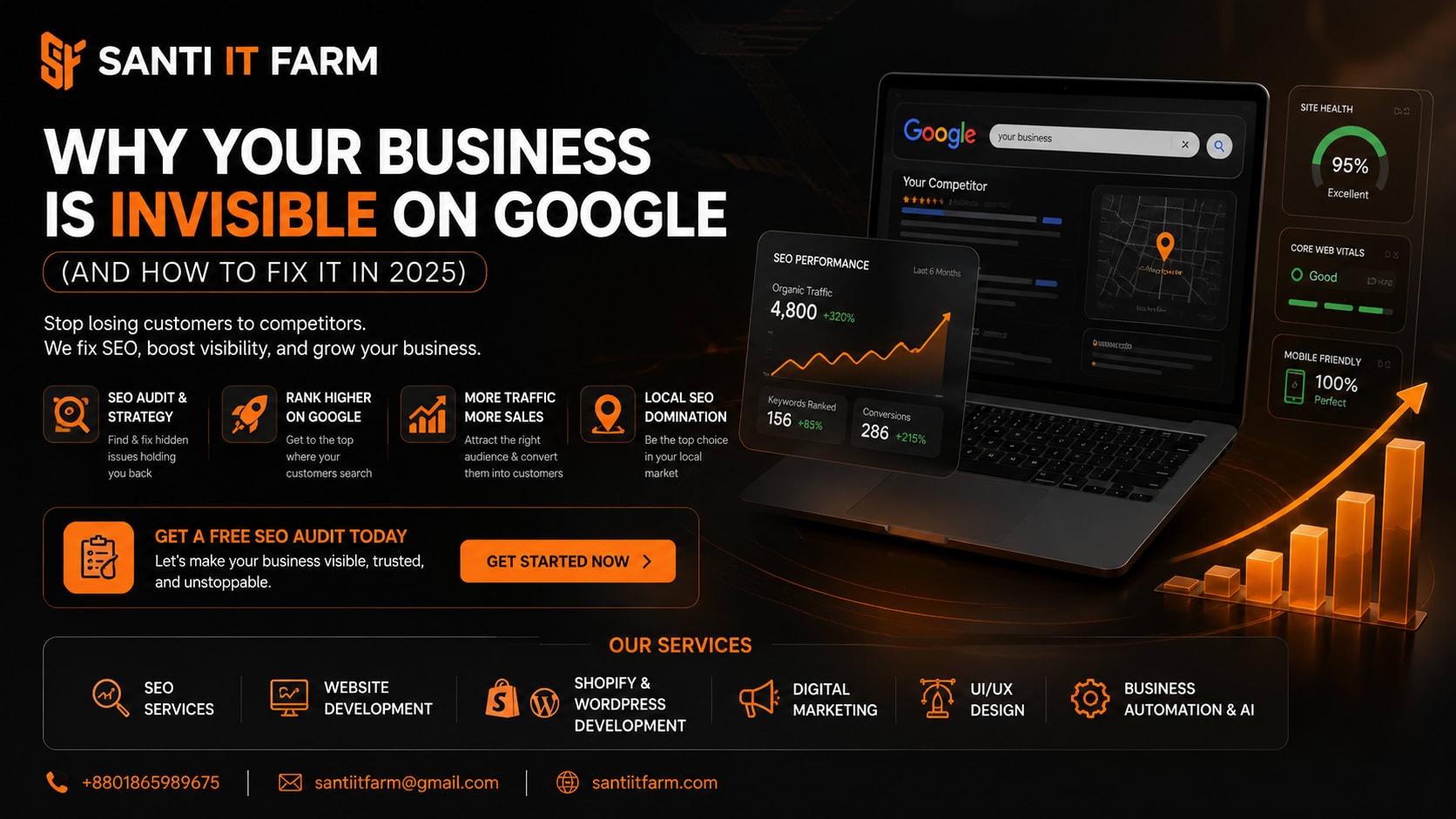
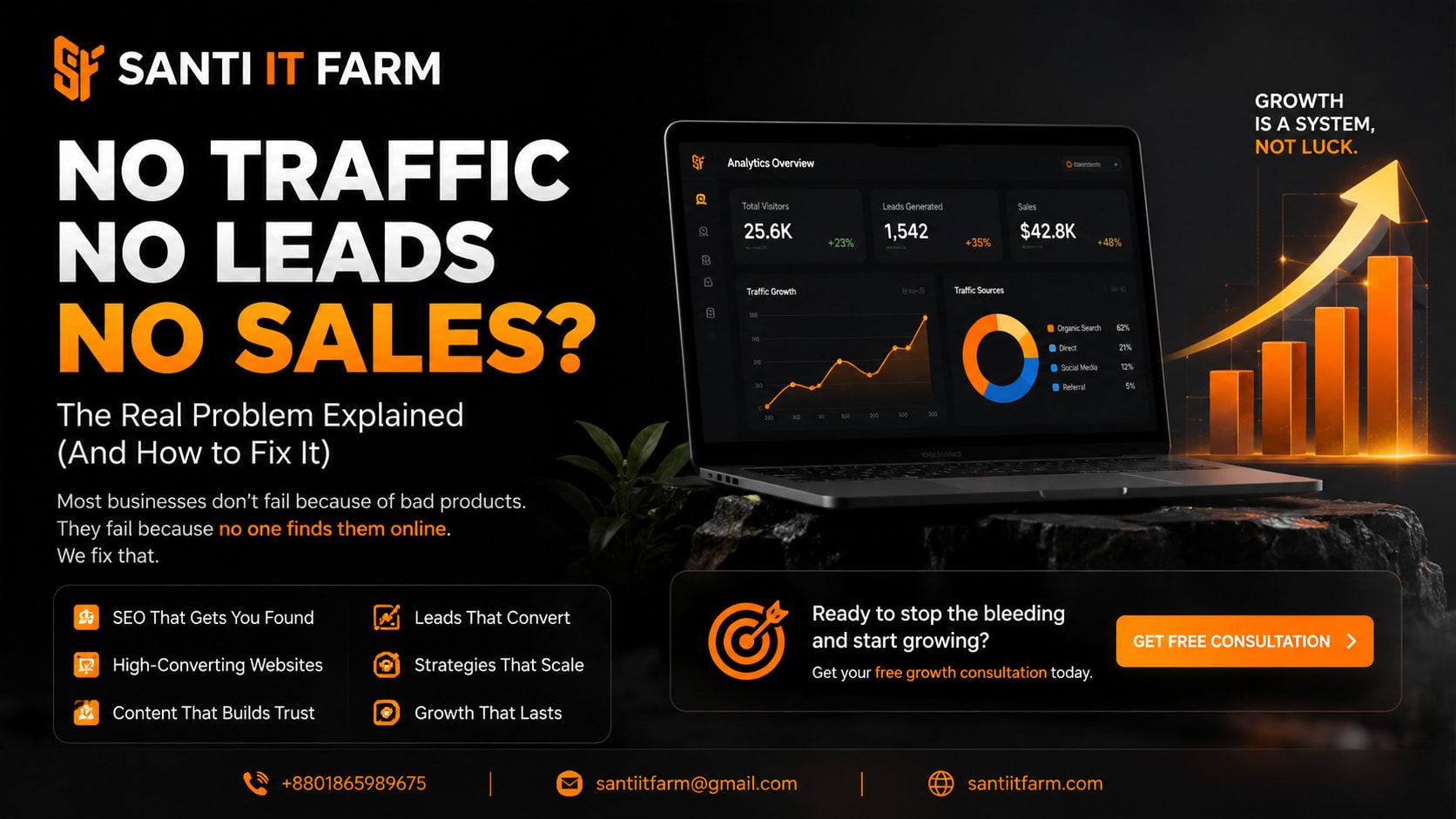
You Did the Work. So Why Is No One Visiting Your Website?
You spent weeks — maybe months — building your website. You got a domain, picked a design, wrote some pages, and maybe even published a few blog posts. You told yourself: once it's live, people will find it. That's how it works, right?
But here you are, checking Google Analytics every day and staring at the same depressing flat line. Zero organic visitors. Zero leads. Zero growth. Just you, your website, and an audience of absolutely no one.
Here's the hard truth most web design agencies won't tell you: a live website is not the same as a discoverable website. Building a site and getting traffic to it are two completely different challenges — and most businesses, from startups in Dhaka to e-commerce brands in London, fall into the same traps that keep their traffic permanently stuck at zero.
In this guide, we're going to be direct about why your website isn't growing, what's actually killing your traffic potential, and the specific steps you need to take to change that — for good. No generic advice. No recycled tips. Just an honest diagnosis and a clear path forward.
Why Does My Website Get No Traffic? (Quick Answer)
- Your website has not been properly indexed by Google
- You are targeting keywords that are too competitive or have no search volume
- Your content does not match what your audience is actually searching for
- Your site has critical technical SEO problems blocking search engines
- You have no backlinks — so Google has no reason to trust or rank you
- Your page speed is too slow, hurting both rankings and user experience
- You are not promoting your content through any external channels
- Your website lacks topical authority in your niche
Most websites that get zero traffic are suffering from at least three of these problems simultaneously. The good news: each one is fixable with the right strategy and execution.
What 'Website Traffic' Actually Means for Business Growth
When we talk about website traffic, we mean the number of people who visit your site — but not all traffic is equal. There are four main types: organic traffic (from search engines like Google), direct traffic (people typing your URL), referral traffic (from other websites linking to you), and social traffic (from platforms like Facebook, LinkedIn, or Instagram).
For most small businesses, startups, and e-commerce brands — whether based in Bangladesh, India, Pakistan, the UK, or the US — organic traffic is the holy grail. It is the only type of traffic that compounds over time. A well-optimized blog post can bring in leads for years without ongoing ad spend. A well-structured product page can rank and convert indefinitely.
The reason most websites fail to generate organic traffic comes down to one fundamental misunderstanding: search engines don't reward websites simply for existing. They reward websites that demonstrate relevance, authority, and trustworthiness — and building those three things requires deliberate, consistent work. Most businesses skip that work and then wonder why nobody visits.
Why Fixing Your Traffic Problem Is More Urgent Than You Think
- Every day without organic traffic is a day your competitors are capturing the customers who should be finding you
- Paid ads stop working the moment you stop paying — organic traffic from SEO is a long-term business asset
- A website that doesn't get traffic cannot generate leads, build brand awareness, or justify its own existence
- Search intent is highest at the point of search — people who find you through Google are already looking for what you offer
- In competitive markets like e-commerce, digital services, and B2B solutions, organic visibility is a compounding competitive advantage that gets harder to build the longer you wait
- Businesses in emerging digital markets like Bangladesh and India are seeing an explosion in online search activity — those who establish organic authority now will dominate their categories within two to three years
Traffic is not a vanity metric. It is the pipeline that feeds your business. Without it, even the most beautifully designed website is functionally invisible — and an invisible business cannot grow.
What Changes When You Fix Your Website Traffic
Consistent, Predictable Lead Flow
When your website ranks for the right keywords, it becomes a 24/7 lead generation machine. You wake up to contact form submissions and quote requests — without running a single ad. For service businesses in competitive markets, this alone transforms their entire business model.
Lower Customer Acquisition Cost
Organic traffic has no cost-per-click. Once your content ranks, it keeps delivering visitors without ongoing spend. Over 12 to 24 months, the ROI of SEO consistently outperforms paid advertising for most business categories — making every pound, dollar, or taka spent on content and optimization worth far more in return.
Stronger Brand Authority
Ranking on page one of Google sends a powerful signal to potential clients: this business is credible, established, and worth trusting. In consulting, agency, and professional services industries, organic visibility directly influences buying decisions — especially for higher-ticket services.
Better Quality Visitors
People who find you through relevant search queries are already interested in what you offer. They convert at significantly higher rates than cold social media audiences or display ad impressions. For e-commerce businesses and service providers alike, this means more qualified inquiries with less effort spent on qualification.
Compounding Long-Term Growth
Unlike paid traffic that stops the moment your budget does, SEO builds on itself. Each new piece of optimized content adds to your topical authority. Each new backlink strengthens your domain. A brand that invests in SEO consistently for 18 months typically sees exponential — not linear — traffic growth.
Platform Independence
Social media algorithms change overnight. Ad platforms raise prices without warning. But Google's core function — connecting people with relevant information — has remained constant for over two decades. Businesses that own their organic search presence are insulated from the volatility of every other digital channel.
Real-World Scenario: What Zero-Traffic Websites Look Like vs. What Works
Before
- — A clothing e-commerce brand in Dhaka launched with 45 product pages and a homepage. No blog, no keyword research, no backlinks. After six months: 12 total organic visitors per month — almost all branded searches from people who already knew them. Revenue from organic: zero.
- — A SaaS startup in Karachi built a polished website with great UI but no structured content strategy. Their blog had four posts — all company announcements. Google had indexed them but ranked them nowhere for commercial terms. Organic traffic after eight months: 60 sessions per month, 0 trial signups.
- — A digital marketing agency in London spent £4,000 on a website redesign that looked stunning but was built entirely in JavaScript with no server-side rendering. Google could barely crawl it. Six months post-launch, not a single service page ranked in the top 50 results.
After
- After a full SEO audit and content strategy overhaul — targeting 80 long-tail keywords, building topical cluster content, and fixing technical issues — the Dhaka clothing brand grew to 3,400 organic visitors per month within nine months, generating consistent daily sales from organic search.
- The Karachi SaaS company restructured their blog around pain-point content targeting their ideal buyers' search queries, built 15 comparison and how-to articles, and acquired 20 high-quality backlinks through outreach. Organic traffic grew to 2,100 monthly visits with a 4.2% trial signup rate within a year.
- The London agency switched to a hybrid rendering approach, fixed crawlability issues, restructured their service pages with proper on-page SEO, and began a consistent link-building campaign. Within 12 months, they ranked in the top 5 for 14 competitive service keywords and attributed six new enterprise clients directly to organic search.
These outcomes aren't magic — they're the direct result of diagnosing the right problems and executing the right fixes. The websites that succeed are the ones where the team stopped guessing and started treating SEO as a strategic business function.
How to Fix a Website That Gets No Traffic: 8 Strategic Steps
Step 1: Run a Full Technical SEO Audit
- › Confirm Google has indexed your most important pages — use the site: operator in Google Search to check
- › Submit your XML sitemap through Google Search Console if you haven't already
- › Fix crawl errors listed in Search Console — these are pages Google is trying to visit but can't
- › Check your robots.txt file — it's surprisingly common for development settings to accidentally block all search engines
- › Resolve duplicate content issues caused by www vs non-www, HTTP vs HTTPS, or trailing slashes in URLs
- › Test your Core Web Vitals in Google Search Console — slow sites get systematically downranked, especially on mobile
- › Fix broken internal links — every broken link wastes crawl budget and harms user experience
Step 2: Rebuild Your Keyword Strategy Around Search Intent
- › Stop targeting broad one-word keywords like 'SEO' or 'web design' — these are dominated by billion-dollar brands
- › Use tools like Ahrefs, Semrush, or free alternatives like Ubersuggest to find long-tail keywords with real search volume and realistic competition
- › Map every piece of content to a specific search intent: informational (how-to, what-is), commercial (best, vs, review), or transactional (buy, hire, get a quote)
- › Research what your competitors are ranking for — identify keyword gaps where they rank but you don't
- › For local businesses in Bangladesh, India, or Pakistan, prioritize geo-modified keywords: 'web design company Dhaka' converts far better than 'web design company' with ten times less competition
- › Build a content calendar around 30 to 50 target keywords, organized into topic clusters that build mutual authority
Step 3: Fix Your On-Page SEO for Every Key Page
- › Write unique, compelling title tags for every page — include the primary keyword near the beginning, keep it under 60 characters
- › Write meta descriptions that summarize the page's value clearly and naturally include the main keyword — these don't rank directly but they influence click-through rates massively
- › Use one H1 per page, aligned with the primary keyword — not your company name, not a tagline, but the actual search term your audience uses
- › Structure content with logical H2 and H3 subheadings that include secondary and semantic keywords naturally
- › Add internal links from every new piece of content to related existing content — this builds topical authority and distributes page authority
- › Compress and properly label every image with descriptive alt text — unoptimized images are one of the most common and easily fixed performance killers
Step 4: Create Content That Actually Answers Real Questions
- › Use Google's 'People Also Ask' boxes and autocomplete suggestions to identify the exact questions your audience is typing
- › Write long-form, comprehensive content that covers a topic better than the current top-ranking pages — thin 300-word pages do not rank in competitive niches
- › Include original insights, data, examples, and practical guidance — AI-generated filler content that says nothing new gets filtered out by both users and Google's quality signals
- › Update existing content regularly — pages that cover a topic as it existed two years ago lose rankings over time as fresher content surpasses them
- › Use a topic cluster model: write one comprehensive pillar article covering a broad topic, then write multiple supporting articles on subtopics that all link back to the pillar
- › Format content for featured snippets: use numbered lists for processes, definition paragraphs for concepts, and comparison tables for evaluations
Step 5: Build Your Backlink Profile Strategically
- › Accept that without backlinks, even perfect content struggles to rank — Google still uses links as the primary signal of a page's authority and trustworthiness
- › Start with the easiest wins: submit to industry directories, get listed on platforms relevant to your business, and claim your Google Business Profile
- › Write guest articles for reputable blogs and publications in your industry — pitch specific, well-researched articles, not generic posts
- › Use digital PR: publish original research, surveys, or data studies that journalists and bloggers naturally want to reference and link to
- › Pursue resource page link building: find pages that list helpful tools or guides in your niche and ask to be included
- › Avoid buying cheap links from link farms — Google's Spam Brain system detects unnatural link patterns and can penalize your site severely
Step 6: Optimize for Page Speed and Mobile Experience
- › Test your site speed on Google PageSpeed Insights and target a score above 85 on mobile — below 50 is a serious ranking handicap
- › Compress images using next-gen formats like WebP — images are the number one cause of slow load times on most small business websites
- › Enable browser caching and use a CDN (content delivery network) to serve your assets faster to international visitors
- › Remove unnecessary WordPress plugins, redundant JavaScript files, and render-blocking resources that delay the page from loading
- › Ensure your site is fully responsive across all screen sizes — with over 60% of global searches happening on mobile, a broken mobile experience is also a broken business
Step 7: Promote Every Piece of Content Across Channels
- › Publishing content without promotion is like opening a store in a location no one ever visits — distribution is as important as creation
- › Share every new article on LinkedIn, Facebook, and Twitter with platform-native copy that drives clicks
- › Repurpose blog content into short videos, infographics, and social posts that drive referral traffic back to the original article
- › Build an email list and send every new piece of content to your subscribers — email-driven traffic sends strong engagement signals to Google
- › Engage in industry forums, Reddit communities, Quora, and Facebook Groups — answer questions and reference your content naturally where genuinely relevant
- › Reach out directly to industry colleagues and collaborators who might want to share or link to your content
Step 8: Track, Measure, and Iterate with Data
- › Set up Google Search Console — it is completely free and tells you exactly which queries your site appears for, your average position, and your click-through rate
- › Set up Google Analytics 4 to understand where your traffic comes from, how long visitors stay, and which pages drive conversions
- › Review your data monthly and identify what is working — double down on the content formats and keyword clusters generating the most impressions
- › Track keyword rankings for your target terms weekly using a tool like Rank Math, Ahrefs, or Semrush
- › Set quarterly traffic goals tied to business outcomes — not just page views, but leads generated, email signups, and revenue attributed to organic traffic
- › Audit underperforming pages every six months: update, consolidate, or redirect content that has stagnated
The Best Tools to Diagnose and Fix Your Website Traffic Problems
You do not need every tool on this list. For most small businesses and startups, Google Search Console plus Ahrefs or Semrush plus Google Analytics 4 covers 90% of what you need to diagnose and fix a traffic problem effectively.
The Biggest Mistakes That Keep Websites Stuck at Zero Traffic
- Launching a website with no keyword strategy and assuming Google will figure out what you do
- Writing content for yourself instead of for your audience's actual search queries
- Publishing thin, low-value content and expecting it to rank against authoritative competitors
- Ignoring Google Search Console entirely — it tells you exactly what is broken, but most site owners never look at it
- Targeting head keywords (one or two word terms) instead of specific long-tail keywords that buyers actually use
- Having no backlink strategy whatsoever and waiting for links to appear organically — they rarely do without deliberate outreach
- Treating SEO as a one-time setup task rather than an ongoing content and authority building process
- Building a beautiful website on a platform or in a way that makes it difficult for search engines to crawl
- Not optimizing for mobile — a site that looks broken on phones loses rankings and loses customers
- Giving up after 90 days — SEO results typically begin to materialize between four and twelve months, and most businesses abandon their strategy right before it starts working
- Confusing activity (publishing posts) with strategy (building topical authority around a defined keyword cluster)
- Neglecting local SEO signals for geographically-relevant businesses — Google Business Profile, local citations, and location-specific content are essential for local visibility in cities like Dhaka, Lahore, Mumbai, or anywhere else
Frequently Asked Questions About Website Traffic
The Bottom Line: Your Website Not Getting Traffic Is a Solvable Problem
We want to leave you with something that's both honest and encouraging: zero website traffic is one of the most fixable problems in digital business. It is not a verdict on your product, your idea, or your potential. It is almost always a technical, strategic, or execution problem — and every single one of those problems has a solution.
The businesses that figure this out — whether they're e-commerce brands in Dhaka building for global markets, software agencies in Karachi serving US clients, or professional services firms in London competing for premium accounts — share one common trait: they stopped treating their website as a design project and started treating it as a strategic growth asset.
The path from zero traffic to consistent, compounding organic growth requires discipline. It requires keyword research done right. It requires content that actually serves your audience. It requires technical foundations that search engines can work with. And it requires patience — because SEO rewards consistency over time, not heroic one-time efforts.
If you're ready to stop guessing and start growing, the next step isn't to publish another blog post. It's to get a clear diagnosis of exactly what is holding your website back — and a prioritized plan for fixing it.
Ready to Turn Your Website Into a Traffic and Lead Generation Machine?
At Santi IT Farm, we work with businesses across Bangladesh, India, Pakistan, the US, UK, Canada, and Australia to build digital presences that actually perform. We don't just build beautiful websites — we build websites engineered to rank, attract qualified visitors, and convert them into real business.
Our team of SEO strategists, content specialists, and technical experts can audit your current website, identify the specific issues holding back your traffic, and build a clear roadmap to organic growth — without jargon, without guesswork, and without wasted budget.
Whether you need a full SEO overhaul, a new website built with organic visibility baked in from day one, or a content strategy that builds topical authority month after month — we've done it for businesses at every stage, in every industry.
- SEO Strategy & Execution
- Technical SEO Audits
- Content Strategy & Creation
- Website Development (WordPress, Shopify, Custom)
- Local SEO for Bangladesh, India, Pakistan, and global markets
- Digital Marketing & Paid Media
- Branding & UI/UX Design
- Business Automation & AI-Powered Systems
Your website has potential you haven't unlocked yet. Let's change that together — get in touch with Santi IT Farm today and start building traffic that actually grows your business.
Get Started