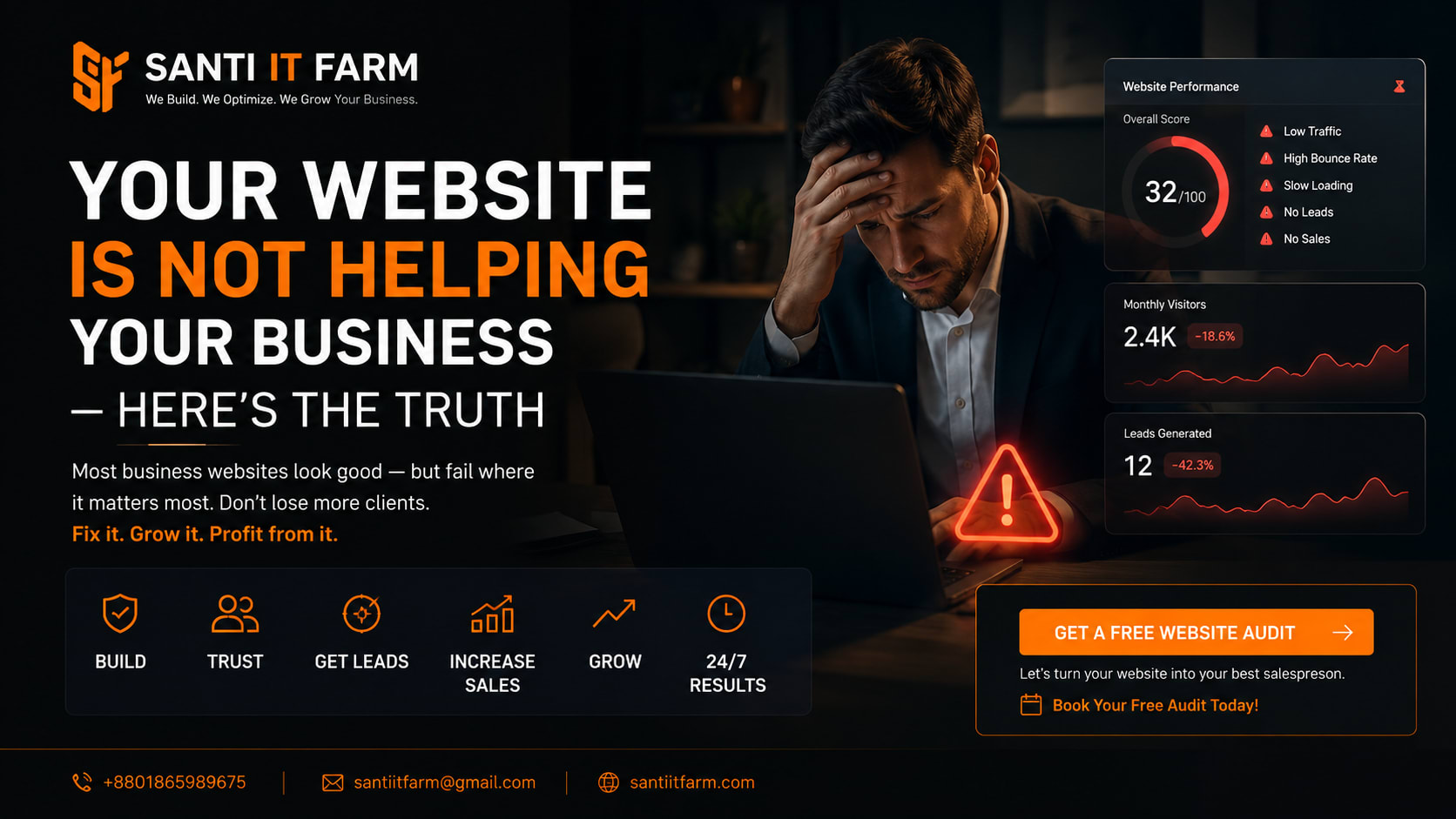
Your Website Is Open — But Is It Actually Working for You?
Here's a question most business owners never ask themselves: when a potential client lands on your website, do they feel confident enough to contact you — or do they quietly close the tab and move on to your competitor?
The painful reality is that millions of business websites across Bangladesh, India, Pakistan, the UK, the US, and beyond look presentable on the outside but fail on every level that actually matters. They load too slowly. They don't communicate clearly. They give visitors no reason to trust, no reason to act, and no obvious next step to take.
You may have invested money into building your site. You may be spending on digital ads driving traffic to it. But if the website itself is broken in ways you haven't noticed, every single visit is a missed opportunity — and the losses compound quietly every single day.
This isn't about having a perfect website. It's about having a functional one — a site that does its actual job, which is to represent your brand credibly, answer your visitors' questions, build enough trust to earn a conversation, and convert that conversation into a paying client.
In this article, we're going to be direct with you about why most business websites silently fail — and exactly what you can do about it.
Why Is My Website Not Helping My Business? (Quick Answer)
- Slow load speed drives visitors away before they even see your offer
- Poor design destroys trust within the first 3 seconds of a visit
- Unclear messaging makes visitors unsure what you do and who you serve
- No visible social proof or credibility signals reduces confidence
- Weak or missing calls-to-action leave visitors with no next step
- Not mobile-optimized alienates the majority of your traffic
- No SEO strategy means Google isn't sending you organic visitors
- Outdated content or broken links signal neglect and unprofessionalism
Any one of these issues can significantly hurt your conversions. Most struggling websites have at least three or four of them running simultaneously.
What Does It Actually Mean for a Website to 'Work' for Your Business?
A website that 'works' isn't just a website that exists online. It isn't a digital brochure sitting quietly on the internet. A functioning business website is an active sales and trust-building tool that operates 24 hours a day, 7 days a week, doing the job your best salesperson would do — but at scale.
In practical terms, a working website attracts the right visitors through search engines and digital marketing, communicates your value proposition clearly in the first few seconds of a visit, establishes enough credibility that strangers feel comfortable reaching out, guides visitors naturally toward a specific action — whether that's filling out a contact form, making a purchase, or booking a call — and then follows through on that action without friction.
When your website isn't doing all of that, it isn't just underperforming. It's actively costing you money. Every visitor who lands on a slow, confusing, or untrustworthy site represents a real business opportunity that evaporated.
For small businesses and startups in competitive markets like Dhaka, Mumbai, Karachi, London, or Toronto, the difference between a website that converts and one that doesn't is often the difference between growing and stagnating.
Why This Problem Is Bigger Than Most Business Owners Realize
- Research consistently shows that 75% of consumers judge a company's credibility based on their website design alone — before reading a single word of content.
- A one-second delay in page load time can reduce conversions by up to 7%. At three seconds, nearly half of all mobile visitors will have already left.
- More than 60% of all web traffic now comes from mobile devices. A site that isn't mobile-responsive is invisible and unusable to the majority of your potential audience.
- First impressions online form in under 50 milliseconds. If your design doesn't immediately signal professionalism and relevance, visitors make a subconscious decision to leave — often without knowing why.
- In markets like Bangladesh and South Asia where digital business competition is accelerating rapidly, a weak website doesn't just lose you individual clients — it hands market share directly to competitors who invested in their digital presence.
- For e-commerce businesses specifically, cart abandonment rates above 70% are often directly tied to trust failures on the checkout page — not product quality or pricing.
The problem isn't that your website looks bad to you — it's that it looks bad, slow, or untrustworthy to the people you're trying to attract. And those people don't give second chances.
What a High-Performing Website Actually Delivers for Your Business
Consistent Lead Generation Without Paid Ads
A properly SEO-optimized website brings in qualified leads organically — people who searched for exactly what you offer and found you first. This is compounding value that grows over time without additional spend.
24/7 Brand Representation at Your Best
Your website works while you sleep, on weekends, and across every timezone. For international clients — particularly in the US, UK, Canada, and Australia — this is often the first and only impression they get before deciding whether to reach out.
Dramatically Higher Conversion Rates
A strategically built website — with clear messaging, compelling social proof, and friction-free calls to action — can convert 3x to 10x more visitors than an average site receiving the same traffic.
Reduced Cost Per Acquisition
When your website converts well, you spend less on advertising to acquire each customer. Every Taka, Rupee, or Dollar you invest in ads stretches further when the landing page it sends traffic to is actually designed to close.
Competitive Differentiation in Crowded Markets
In markets saturated with competitors offering similar services, a premium website signals premium quality. It communicates that you take your business seriously — and that you'll take your clients' businesses seriously too.
Scalable Business Growth Without Proportional Effort
A well-built website with automation, proper CMS, and conversion flows allows you to scale your reach and client acquisition without scaling your workload at the same rate.
Real-World Example: Two IT Service Agencies, Same Market, Very Different Results
Before
- — Agency A had a website built in 2019 that hadn't been updated since. It loaded in 6.2 seconds on mobile. The homepage opened with the company name and a vague tagline that said 'We deliver technology solutions.' There was no portfolio, no client testimonials, and the only contact option was an email address buried in the footer.
- — When a startup founder in Dhaka searched for a local web development agency, Agency A came up on the third page of Google. The founder briefly visited the site, felt uncertain about the company's legitimacy, and moved on.
- — Agency A was doing good work — but their website was communicating none of it. Their pipeline was almost entirely dependent on referrals, which capped their growth.
After
- Agency B had invested in a professionally designed, fast-loading website with clear service pages, a portfolio with real client results, Google reviews prominently featured on the homepage, and a free consultation CTA above the fold.
- The same startup founder found Agency B organically through a blog post that answered a question they had Googled. They read the article, trusted the expertise it demonstrated, browsed the portfolio, and booked a free consultation that same afternoon.
- Agency B was closing 4 to 6 new clients per month from organic website traffic alone — without any paid advertising. Their website was working. Agency A's wasn't.
The quality of work both agencies delivered was comparable. The quality of their websites was not — and that gap determined everything.
How to Fix a Website That Isn't Helping Your Business: A Strategic Approach
Step 1: Run an Honest Audit of Your Current Website
- › Check your page speed using Google PageSpeed Insights — aim for a score above 85 on mobile
- › Review your homepage messaging: can a stranger understand exactly what you do and who you help within 5 seconds?
- › Test your website on three different mobile devices to assess responsiveness
- › Check all contact forms, buttons, and purchase flows to confirm they work without errors
- › Review your Google Search Console for crawl errors, indexing issues, and organic traffic trends
Step 2: Fix the Trust Signals That Are Missing
- › Add real client testimonials with names, companies, and ideally photos — not anonymous quotes
- › Display any certifications, partnerships, awards, or media mentions prominently
- › Include a team or founder page with real photos and genuine professional backgrounds
- › Add a clear privacy policy and secure HTTPS — visitors notice when sites aren't secured
- › For e-commerce businesses: add trust badges, return policies, and visible customer support options on product and checkout pages
Step 3: Clarify Your Messaging from Top to Bottom
- › Rewrite your homepage headline to focus on the outcome you deliver — not on your company name or what you are
- › Remove all industry jargon and replace it with plain language your ideal client actually uses
- › Structure every service page around the client's problem first, then your solution, then evidence you can deliver
- › Add a clear, specific value proposition that explains why someone should choose you over the alternatives
Step 4: Implement Conversion Architecture Across Every Page
- › Place a primary call-to-action above the fold on your homepage — make it specific ('Book a Free Strategy Call' beats 'Contact Us')
- › Add secondary CTAs mid-page and at the bottom of every key service page
- › Use urgency or value framing in your CTAs where appropriate — free consultations, limited availability, or bonus deliverables
- › Reduce friction in your contact forms — ask only for what you actually need to start a conversation
- › If you offer e-commerce, implement abandoned cart recovery flows and exit-intent offers
Step 5: Build an SEO Foundation That Brings You Organic Traffic
- › Conduct keyword research focused on what your ideal clients actually search — not what you think they search
- › Optimize every service page with proper title tags, meta descriptions, headers, and internal linking
- › Create authoritative blog content that answers the real questions your audience is asking
- › Build quality backlinks through guest posting, partnerships, and directory listings relevant to your industry
- › Set up Google Search Console and Google Analytics to track what's working and what needs improvement
Step 6: Maintain and Evolve Your Website Consistently
- › Update your portfolio, case studies, and testimonials every quarter
- › Refresh your blog with new content at least twice per month to maintain SEO momentum
- › Monitor Core Web Vitals monthly and address any performance degradation immediately
- › A/B test your key CTAs, headlines, and page layouts to continuously improve conversion rates
- › Treat your website as a living business asset — not a one-time project
Tools to Diagnose and Improve Your Website's Performance
You don't need all of these tools at once. Start with Google PageSpeed Insights, Google Search Console, and Hotjar — together they'll show you the biggest problems to fix first.
The Most Damaging Website Mistakes Businesses Keep Making
- Building a website based on what the business owner likes visually — rather than what converts the target audience
- Using stock photos of strangers instead of real team and client photos, which immediately undermines authenticity
- Writing homepage copy that leads with 'Welcome to our website' or the company's founding year — nobody cares
- Having a contact page with only a form and no phone number, address, or live chat option — this kills trust in B2B contexts
- Ignoring website speed because 'it seems fine to me' — testing on a fast office wifi connection is not the same as a mobile visitor on 4G
- Treating the website as a one-time build rather than an ongoing business investment that requires attention and updates
- Not having a blog or content strategy, then wondering why competitors rank higher on Google
- Sending paid ad traffic to a homepage instead of a dedicated, conversion-optimized landing page
- Neglecting to set up conversion tracking, which means spending money on marketing with no idea what's actually working
- Using free website builders for a professional business and wondering why clients question your legitimacy
Frequently Asked Questions About Website Performance and Business Results
The Honest Truth About Your Website — and Your Next Move
Your website doesn't have to be perfect. It doesn't need to win design awards. But it absolutely has to work — and 'working' means it builds trust fast, communicates clearly, removes friction, and makes it genuinely easy for the right people to choose you.
If you've been running a business for any amount of time and your website isn't actively generating leads, inquiries, or sales on a consistent basis, that's not just a tech problem. It's a growth problem. And the longer it goes unaddressed, the more compounding damage it does to your brand, your pipeline, and your revenue.
The good news is that website problems, unlike many business challenges, are highly fixable. With the right partner, a struggling website can be transformed into one of your highest-performing business assets — often in a matter of weeks, not months.
Whether you're a startup founder in Dhaka looking to make a serious first impression, an e-commerce brand in India trying to reduce cart abandonment, a service business in the UK struggling to rank on Google, or a growing agency anywhere in the world that wants a website as ambitious as its goals — the path forward starts with an honest look at where you are right now.
Don't wait for another quarter of missed opportunities. The fix is within reach.
Ready for a Website That Actually Works for Your Business?
At Santi IT Farm, we've helped businesses across Bangladesh, India, and international markets transform underperforming websites into high-converting digital growth engines. We don't just build websites — we build business systems that attract the right clients, communicate the right message, and close the gap between where you are and where you want to be.
Whether you need a full website rebuild, a targeted conversion optimization project, a Shopify e-commerce store that sells, or an SEO strategy that brings you consistent organic leads — our team is ready to audit your current situation and give you a clear, honest roadmap forward.
- Professional Website Design & Development
- Shopify & E-commerce Development
- WordPress Development & Optimization
- Conversion Rate Optimization
- SEO Strategy & Implementation
- Branding & UI/UX Design
- Digital Marketing & Business Automation
Your competitors aren't waiting. Neither should you. Book a free website audit with Santi IT Farm today — and find out exactly what your website is costing you, and what it could be earning you instead.
Get Started

