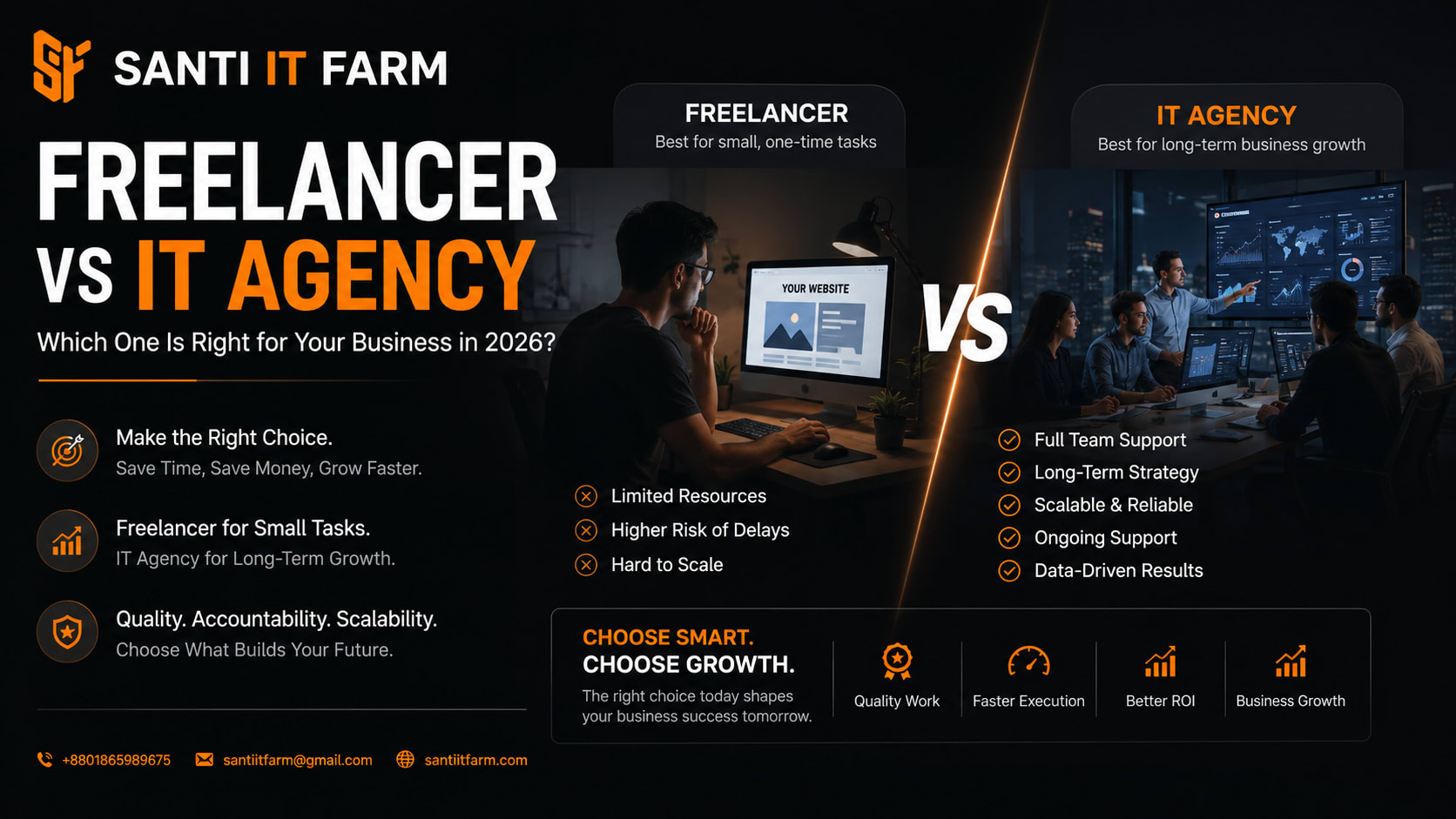
Why Most Freelancers Struggle to Scale Into Agencies
Many freelancers reach a stage where the workload becomes overwhelming. Projects increase, deadlines become harder to manage, and client communication starts consuming more time than the actual work. Revenue may grow temporarily, but stress grows faster.
The transition from freelancer to agency is one of the most important growth phases in the digital service industry. However, scaling successfully requires more than hiring a few people or creating a new logo. It demands operational structure, repeatable systems, leadership skills, positioning, financial discipline, and a scalable client delivery process.
Across Bangladesh, India, Pakistan, and global markets like the USA, UK, Canada, and Australia, thousands of freelancers attempt to scale every year. Many fail because they scale chaos instead of building systems first.
At Santi IT Farm, we have seen a clear pattern among agencies that grow sustainably. They focus on processes before expansion, quality before volume, and long-term reputation before short-term cash flow. This guide breaks down how freelancers can scale properly while protecting client trust, profitability, and service quality.
Quick Answer: How Do You Scale From Freelancer to Agency Properly?
- Choose a specialized service niche instead of offering everything.
- Build repeatable systems before hiring a team.
- Document workflows for onboarding, delivery, revisions, and communication.
- Hire slowly and prioritize reliability over low cost.
- Shift from hourly pricing to value-based or retainer pricing.
- Use automation tools to reduce manual operations.
- Focus on recurring revenue instead of one-time projects.
- Build a strong agency brand and authority presence.
- Create standard operating procedures for quality control.
- Develop leadership, sales, and client management skills.
Scaling successfully is less about working harder and more about creating systems that allow consistent delivery without depending entirely on one person.
What Does Scaling From Freelancer to Agency Actually Mean?
Scaling from freelancer to agency means transforming a personal service business into a structured company capable of delivering services consistently through processes, systems, and a team. Instead of clients depending entirely on one individual, the business becomes operationally scalable.
A freelancer usually handles sales, project management, communication, design, development, revisions, invoicing, and support alone. An agency distributes these responsibilities through specialized roles and documented workflows.
True agency scaling is not simply outsourcing random tasks. It involves building a reliable business infrastructure where quality, communication, branding, and client outcomes remain consistent even as project volume increases.
Modern agencies also integrate automation, AI-assisted workflows, CRM systems, SEO strategies, project management frameworks, and analytics to improve efficiency and profitability. This is especially important in competitive digital markets where clients expect fast delivery, transparency, and professional communication.
Why Proper Scaling Matters for Long-Term Business Growth
- Improper scaling often destroys client trust because quality becomes inconsistent when operations grow without systems.
- Freelancers who stay trapped in solo operations eventually face burnout, revenue limitations, and unstable income cycles.
- A scalable agency model creates recurring revenue opportunities through retainers, maintenance plans, SEO services, and automation support.
- Structured agencies attract higher-value clients because businesses trust operational maturity more than solo dependency.
- Global clients from countries like the USA, UK, and Australia often prefer agencies that demonstrate process reliability and communication standards.
- Agencies with documented systems can onboard new team members faster and maintain service quality consistently.
- Scalable operations improve business valuation and long-term sustainability compared to personality-dependent freelancing.
- Professional branding and positioning allow agencies to charge premium pricing instead of competing only on low rates.
Scaling properly creates operational freedom, predictable growth, stronger profitability, and long-term brand credibility in highly competitive digital markets.
Major Benefits of Transitioning From Freelancer to Agency
Higher Revenue Potential
Agencies can handle multiple projects simultaneously through team collaboration and systemized operations, allowing revenue growth beyond personal working hours.
Recurring Monthly Income
Agencies can offer SEO retainers, maintenance plans, digital marketing, hosting management, automation support, and consulting services that create predictable cash flow.
Improved Client Trust
Businesses are often more confident hiring agencies with teams, systems, contracts, and structured support processes.
Better Work-Life Balance
Delegating repetitive or specialized tasks reduces founder overload and creates more strategic focus on growth and leadership.
Stronger Brand Authority
A professional agency brand positions the business as a long-term growth partner rather than a temporary freelancer.
Access to Bigger Projects
Larger clients typically require multi-disciplinary expertise, scalability, and team availability that solo freelancers cannot easily provide.
Operational Efficiency
Standardized workflows, automation, and project management systems improve productivity while reducing delivery errors.
Business Stability
Agencies are less vulnerable to revenue collapse because delivery does not rely entirely on one person's availability.
Realistic Example of Freelancing vs Agency Scaling
Before
- — A solo web developer manages every task manually.
- — Projects are delayed because communication, revisions, and technical work compete for time.
- — Pricing is inconsistent and mostly hourly-based.
- — Client acquisition depends heavily on freelance marketplaces.
- — Revenue fluctuates month to month.
- — Burnout becomes common after handling multiple clients simultaneously.
After
- The business specializes in Shopify and WordPress growth solutions.
- A project manager handles communication and delivery coordination.
- Design, development, SEO, and support tasks are distributed across a structured remote team.
- CRM systems automate lead tracking and onboarding.
- The agency offers recurring SEO, maintenance, and automation retainers.
- Brand positioning attracts direct international clients instead of relying entirely on freelance platforms.
The biggest transformation is not only revenue growth. It is operational maturity, predictability, and client confidence.
Step-by-Step Guide to Scaling From Freelancer to Agency
Choose a Clear Niche and Positioning
- › Avoid trying to serve every industry and every service category.
- › Specialized agencies grow faster because clients understand their expertise immediately.
- › Focus on profitable areas like Shopify development, SEO, WordPress, UI/UX, branding, or business automation.
- › Position the agency around measurable business outcomes instead of generic service lists.
- › Strong niche positioning also improves SEO rankings and AI-search visibility.
Build Standardized Service Packages
- › Create clearly defined deliverables, timelines, pricing structures, and communication processes.
- › Standardization improves scalability and reduces operational confusion.
- › Package services into tiers for startups, growing businesses, and enterprise clients.
- › Include recurring support options to improve lifetime client value.
- › Well-structured packages also simplify sales conversations.
Document Every Core Process
- › Create SOPs for onboarding, communication, revisions, project delivery, reporting, and support.
- › Documenting workflows reduces dependency on memory and improves team consistency.
- › Use video walkthroughs, templates, checklists, and shared knowledge bases.
- › Process documentation becomes essential as team size increases.
- › Consistent systems help agencies scale without sacrificing quality.
Hire Carefully and Slowly
- › Many agencies fail because they hire too quickly without operational structure.
- › Prioritize communication skills, reliability, accountability, and cultural fit.
- › Start with specialized freelancers or remote contractors before building a full internal team.
- › Create trial projects before long-term hiring decisions.
- › Strong hiring protects agency reputation and delivery quality.
Shift From Freelancer Pricing to Agency Pricing
- › Hourly pricing limits scalability because revenue remains tied to time.
- › Agencies should focus on value-based pricing and outcome-focused proposals.
- › Package strategy, implementation, optimization, and support together.
- › Position services around ROI, lead generation, sales growth, or operational efficiency.
- › Premium positioning attracts higher-quality clients and reduces price competition.
Build Strong Client Communication Systems
- › Poor communication destroys agency growth faster than technical mistakes.
- › Use project management tools, regular updates, shared dashboards, and transparent timelines.
- › Set clear boundaries and response expectations.
- › Create onboarding systems that explain workflows clearly from the beginning.
- › Professional communication increases referrals and retention.
Invest in Branding and Authority
- › A professional website, case studies, SEO content, and brand identity build credibility.
- › Clients trust agencies that demonstrate expertise publicly.
- › Publish educational blogs, business insights, SEO resources, and growth case studies.
- › Build authority across Google search, LinkedIn, YouTube, and AI-search platforms.
- › Consistent branding increases conversion rates significantly.
Automate Repetitive Operations
- › Automation reduces manual workload and operational bottlenecks.
- › Use CRM systems, invoicing tools, email automation, proposal templates, and reporting dashboards.
- › AI-powered systems can improve lead qualification, content workflows, and support efficiency.
- › Automation allows agencies to scale with smaller teams while maintaining speed.
- › Operational efficiency directly improves profitability.
Focus on Recurring Revenue
- › One-time projects create unstable cash flow.
- › Offer monthly SEO, maintenance, digital marketing, hosting management, automation support, or analytics reporting.
- › Recurring services improve forecasting and business stability.
- › Long-term client relationships also increase upsell opportunities.
- › Agencies with recurring revenue scale more sustainably.
Develop Leadership Skills
- › Agency founders must transition from technician mindset to leadership mindset.
- › Focus on decision-making, delegation, communication, financial planning, and team management.
- › Avoid micromanaging every task.
- › Strong leadership creates scalable culture and accountability.
- › Growth eventually depends more on leadership quality than technical ability.
Useful Tools for Scaling a Freelance Business Into an Agency
The right tools do not replace strategy, but they significantly improve scalability, operational visibility, collaboration, and efficiency.
Common Mistakes Freelancers Make While Scaling
- Hiring too many people before building stable systems.
- Offering too many unrelated services without specialization.
- Underpricing services to compete on cost alone.
- Ignoring contracts, documentation, and operational structure.
- Trying to manage every task personally.
- Failing to build recurring revenue streams.
- Scaling client volume without improving communication systems.
- Neglecting branding and professional positioning.
- Avoiding delegation because of trust issues.
- Focusing only on revenue instead of profitability and client retention.
- Depending entirely on freelance marketplaces for leads.
- Ignoring SEO and long-term authority building.
- Expanding too quickly without cash flow planning.
- Failing to define internal quality control standards.
Frequently Asked Questions
Scaling Successfully Requires Systems, Not Just More Work
The journey from freelancer to agency can completely transform a business, but sustainable growth requires intentional structure. Agencies that scale successfully do not rely on hustle alone. They build systems, processes, positioning, leadership, and recurring revenue models that support long-term expansion.
The most successful agencies understand that growth is not about taking every project possible. It is about creating operational consistency, building trust, delivering measurable business outcomes, and establishing authority in competitive markets.
Whether you are a freelancer in Bangladesh serving local businesses or a digital consultant targeting clients in the USA, UK, Canada, or Australia, the core principles remain the same: specialize, systemize, automate, communicate clearly, and focus relentlessly on client results.
Scaling properly takes time, but when done strategically, it creates a business that is more profitable, more respected, and far more sustainable than solo freelancing alone.
Build a Scalable Digital Agency With the Right Growth Partner
Santi IT Farm helps freelancers, startups, and growing agencies build scalable digital systems that support long-term growth. From professional branding and SEO to automation, web development, Shopify solutions, and operational strategy, our team helps businesses scale with clarity and confidence.
If you are ready to move beyond inconsistent freelance growth and build a structured agency that attracts better clients, stronger revenue, and sustainable operations, our experts are ready to help.
- Website Development
- Shopify Development
- WordPress Development
- SEO Services
- Branding & Positioning
- Business Automation
- Custom Software Development
- Digital Marketing
- UI/UX Design
- Growth Strategy Consulting
Scale smarter, build stronger systems, and turn your freelance business into a growth-focused agency with Santi IT Farm.
Get Started