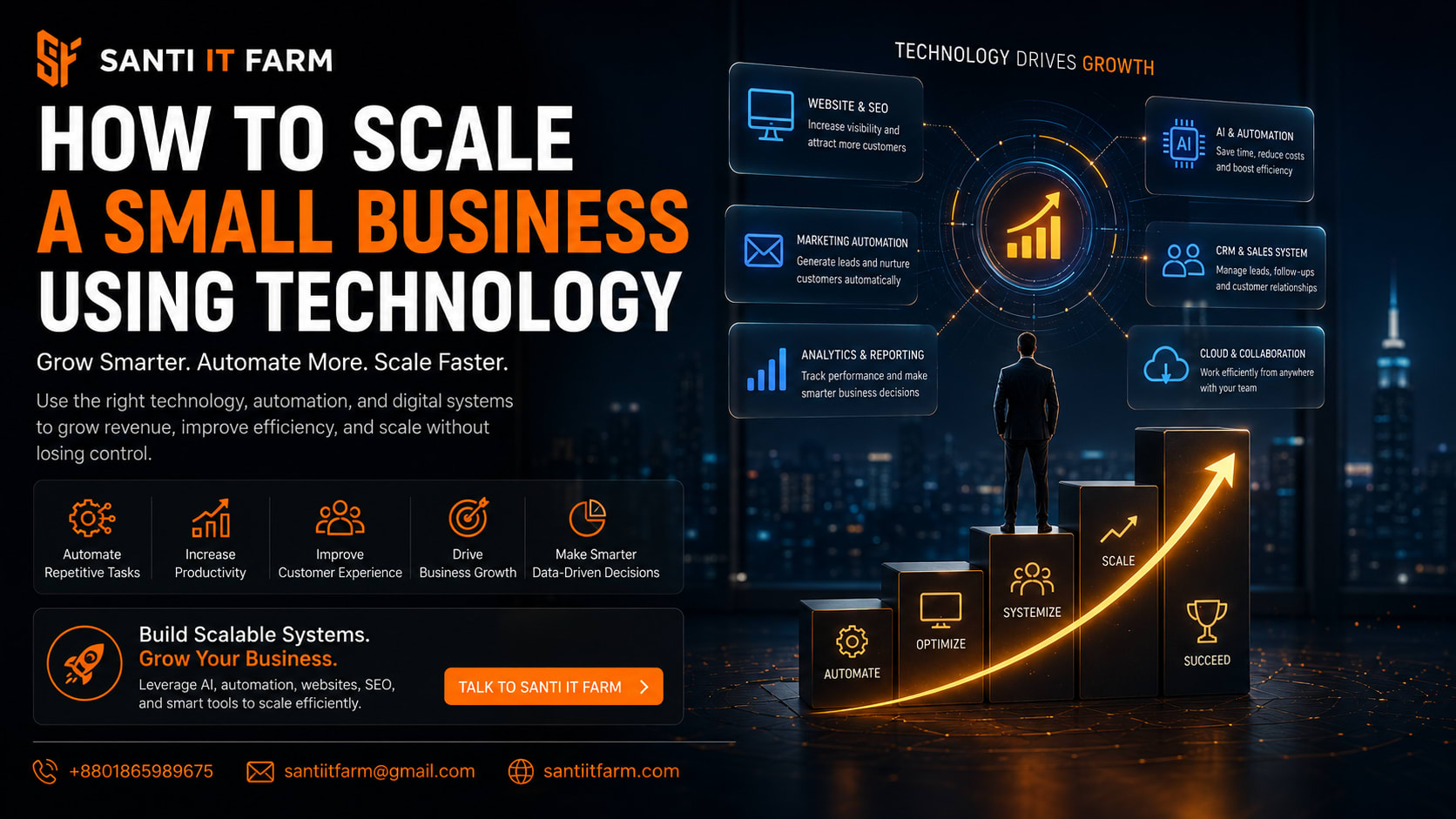
Scaling a Business Today Requires More Than Hard Work
Many small businesses reach a frustrating point where growth starts creating operational chaos instead of profit. More orders mean more customer support issues. More leads create follow-up delays. More employees increase management complexity. Without the right systems, growth can actually slow a business down.
This is where technology becomes a competitive advantage instead of just a support tool. Smart businesses across Bangladesh, India, Pakistan, the USA, the UK, Canada, and Australia are using automation, AI-powered workflows, websites, digital marketing systems, CRMs, and data-driven decision-making to scale faster while staying efficient.
The businesses that scale successfully are not always the ones with the largest budgets. They are usually the ones that build repeatable systems early. Technology helps small businesses remove bottlenecks, reduce manual work, improve customer experience, and create predictable growth.
Whether you run an e-commerce brand, local service company, startup, agency, or corporate business, understanding how to scale with technology can dramatically improve profitability, operational control, and long-term sustainability.
Quick Answer: How Can Technology Help Scale a Small Business?
- Technology helps automate repetitive tasks so teams can focus on revenue-generating work.
- Business automation reduces operational costs and human error.
- CRM systems improve lead management and customer retention.
- SEO and digital marketing tools increase customer acquisition at scale.
- AI-powered systems improve productivity, analytics, and customer support.
- Cloud-based collaboration tools improve remote team efficiency.
- Custom websites and e-commerce platforms help businesses handle larger customer volumes.
- Data analytics tools help businesses make smarter growth decisions faster.
- Technology improves customer experience, which directly impacts retention and referrals.
- Scalable systems allow businesses to grow without proportionally increasing expenses.
The most successful scaling strategy combines automation, digital infrastructure, marketing systems, and customer experience improvements together rather than relying on a single tool.
What Does It Mean to Scale a Business Using Technology?
Scaling a business using technology means increasing revenue, customers, and operational capacity without increasing costs at the same rate. Instead of solving every problem with more hiring, businesses use software, automation, AI, websites, and digital systems to improve efficiency.
For example, a growing e-commerce business may automate inventory tracking, customer support, abandoned cart recovery, email marketing, and analytics reporting. A service company might use CRM software, automated invoicing, project management systems, and SEO to generate and manage leads consistently.
Technology-driven scaling focuses on creating repeatable systems that continue working even as customer demand increases. This allows businesses to grow sustainably rather than becoming overwhelmed during expansion.
Modern scaling strategies also involve improving digital visibility. Businesses with strong websites, optimized SEO, fast-loading user experiences, automation systems, and integrated marketing funnels often outperform competitors that still rely heavily on manual processes.
Why Technology Is Essential for Modern Business Scaling
- Consumer expectations are higher than ever, especially in competitive digital markets.
- Manual business operations become expensive and inefficient during growth phases.
- Technology helps businesses serve more customers without dramatically increasing staff.
- Automation improves consistency across marketing, sales, support, and operations.
- AI tools can significantly improve productivity and decision-making speed.
- Data-driven systems reduce guesswork and improve profitability.
- Scalable digital infrastructure creates long-term competitive advantages.
- Businesses with strong digital ecosystems adapt faster to market changes.
- Online visibility through SEO and digital marketing creates sustainable lead generation.
- Global customers increasingly trust businesses with modern websites and professional digital systems.
Technology is no longer optional for businesses that want long-term growth. Companies that delay digital transformation often struggle with inefficiency, slow operations, inconsistent customer experiences, and reduced competitiveness.
Major Benefits of Scaling a Small Business With Technology
Reduced Operational Bottlenecks
Automation tools reduce repetitive work such as invoicing, lead tracking, customer follow-ups, and reporting, allowing businesses to operate more efficiently.
Higher Revenue Potential
Technology allows businesses to serve more customers, process more orders, and generate more leads without proportionally increasing costs.
Better Customer Experience
Fast websites, AI chat support, automated responses, CRM systems, and personalized marketing improve customer satisfaction and retention.
Improved Team Productivity
Cloud collaboration tools, project management systems, and workflow automation help teams work faster and with fewer communication issues.
More Accurate Business Decisions
Analytics tools provide real-time insights into sales, customer behavior, marketing performance, and operational efficiency.
Stronger Marketing Performance
SEO, social media marketing, paid advertising, and email automation help businesses generate predictable customer acquisition.
Scalable E-commerce Operations
Platforms like Shopify and WooCommerce help online stores handle increased traffic, payments, inventory, and customer interactions more efficiently.
Global Market Expansion
Digital systems make it easier for businesses in Bangladesh, India, and Pakistan to serve international clients across the USA, UK, Canada, and Australia.
Realistic Example of Technology-Driven Business Scaling
Before
- — A small online fashion store managed inventory manually using spreadsheets.
- — Customer inquiries were handled only through Facebook Messenger.
- — Orders were often delayed because inventory updates were inaccurate.
- — Marketing relied mostly on inconsistent social media posting.
- — The owner spent most of the day handling repetitive operational tasks.
After
- The business migrated to a scalable Shopify e-commerce platform.
- Inventory management became automated and synchronized in real time.
- SEO optimization increased organic search traffic consistently.
- Email marketing automation improved repeat customer sales.
- AI-powered chat systems handled basic customer support inquiries.
- Analytics tools helped identify the highest-performing products and campaigns.
- The owner gained more time to focus on growth strategy and partnerships.
This type of transformation is increasingly common among small businesses investing in digital infrastructure and automation systems.
Step-by-Step Strategy to Scale a Small Business Using Technology
Build a Scalable Website Foundation
- › Invest in a professional website optimized for speed, conversions, mobile responsiveness, and SEO.
- › Use scalable platforms such as WordPress, Shopify, or custom-built systems depending on your business model.
- › Ensure your website supports future growth including payment systems, automation, CRM integration, and analytics.
- › A poorly built website often becomes a major bottleneck during growth.
Automate Repetitive Business Processes
- › Identify repetitive tasks consuming large amounts of time.
- › Automate invoicing, customer onboarding, follow-up emails, appointment booking, reporting, and support systems.
- › Use workflow automation tools to reduce operational dependency on manual labor.
- › Automation improves consistency while reducing human error.
Implement CRM and Customer Management Systems
- › Use CRM platforms to organize leads, customer communication, and sales pipelines.
- › Track customer behavior and engagement for personalized marketing.
- › Improve customer retention through automated nurturing sequences.
- › Businesses that manage customer relationships strategically often scale faster.
Use SEO for Long-Term Customer Acquisition
- › Optimize your website for search engines and AI search platforms.
- › Create high-quality content targeting commercial and informational search intent.
- › Focus on semantic SEO and user experience rather than outdated keyword stuffing tactics.
- › SEO creates compounding long-term growth unlike short-term advertising alone.
Leverage AI-Powered Tools Strategically
- › Use AI for customer support, content assistance, analytics, forecasting, and workflow automation.
- › AI should improve operational efficiency rather than replace strategic decision-making.
- › Businesses using AI strategically can reduce overhead and improve response times significantly.
- › AI-powered systems are becoming increasingly important for competitive scalability.
Create Data-Driven Decision Systems
- › Track business KPIs consistently including conversion rates, customer acquisition costs, retention rates, and sales trends.
- › Use analytics dashboards to identify operational inefficiencies early.
- › Technology allows businesses to make smarter decisions faster.
- › Data-driven scaling is usually more sustainable than intuition-based growth.
Strengthen Digital Marketing Infrastructure
- › Combine SEO, social media marketing, paid ads, email marketing, and content marketing strategically.
- › Build marketing funnels that generate leads consistently.
- › Use retargeting systems and automation to increase customer lifetime value.
- › Marketing scalability is essential for predictable business growth.
Invest in Scalable Internal Operations
- › Use cloud-based project management and communication tools.
- › Improve internal documentation and workflows.
- › Create systems that new employees can adopt quickly.
- › Operational scalability becomes increasingly important as teams grow.
Useful Technology Tools for Scaling a Small Business
The best technology stack depends on business size, goals, operational complexity, and growth stage. Choosing the wrong tools can create unnecessary complexity, so businesses should prioritize scalability, integration, and long-term usability.
Common Mistakes Businesses Make When Scaling With Technology
- Trying to automate broken processes instead of fixing them first.
- Using too many disconnected tools that create operational confusion.
- Ignoring website performance and mobile optimization.
- Focusing only on social media while neglecting SEO and owned traffic.
- Choosing cheap systems that cannot scale with growth.
- Failing to train teams properly on new technology.
- Not using analytics to measure performance improvements.
- Overcomplicating automation during early growth stages.
- Ignoring cybersecurity and data protection.
- Treating technology as an expense instead of a growth investment.
Frequently Asked Questions
Technology Creates Scalable Growth When Used Strategically
Scaling a small business successfully is no longer about simply working harder or hiring faster. Sustainable growth comes from building efficient systems that improve operations, customer experience, marketing performance, and decision-making simultaneously.
Businesses that invest early in websites, SEO, automation, AI-powered systems, digital marketing infrastructure, and scalable workflows position themselves for long-term competitive advantage. This is especially important in increasingly digital markets across Bangladesh, India, Pakistan, the USA, the UK, Canada, and Australia.
The companies growing fastest today are usually the ones that combine strategic thinking with modern technology implementation. They reduce friction, improve customer experiences, and create scalable operational ecosystems that continue generating results as demand increases.
Technology alone will not guarantee business growth. However, when paired with smart strategy, customer-focused execution, and consistent optimization, it becomes one of the most powerful growth accelerators available to modern businesses.
Ready to Scale Your Business With Smarter Technology?
Santi IT Farm helps businesses build scalable digital ecosystems designed for long-term growth. From high-converting websites and Shopify development to SEO, automation, branding, AI-powered systems, and digital marketing, our team focuses on creating solutions that improve both growth and operational efficiency.
Whether you are a startup, local business, e-commerce company, agency, or corporate brand, we can help you build the digital infrastructure needed to scale sustainably in competitive global markets.
- Website Development
- Shopify Development
- WordPress Development
- SEO Services
- Digital Marketing
- Branding
- Business Automation
- AI-Powered Systems
- UI/UX Design
- Custom Software Development
If you are serious about scaling your business with modern technology, strategic systems, and sustainable growth, contact Santi IT Farm today.
Get Started

