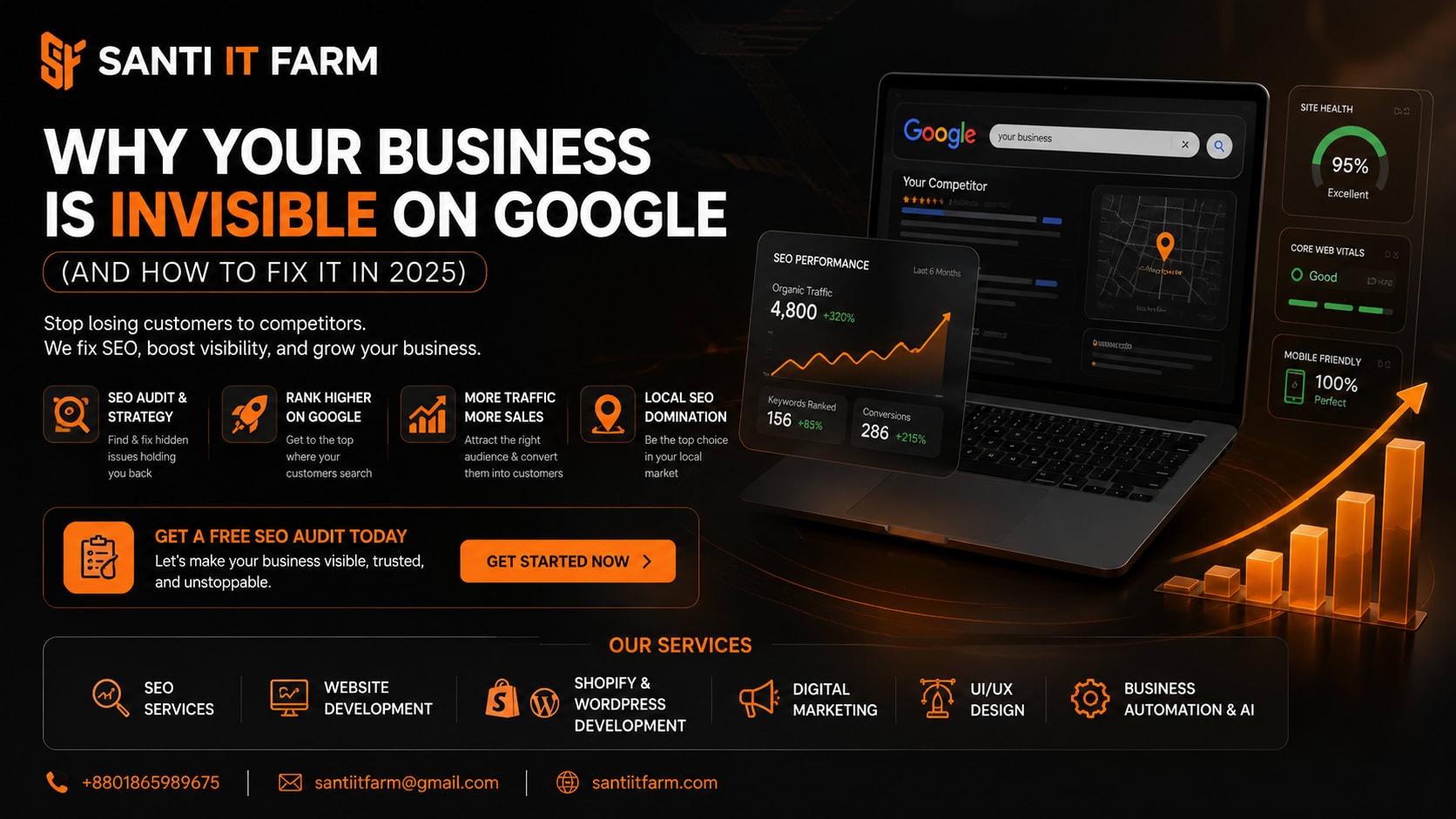
You Have a Website. Google Has No Idea It Exists.
Imagine spending weeks — or thousands of dollars — building a professional website, only to search your own business name and find nothing. No listing. No ranking. Just silence. For thousands of small business owners in Bangladesh, India, Pakistan, the UK, and beyond, this is a daily frustration that costs real money.
The painful truth is: having a website doesn't mean anyone will find it. Google doesn't automatically know your site exists, and even when it does, dozens of hidden technical and content-level issues can quietly suppress your visibility. You can be doing everything right on the surface and still be completely invisible in search.
The good news? Every single one of these problems has a fix. In this guide, we're breaking down the most common and most overlooked reasons your website isn't showing up in search results — and exactly what you need to do about each one. Whether you're a startup in Dhaka, an e-commerce brand in London, or a service business in Toronto, this applies to you.
Why Is My Website Not Showing Up in Search Results? (Quick Answer)
- Your website hasn't been indexed by Google yet
- You accidentally blocked search engines with a noindex tag or robots.txt
- Your site has zero or very low-quality backlinks
- Your content doesn't match what your target audience is actually searching for
- Your website loads too slowly or fails Core Web Vitals standards
- Your site isn't mobile-friendly
- You're targeting keywords that are far too competitive
- Your website has thin, duplicate, or poorly structured content
- You have crawl errors that prevent Google from reading your pages
- Your domain is brand new and hasn't built authority yet
- Technical SEO issues like broken links, missing sitemaps, or bad URL structures
Most websites suffer from 3 to 5 of these issues at once. Fixing even two or three can produce a noticeable improvement in search visibility within weeks.
What Does 'Showing Up in Search Results' Actually Mean?
When someone types a query into Google — say, 'affordable web designer in Dhaka' or 'best Shopify agency for small business' — Google returns a list of results it considers most relevant and trustworthy for that query. Showing up in those results means Google has found your website, crawled it, indexed it, and decided it's worth surfacing to searchers.
This process involves three stages: crawling (Google's bots discover your pages), indexing (Google stores and categorizes your content), and ranking (Google decides where your page should appear relative to competitors). If any stage breaks down, your site won't appear — regardless of how good your product or service actually is.
Many business owners assume publishing a website automatically triggers this process. It doesn't. Without the right technical setup, content strategy, and authority signals, your website can remain invisible for months — or indefinitely. Understanding where the breakdown happens is the first step to getting found.
Why Search Visibility Is a Business-Critical Priority
- Over 68% of all online experiences begin with a search engine query — if you're not there, you're handing customers to competitors who are.
- Organic search is the highest-converting traffic channel for most businesses, generating leads that are already looking for exactly what you offer.
- In markets like Bangladesh, India, and Pakistan where digital adoption is accelerating rapidly, businesses that build early search visibility gain compounding advantages that are very hard to overcome later.
- Unlike paid ads that stop working when your budget runs out, strong organic rankings generate consistent, scalable traffic for months and years.
- For e-commerce businesses especially, search visibility directly correlates with revenue — a move from page 2 to page 1 can double or triple organic sales overnight.
- In international markets like the UK, USA, Canada, and Australia, search ranking is often the primary trust signal for first-time customers evaluating whether to do business with you.
Search visibility isn't a marketing luxury. For any business serious about sustainable growth, it's as essential as having a phone number or a storefront. Getting it right — and fixing it when it breaks — is one of the highest-ROI investments you can make.
What Happens When You Fix Your Search Visibility
Consistent Inbound Traffic Without Ad Spend
Once your pages rank, they attract traffic around the clock — without ongoing cost per click. A well-optimized blog post or service page can generate qualified leads for years, making organic SEO one of the most cost-effective long-term growth strategies available to any business.
Higher-Quality Leads Who Are Ready to Buy
Organic search visitors arrive with intent. They searched a specific query, found your page, and clicked. That behavioral signal makes them far more likely to convert than cold social media traffic or paid audiences who weren't actively looking.
Stronger Brand Authority in Your Niche
Appearing consistently on the first page of Google builds perceived authority. Customers trust businesses they can find easily. In competitive markets across South Asia and Western markets alike, being searchable is being credible.
Compounding Growth Over Time
Unlike most marketing channels where results plateau, SEO compounds. Each new indexed page, each new backlink, each improvement in site speed adds to your overall authority — so your results typically improve month over month as you build.
Reduced Dependency on Paid Advertising
Many businesses that fix their SEO find they can reduce their Google Ads budget significantly, redirecting that spend into other growth initiatives while maintaining or growing their inbound traffic.
Competitive Advantage That's Hard to Replicate Fast
Search authority takes time to build — which means once you have it, competitors can't buy their way past you overnight. Businesses that invest in SEO early create a moat that compounds in their favor for years.
Real-World Example: A Dhaka-Based E-Commerce Store That Was Invisible Online
Before
- — A Dhaka-based fashion e-commerce store came to us with zero organic traffic despite having 200+ product pages live for over a year.
- — Their site had a noindex meta tag accidentally left on from development — Google was being told explicitly not to index their pages.
- — Their product descriptions were duplicated from supplier copy, which Google treats as low-quality thin content.
- — Their page load time was over 8 seconds on mobile — well beyond Google's acceptable threshold.
- — They had no backlinks, no Google Search Console setup, and no sitemap submitted.
After
- We removed the noindex tags and submitted a proper XML sitemap to Google Search Console within the first week.
- We rewrote product descriptions with original, keyword-rich content targeting buyer-intent queries in both English and Bangla search contexts.
- We compressed images, implemented lazy loading, and moved to a faster hosting environment — bringing load time down to under 2.5 seconds.
- We built an initial backlink profile through local business directories, partner websites, and a targeted content outreach campaign.
- Within 90 days, over 140 product pages were indexed. Within 6 months, organic traffic grew by 380% and they ranked on page one for 23 priority keywords.
This isn't an unusual result. Most websites that are invisible on Google have fixable technical issues — and fixing them produces results faster than most business owners expect.
How to Fix Your Website's Search Visibility: Step-by-Step
Step 1: Check If Google Can Even Find Your Website
- › Open Google and type 'site:yourdomain.com' — if no results appear, Google hasn't indexed your site at all.
- › Set up Google Search Console (it's free) and check the Coverage report for indexing errors and excluded pages.
- › Look for a noindex meta tag in your page source code — it's a common dev oversight that blocks indexing entirely.
- › Check your robots.txt file (yourdomain.com/robots.txt) to confirm search bots aren't being blocked from crawling your site.
- › Submit your XML sitemap to Google Search Console so Google knows exactly which pages to crawl.
Step 2: Fix Technical SEO Issues That Block Rankings
- › Resolve all crawl errors shown in Google Search Console — broken internal links, server errors, and redirect chains all damage crawl efficiency.
- › Ensure your site uses HTTPS — Google has used SSL as a ranking signal since 2014 and non-secure sites are increasingly penalized.
- › Audit your URL structure to ensure it's clean, descriptive, and consistent (avoid URLs with random numbers or parameters).
- › Fix duplicate content issues using canonical tags to tell Google which version of a page is authoritative.
- › Verify your website passes Core Web Vitals — specifically Largest Contentful Paint, First Input Delay, and Cumulative Layout Shift.
Step 3: Fix Your Site Speed and Mobile Experience
- › Use Google PageSpeed Insights to get a specific score and list of issues — target above 80 on both mobile and desktop.
- › Compress all images using modern formats like WebP and implement lazy loading for off-screen images.
- › Minimize JavaScript and CSS files, and defer non-critical scripts from loading until after the page is interactive.
- › Switch to a faster hosting provider if your server response time is above 200ms — cheap shared hosting is a common growth ceiling.
- › Test your site on mobile devices and fix any layout, button sizing, or navigation issues — Google now indexes mobile-first.
Step 4: Build Content That Matches Real Search Intent
- › Use Google Search Console, Ahrefs, or Semrush to find what your target audience is actually searching for — then create content that directly answers those queries.
- › Avoid targeting extremely broad, high-competition keywords when starting out — focus on specific long-tail queries where you can realistically rank faster.
- › Structure your content with clear H1, H2, and H3 headings that include your target keywords naturally — this helps both search engines and readers.
- › Write content that genuinely answers the full question behind a search query — not just the surface keyword — to perform well in AI search engines like Perplexity and ChatGPT.
- › Update outdated content regularly — Google rewards freshness, and a page that was published years ago without updates will lose rankings over time.
Step 5: Build Backlinks and Domain Authority
- › Earn backlinks from reputable websites in your industry — even a handful of high-quality links can dramatically improve rankings for a new or low-authority site.
- › Start with business directories, local listings, and industry associations — these are often free and provide strong local SEO signals.
- › Publish genuinely useful content that other sites want to link to — data reports, how-to guides, and original research earn links naturally over time.
- › Reach out to partner businesses, suppliers, or complementary service providers about mutual linking opportunities.
- › Avoid low-quality link schemes or purchased links — Google's spam detection has become extremely sophisticated and penalties can be severe.
Step 6: Optimize Your Local and Regional SEO
- › If you serve a specific geography — whether Dhaka, Karachi, Mumbai, Manchester, or Melbourne — create and optimize your Google Business Profile immediately.
- › Include location-specific keywords naturally in your page titles, meta descriptions, and content body.
- › Get listed in local business directories relevant to your region and industry — these signals tell Google you're a real, established business in a specific area.
- › Encourage genuine customer reviews on Google — review volume and quality are significant local ranking factors.
- › Create location-specific service pages if you operate in multiple cities or serve international clients across different markets.
The Best Tools to Diagnose and Fix Your Search Visibility Problems
You don't need all of these tools to get started. Google Search Console and PageSpeed Insights are free and alone can surface the majority of issues affecting most websites. Start there before investing in premium tools.
The Most Damaging SEO Mistakes Business Owners Make
- Launching a website without removing the 'discourage search engines' setting used during development — this is the single most common reason new sites stay invisible.
- Using copied or templated content across multiple pages — Google deprioritizes duplicate content and it actively hurts rankings rather than helping.
- Targeting only broad, highly competitive keywords when a new or low-authority site has no realistic chance of ranking for them yet.
- Ignoring mobile experience — with over 60% of searches happening on mobile, a poor mobile experience directly impacts both rankings and bounce rate.
- Building a beautiful website on cheap shared hosting that loads slowly — site speed is a direct ranking factor and a poor user experience signal.
- Having no internal linking structure — pages that aren't linked from anywhere on your own site are harder for Google to discover and contextualize.
- Skipping meta titles and descriptions — these are the first thing search users see and directly influence whether they click on your result.
- Waiting for results without measuring — without Google Search Console data, you're optimizing blind and can't tell what's working or what to fix next.
- Publishing content and never updating it — Google rewards fresh, updated content and outdated pages gradually lose their rankings.
- Ignoring local SEO signals if you serve a specific region — a business in Karachi, Kolkata, or Manchester leaving their Google Business Profile unclaimed is losing very accessible local traffic.
Frequently Asked Questions About Website Search Visibility
Your Website Being Invisible on Google Is a Solvable Problem
The most important thing to understand is this: being invisible in search is almost never permanent and almost never random. Every instance of poor search visibility has a traceable cause — a technical issue, a content gap, an authority deficit, or some combination. And every cause has a proven fix.
What separates businesses that grow through organic search from those that stay invisible isn't luck or budget alone — it's knowledge, execution, and patience. The businesses ranking at the top of Google for competitive terms didn't get there accidentally. They invested in understanding how search works, fixed their fundamentals, and built authority over time.
Whether you're a startup in Lahore trying to compete with established players, an e-commerce brand in Dhaka looking to reduce paid ad dependency, or a service business in London wanting more consistent inbound leads — the path forward is the same. Diagnose the real problems, fix them systematically, and build content and authority that makes Google's job easy.
You've already done the hard part of building your website. Now it's time to make sure the world can actually find it.
Ready to Stop Being Invisible Online? Let's Fix It Together.
At Santi IT Farm, we've helped businesses across Bangladesh, India, Pakistan, the UK, USA, Canada, and Australia go from completely invisible on Google to ranking competitively for the keywords that actually drive leads and revenue.
We don't do generic SEO packages. We do deep technical audits, custom content strategies, and hands-on optimization that's built around your specific business goals, your market, and your competition.
If your website isn't showing up in search results, the longer you wait, the more business goes to competitors who invested in getting found. We can identify exactly what's holding your site back — and build a roadmap to fix it.
- Full Technical SEO Audit
- Keyword Strategy and Content Planning
- On-Page SEO Optimization
- Backlink Building and Authority Development
- Google Search Console Setup and Management
- Core Web Vitals and Page Speed Optimization
- Local SEO and Google Business Profile Optimization
- SEO for WordPress, Shopify, and Custom Websites
Your business deserves to be found. Get in touch with Santi IT Farm today and let's build the search visibility that drives real growth — starting now.
Get Started