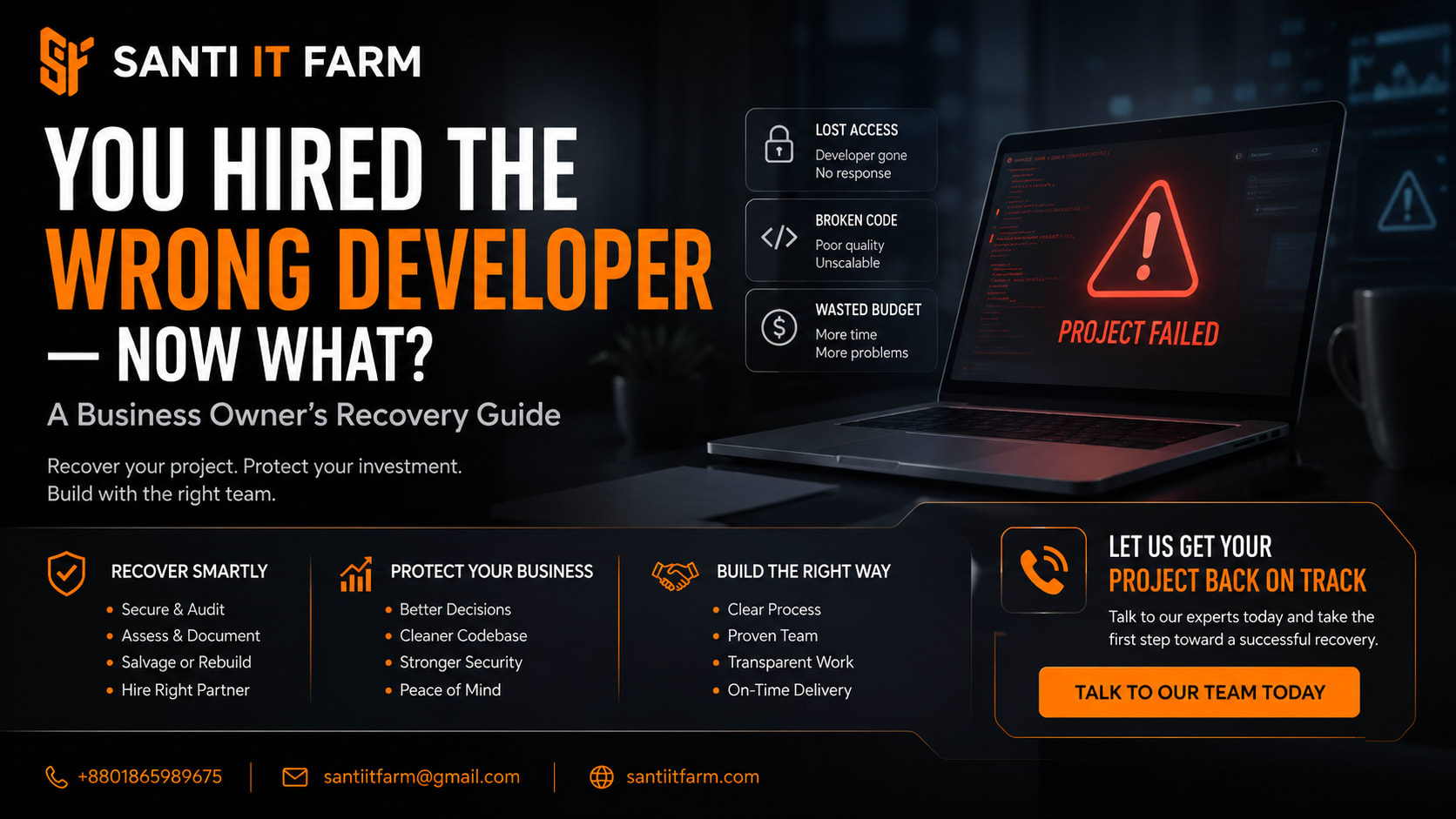
The Silent Budget Killer Most Business Owners Never See Coming
There's a particular kind of pain that comes not from a sudden catastrophic failure, but from a slow, steady drain you don't notice until your runway is shorter than you planned and your competitors are pulling ahead. That pain has a name: bad IT decisions.
It doesn't always look dramatic. Sometimes it's a website built by a freelancer who disappeared six months later. Sometimes it's an e-commerce store on the wrong platform that costs three times more to scale than it should. Sometimes it's a digital marketing agency that talked a big game and delivered a string of beautiful-looking reports with zero real growth to show for it.
Across Bangladesh, India, Pakistan, the UK, Canada, and markets everywhere, we see the same pattern repeat itself. Business owners and entrepreneurs invest in technology and IT services with the best intentions — and get burned, not because they weren't smart, but because the IT landscape is genuinely confusing and full of providers who are better at selling than delivering.
This guide is not a lecture. It's a practical breakdown of where businesses lose the most money in IT, why those decisions feel reasonable in the moment, and how to make choices that actually protect your time, budget, and growth trajectory.
How Do Bad IT Decisions Cost Businesses Money?
- Hiring underqualified developers who deliver broken or unmaintainable code
- Choosing the wrong platform for your business model, leading to expensive migration later
- Investing in SEO or marketing services with no strategy or measurable ROI
- Delaying technology upgrades until technical debt becomes a full crisis
- Outsourcing to the cheapest provider and paying twice to fix the output
- Skipping proper UI/UX design and losing customers at every touchpoint
- Building custom solutions when off-the-shelf tools would work better and faster
- Ignoring cybersecurity until a breach forces emergency spending
- Failing to align IT investment with actual business goals
Studies estimate that poor technology decisions cost mid-sized businesses between 20% and 40% of their annual IT budget in rework, fixes, and lost productivity. For smaller businesses, that figure can represent the difference between growth and stagnation.
What Counts as a Bad IT Decision?
A bad IT decision isn't necessarily one that looks wrong on paper at the time. Many of them look completely reasonable — even smart — when they're made. The problem is that they're made without full information, without the right expertise, or without proper alignment to the business's real needs.
A bad IT decision is any technology, hiring, or strategy choice that fails to deliver its intended business outcome, creates technical debt, or costs significantly more to correct than it would have to do right the first time. This spans everything from which CMS you build your website on, to whether you hire an in-house developer or outsource, to which digital marketing model you invest in.
What makes this especially tricky for business owners in fast-moving markets — whether you're running a Dhaka-based e-commerce brand, a startup in Karachi, a retail business in London, or a services company in Toronto — is that the consequences are often delayed. The website looks fine for months before the SEO limitations become visible. The app feels functional until it needs to scale. The agency's reports look professional right up until you realize traffic has flatlined.
The most dangerous bad IT decisions are the ones that feel fine until they very suddenly don't.
Why Getting IT Right Is a Business-Critical Priority
- Technology now underpins nearly every revenue-generating function in a modern business — from how customers find you, to how they experience your brand, to how efficiently your team operates internally.
- In competitive markets, your website and digital presence is your first impression. A slow, poorly designed, or SEO-invisible website doesn't just underperform — it actively sends potential customers to competitors.
- The cost of rework is almost always higher than the cost of doing it right the first time. When a development project has to be rebuilt from scratch, you're paying for two projects instead of one — and absorbing the opportunity cost of lost time in between.
- IT decisions compound over time. Choosing the right platform, partner, and strategy early means future updates, marketing campaigns, and expansions are faster and cheaper. Choosing the wrong ones means everything downstream gets harder.
- In regions like South Asia and growing digital markets, businesses that invest strategically in IT consistently outpace competitors who treat technology as an afterthought or a cost center rather than a growth lever.
- Investor and client confidence is increasingly tied to technology quality. A professional, well-performing digital infrastructure signals that your business is serious, scalable, and trustworthy.
Getting IT right isn't a nice-to-have for modern businesses. It's one of the highest-leverage decisions you'll make — and getting it wrong has consequences that ripple through every part of your operation.
What You Gain When You Make Smarter IT Decisions
Faster Time to Revenue
When you choose the right platform and the right partner from the start, you launch faster, iterate faster, and start generating returns sooner. A well-built Shopify store or WordPress site with proper SEO architecture can start driving organic traffic within weeks rather than being held back by technical issues for months.
Lower Total Cost of Ownership
Smart IT decisions reduce the ongoing cost of maintaining and growing your digital infrastructure. Clean code, proper documentation, and scalable architecture mean that adding features or fixing issues doesn't require starting from scratch every time — and that you're not trapped in an expensive dependency on one developer.
Measurable Marketing ROI
When your SEO strategy is built on real keyword research and technical health, and your digital marketing campaigns are properly tracked and attributed, you stop spending money into a black hole. You can see exactly what's working, optimize accordingly, and invest more confidently where returns are proven.
Stronger Customer Experience
Great UI/UX design backed by real user research translates directly into higher conversion rates, lower bounce rates, and better customer retention. Every percentage point improvement in conversion is pure revenue gain with no additional acquisition cost.
Operational Efficiency Through Automation
The right business automation and AI-powered systems reduce manual workload, eliminate repetitive errors, and free your team to focus on high-value work. Businesses that automate the right processes consistently report significant gains in output without proportional increases in headcount.
Scalability Without Crisis
Building on the right foundation means growth doesn't break your systems. Whether you're scaling from 100 to 10,000 customers or expanding from one market to several, the right technical decisions mean expansion is an exciting milestone rather than a painful emergency.
Real-World Scenario: What Bad IT Decisions Look Like in Practice
Before
- — A mid-sized clothing retailer in Dhaka decides to build a custom e-commerce website from scratch because a local freelancer offered a low price and promised full ownership of the code.
- — Twelve months later: the site is slow, has poor mobile UX, zero structured SEO, no integration with payment gateways that work reliably, and the freelancer is unreachable.
- — The business owner hires another developer to fix the issues. That developer says the code is too messy to salvage and recommends a rebuild.
- — Total cost: the original project budget, the lost twelve months of potential online revenue, the second developer's assessment fee, and now an entirely new build — on top of significant damage to customer trust from a poor shopping experience.
- — This is not a rare story. Variations of it happen to businesses across Bangladesh, India, Pakistan, and globally every single week.
After
- The same retailer consults with a professional IT agency before committing to any build.
- Based on their product volume, growth plans, and budget, the agency recommends Shopify — a proven, scalable e-commerce platform with built-in payment processing, mobile optimization, and an extensive app ecosystem.
- The store launches in six weeks with a clean UI, proper on-page SEO, Google Analytics integration, and a clear content strategy.
- Within three months, organic traffic is growing steadily. Within six months, online sales represent a meaningful portion of total revenue.
- When the business is ready to expand to international shipping and multiple currencies, the platform handles it without requiring a rebuild.
The difference between these two outcomes wasn't budget — the Shopify build actually cost less than the failed custom project. The difference was the quality of the initial decision and the expertise behind it.
How to Make Smarter IT Decisions Going Forward
Start With Business Goals, Not Technology
- › Before evaluating any platform, tool, or provider, define what business outcome you're trying to achieve. Are you trying to increase online sales? Reduce customer acquisition cost? Improve operational efficiency? Expand to a new market?
- › Technology is a means to a business end — not an end in itself. Decisions made from a technology-first perspective frequently miss the actual business need.
- › Document your goals, your constraints, and your success metrics before any IT conversation begins. This single step eliminates a huge percentage of costly misalignments.
Evaluate Providers on Track Record, Not Price
- › The cheapest option almost never delivers the lowest total cost. A quality agency or developer will cost more upfront and save dramatically more over the life of the project.
- › Ask for case studies, references, and evidence of results in your industry or market. Ask specifically about projects that faced challenges — how a provider handles difficulty tells you more than how they handle smooth projects.
- › Look for providers who ask good questions before proposing solutions. An agency that jumps straight to a proposal without understanding your business is a warning sign.
Choose Platforms That Fit Your Model, Not Your Budget
- › Shopify is excellent for e-commerce businesses that want reliability, speed to market, and a rich ecosystem. WordPress is powerful for content-driven businesses and flexible websites. Custom development makes sense for genuinely unique requirements — not as a default choice.
- › Choosing the wrong platform because it's cheaper to build on in the short term almost always results in a more expensive migration later. Match platform to business model, not to the lowest line item on a proposal.
- › Involve technical experts in platform decisions, especially if the choice will be foundational to your business for years.
Demand Transparency and Measurable Outcomes
- › Any digital marketing, SEO, or technology investment should come with clear success metrics defined in advance. What does success look like at 90 days? At six months? At one year?
- › Insist on regular reporting that connects activity to business outcomes — not vanity metrics like impressions and clicks in isolation, but metrics tied to revenue, leads, or the specific goal you identified.
- › Be wary of any provider that resists defining measurable outcomes. That resistance usually signals an inability to deliver them.
Build for Scalability From Day One
- › Even if you're a startup or small business, the systems you build today will be the foundation you scale on tomorrow. A little investment in proper architecture, clean code, and documentation now will save exponentially more later.
- › Ask any potential development partner how the solution they're proposing will perform at 10x your current load. Ask what it will cost to add the next major feature. Ask who else can maintain the code if they're unavailable.
- › Scalability is not a luxury. It's the difference between growth feeling exciting and growth feeling like a crisis.
Build an IT Advisory Relationship, Not Just a Vendor Relationship
- › The most valuable IT relationship for any business is one where your technology partner understands your business deeply enough to proactively identify risks and opportunities — not just execute tasks.
- › This kind of relationship develops over time when both parties communicate openly about business goals, constraints, and changes in direction. It requires a partner who is genuinely invested in your outcomes.
- › Choose partners you can build this relationship with. The transactional, project-by-project approach to IT is one of the most common root causes of accumulated bad decisions.
Tools and Platforms That Support Smarter IT Decisions
The right tools support better decisions, but they don't replace the need for the right partner. Use these resources to inform your choices — and engage an expert team to implement them properly.
The Most Costly IT Mistakes Businesses Keep Making
- Choosing an IT provider based on the lowest quote without evaluating quality, methodology, or track record — and absorbing the full cost of rework when the output fails to perform.
- Building a custom solution when a proven platform like Shopify or WordPress would deliver better results faster and at lower long-term cost.
- Treating SEO as a one-time task rather than an ongoing strategic investment — then wondering why rankings plateau or decline within months of the initial work.
- Failing to establish clear ownership of code, accounts, and digital assets — and discovering during a dispute or transition that you don't actually control your own website or ad accounts.
- Investing heavily in paid advertising before the website is optimized for conversion — sending expensive traffic to a leaky funnel.
- Neglecting mobile optimization in markets where the majority of users are on smartphones — particularly critical across South Asia, where mobile-first browsing is the norm, not the exception.
- Skipping discovery and requirements documentation and jumping straight to development — resulting in scope creep, misaligned deliverables, and budget overruns.
- Dismissing UI/UX design as a cosmetic concern rather than a revenue function — losing customers at every poorly designed touchpoint.
- Delegating technology decisions entirely to non-technical staff without appropriate expert input — leading to choices made on superficial criteria rather than business-relevant technical factors.
- Ignoring the total cost of ownership when evaluating technology — focusing only on build cost and ignoring ongoing maintenance, licensing, hosting, and upgrade costs.
Frequently Asked Questions About IT Decision Mistakes
The Most Expensive IT Decision Is the One You Don't Think Carefully About
Technology decisions are not just IT choices — they are business decisions with consequences that compound over time. The businesses that grow fastest and most sustainably are not always the ones with the biggest IT budgets. They're the ones that spend their IT budget wisely, guided by clear strategy, genuine expertise, and a commitment to measuring real outcomes.
Every business makes some bad IT decisions over its lifetime. That's inevitable in a landscape that moves as fast as technology does. What separates high-growth businesses from stagnant ones is how quickly they recognize when something isn't working, how decisively they course-correct, and how deliberately they build relationships with partners who help them make better choices going forward.
The goal isn't perfection. The goal is a system of decision-making that tilts the odds strongly in your favor — where you're choosing technology and partners based on evidence, expertise, and alignment to your actual business needs rather than on price, promises, or convenience.
If any part of this guide felt uncomfortably familiar, that's useful information. It means there are decisions worth revisiting and likely meaningful improvements available to your business right now — without necessarily requiring a large new investment, just a smarter approach to the investments you're already making.
Ready to Stop Paying for IT Mistakes and Start Investing in Real Growth?
At Santi IT Farm, we work with businesses across Bangladesh, India, Pakistan, the UK, USA, Canada, and Australia to make technology decisions that actually deliver — websites that perform, e-commerce stores that convert, SEO strategies that build lasting visibility, and digital systems that grow with your business rather than against it.
We don't just build things. We help you figure out what to build, what platform to build it on, what strategy to deploy it with, and how to measure whether it's working. If you're tired of technology that costs more than it returns, we'd like to change that.
- Website Development & Web Design
- Shopify & E-commerce Development
- WordPress Development
- SEO Services & Digital Marketing
- UI/UX Design
- Branding & Social Media Marketing
- Business Automation & AI-Powered Systems
- Custom Software Development
Your next IT decision doesn't have to be another costly mistake. Book a free strategy consultation with Santi IT Farm and let's build something that actually works for your business.
Get Started