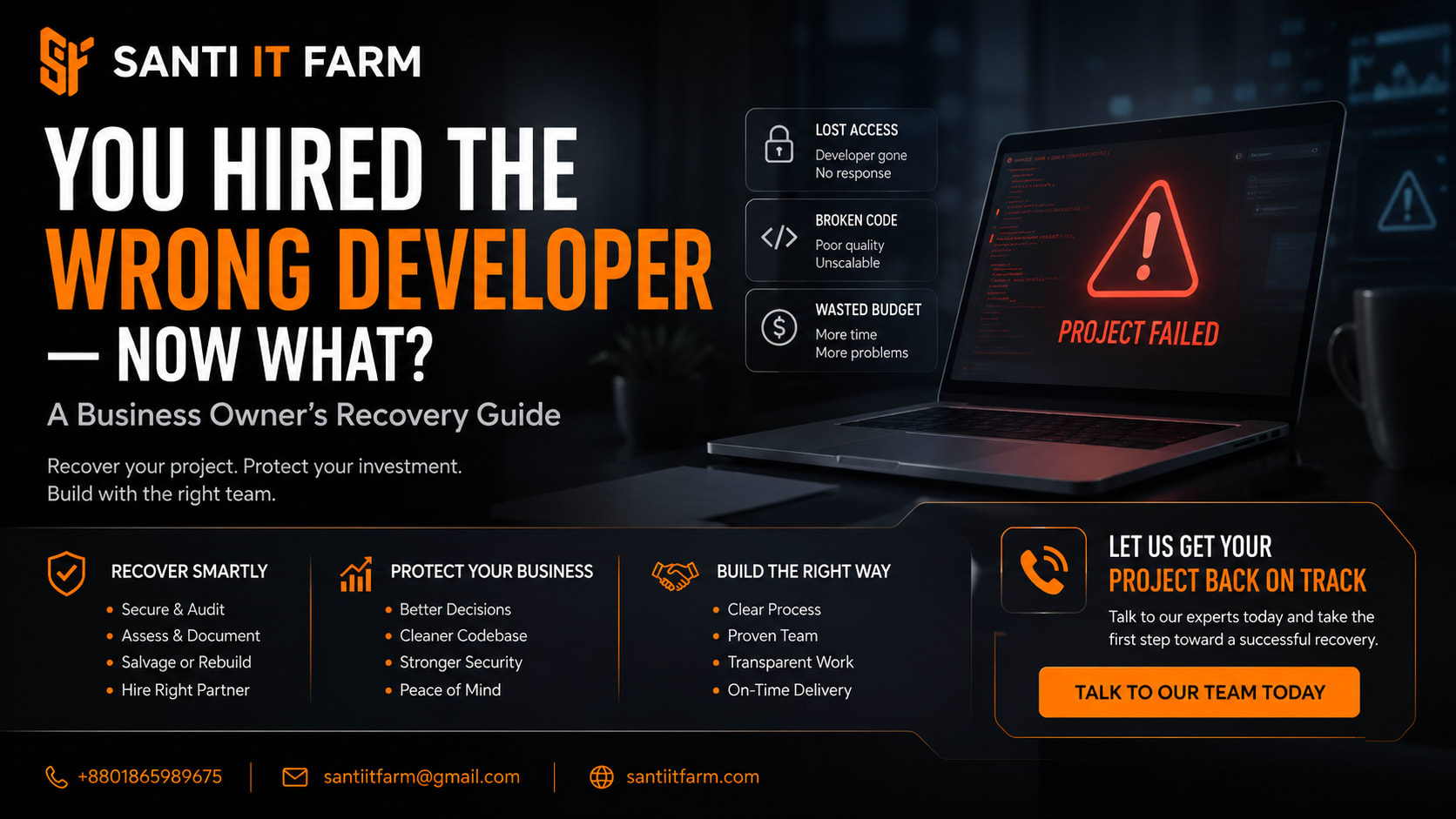
That Sinking Feeling When You Realize Your Developer Was the Wrong Choice
It usually starts with a small red flag — a missed deadline here, a vague reply there. Then one day you log in to check progress, and you realize your project is either half-built, completely broken, or simply... gone. Your developer has gone quiet, the code doesn't work, and the money you invested is nowhere near reflected in what you received.
This scenario plays out thousands of times a year across Bangladesh, India, Pakistan, the UK, the US, and everywhere in between. Business owners — some tech-savvy, some not — hire developers through Fiverr, Upwork, or personal referrals, trusting them with their digital future. And sometimes, those hires go catastrophically wrong.
If you're reading this right now feeling frustrated, panicked, or even embarrassed — stop. This is more common than anyone admits, and there is a clear path forward. In this guide, we'll walk you through exactly what to do when a bad developer hire threatens your business, how to salvage your project, and how to ensure you never end up in this situation again.
Quick Answer: What Should You Do After Hiring the Wrong Developer?
- Stop all active access and secure your codebase, domain, and accounts immediately
- Audit what has actually been built — understand the damage honestly
- Document everything: contracts, messages, deliverables, invoices
- Decide whether to salvage, rebuild, or partially restructure the project
- Hire an experienced agency or senior developer to assess and take over
- Establish clearer contracts, milestones, and communication protocols going forward
- Learn the vetting signals that separate good developers from risky ones
Speed matters here. The longer a bad situation festers — especially if a developer still has access to your systems — the more damage can accumulate. Act quickly and methodically.
What Does 'Hiring the Wrong Developer' Actually Look Like?
The phrase covers a surprisingly wide range of situations, and it's important to be precise about which one you're dealing with — because the recovery strategy differs depending on the root problem.
In some cases, the wrong hire is a skills mismatch. The developer was competent at one thing — say, basic WordPress setup — but was hired for something far more complex, like a custom Shopify integration or a multi-vendor e-commerce platform. They weren't malicious; they were simply in over their head and didn't have the integrity to admit it upfront.
In other cases, the problem is professionalism. The developer disappeared mid-project, stopped responding, or delivered work so inconsistent that it's unclear whether anything is salvageable. In the most serious scenarios, the developer may have copied code, introduced security vulnerabilities, or even held your site hostage over a payment dispute.
And sometimes, the issue is purely about fit — the communication was poor, the process was chaotic, and even though something was delivered, it doesn't match what you needed or envisioned. Any of these situations can set a business back by weeks or months, and recovering from them requires a clear head and a structured approach.
Why This Decision Matters More Than Most Business Owners Realize
- Your website or application is often your most important commercial asset — a bad build can cost you customers, credibility, and revenue every single day it underperforms
- Technical debt accumulates fast — a poorly written codebase becomes exponentially more expensive to fix the longer it's left in production
- Security vulnerabilities introduced by careless developers can expose your customers' data, putting you at legal and reputational risk
- In competitive markets — whether you're a startup in Dhaka, an e-commerce brand in Lahore, or a service business in London — digital execution speed is a real competitive advantage you cannot afford to waste
- Recovering from a bad hire without a plan often leads to a second bad hire, creating a cycle of wasted investment and missed opportunity
The reason to treat this situation seriously isn't to assign blame — it's because your business outcomes are directly tied to the quality and reliability of the team building your digital infrastructure. Getting this right matters enormously.
What You Gain by Handling This Correctly
A Cleaner, More Solid Foundation
When an experienced team audits and restructures a failed project, they often uncover not just the developer's mistakes but also gaps in the original specification. What emerges is a cleaner, better-documented, more scalable product — sometimes stronger than what you originally planned.
Better Vendor Vetting Skills
Going through a bad hire is painful, but business owners who take the time to understand what went wrong develop a much sharper eye for evaluating developers in the future. You'll ask better questions, read contracts more carefully, and recognize warning signs early.
A Protected Business Reputation
A broken or insecure website directly damages how customers perceive your brand. Fixing the technical problems promptly — before they become public-facing failures — protects your reputation and signals to your market that your business is serious and professional.
Recovered Timeline With Proper Project Management
Contrary to what many fear, a professional recovery doesn't always mean starting over from zero. Experienced developers can often salvage significant portions of existing work, dramatically reducing the time needed to reach your original launch goal.
Peace of Mind Through Transparency
Working with a professional agency during recovery means you'll have real milestones, real communication, and real documentation — not vague promises. For business owners who've just been burned, this clarity is genuinely valuable and often transformative.
Real-World Scenario: From Failed Project to Functioning Business Asset
Before
- — A small e-commerce business owner in Chittagong, Bangladesh hired a freelance developer to build a custom WooCommerce store with a local delivery integration and a multilingual interface for Bangla and English audiences.
- — Six months in, after paying roughly $1,800, the store was live — but barely. Products loaded slowly, the checkout process broke on mobile, the Bangla text was improperly encoded and unreadable, and the delivery integration had never actually been connected to the backend.
- — The developer had gone silent after the final payment, responding only with brief messages saying he was 'working on it.' Meanwhile, the business owner was hemorrhaging potential sales every day the site underperformed.
After
- After engaging a professional web development team to perform a technical audit, the scope became clear. About 40% of the existing work — primarily the product catalog structure and some design elements — was usable and worth preserving.
- The remaining 60% required rebuilding: proper mobile optimization, Bangla language encoding, payment gateway reconfiguration, and actual delivery API integration. With a structured project plan, clear milestones, and weekly progress calls, the revised store launched in 7 weeks.
- Within 90 days of relaunch, the store's mobile conversion rate had improved significantly, checkout abandonment dropped, and the owner finally had a platform that actually served her customers — in both languages, on all devices.
This story isn't unusual. The recovery cost was higher than it needed to be because of the delay in acting. If the owner had raised concerns at the first red flag — around month two — the damage would have been far less severe.
Step-by-Step: How to Recover From a Bad Developer Hire
Step 1 — Secure Everything Immediately
- › Change all passwords your developer had access to: hosting panel, domain registrar, CMS admin, FTP, database, staging environment, and any third-party API keys
- › Revoke their access to GitHub, Bitbucket, or any version control repository
- › Take a full backup of the current codebase and database — even if it's broken, you may need it as a reference
- › Contact your hosting provider to flag recent file changes or suspicious activity if you suspect anything beyond incompetence
Step 2 — Conduct an Honest Damage Assessment
- › List every feature that was promised versus what was actually delivered
- › Test the live site or application methodically — document what works, what's broken, and what's missing entirely
- › Check for security issues: are there outdated plugins, exposed admin URLs, missing SSL certificates, or hardcoded credentials in the code?
- › If you're not technical, hire a freelance senior developer or agency for a one-time technical audit — this is worth the cost before you make any further decisions
Step 3 — Document Everything for Your Records
- › Save all written communication: emails, WhatsApp messages, Slack threads, Upwork or Fiverr messages
- › Collect your contracts, invoices, payment receipts, and any project briefs or scope documents
- › Screenshot and archive the developer's profile, portfolio, and any public representations they made about their skills
- › This documentation matters if you pursue a refund, dispute, or platform complaint — and it helps your next developer understand what was promised and what was actually built
Step 4 — Decide: Salvage, Rebuild, or Hybrid?
- › Salvage: If the architecture is sound but execution was poor, an experienced developer may be able to clean and extend the existing codebase — often the fastest and most cost-effective path
- › Rebuild: If the code is fundamentally broken, insecure, or built on the wrong technology for your needs, starting fresh with proper planning is smarter than patching bad foundations
- › Hybrid: Most recovery situations fall here — keep the usable parts, redesign or rebuild the broken elements, and document everything properly from this point forward
- › Get a professional second opinion before deciding — sunk cost bias often pushes business owners toward salvage when rebuild would serve them better
Step 5 — Find a Trustworthy Development Partner
- › Look for agencies or senior developers with demonstrable experience in your specific technology stack — WordPress, Shopify, custom React, Laravel — not generalists who 'do everything'
- › Ask for case studies, live project references, and a clear onboarding process before signing anything
- › Insist on a structured contract that includes milestone-based payments, intellectual property clauses, and post-launch support terms
- › Evaluate communication quality during your first interaction — a team that responds clearly and asks intelligent questions about your project is a strong signal of professionalism
Step 6 — Establish a Better Process Going Forward
- › Define your project scope in writing before any development begins — include features, technology choices, design references, and explicit exclusions
- › Use milestone-based payment structures tied to deliverable acceptance, not calendar dates
- › Schedule regular check-in calls — weekly for active builds, bi-weekly for longer projects
- › Maintain your own access to all accounts, repositories, and tools throughout the project — never allow a developer to hold sole ownership of your digital infrastructure
Useful Tools to Protect Your Project and Vet Future Developers
You don't need every tool on this list. Pick the ones that address your specific vulnerability — whether that's security, communication, payment protection, or vetting. The goal is to build a system around your development process, not to create bureaucracy.
Common Mistakes Business Owners Make After a Bad Developer Experience
- Hiring the next developer too quickly out of panic, without addressing what went wrong in the selection process the first time
- Trying to negotiate or appease a non-performing developer rather than cutting losses early and decisively
- Assuming the existing codebase is fine without a proper technical audit — bad code is often invisible to non-technical eyes
- Keeping the failed developer's access active while 'giving them another chance' — a significant security risk
- Not documenting the failed engagement, which weakens your position in any dispute or refund claim
- Choosing the cheapest option again — price is a signal, not just a number, and the lowest bid almost always carries the highest risk
- Skipping a proper project brief for the new developer and assuming they'll 'figure out what you need'
- Failing to insist on code ownership and intellectual property clauses in the new contract
- Blaming only the developer when the brief, communication, or contract on your side may have contributed to the failure
- Abandoning the project entirely when a structured recovery could have brought it to a successful launch
Frequently Asked Questions: Recovering From a Bad Developer Hire
A Bad Hire Isn't the End — It's a Decision Point
Every experienced business owner has a story about a vendor, hire, or partner that didn't work out. It's not a sign that you made a foolish decision — the digital talent market is genuinely difficult to navigate, especially for business owners who aren't deeply technical. What separates businesses that thrive from those that stall is how they respond when things go wrong.
The business owners who recover fastest from a bad developer hire are the ones who act quickly to secure their assets, assess the damage honestly, and bring in experienced help without ego or delay. They don't spend weeks in denial, keep giving the failing developer chance after chance, or make another hire in a panic without fixing the underlying selection process.
More than that, they treat the experience as valuable data. They understand now — in a visceral, hard-earned way — what a professional development engagement actually looks like versus what a risky one looks like. That knowledge changes how they build their digital team going forward.
Your project can recover. Your business can recover. And with the right team behind you from this point forward, you may end up with something better than you originally planned.
Let Santi IT Farm Take It From Here
At Santi IT Farm, we've helped business owners across Bangladesh, India, Pakistan, the UK, the USA, Canada, and Australia recover from exactly the kind of situation you're dealing with right now. We've inherited broken codebases, rescued stalled Shopify stores, rebuilt failed WordPress projects, and delivered what previous developers promised but never delivered.
We operate with full transparency — clear contracts, milestone-based delivery, regular communication, and documented handover. You'll always have access to your own code, accounts, and infrastructure. No surprises. No hostage situations. No ghost.
Whether you need a technical audit of what's been built, a full project rescue, or a fresh start with a team you can actually trust — we're ready to have that conversation with you.
- Website Development & Recovery
- Shopify Development
- WordPress Development
- E-commerce Development
- Custom Software Development
- UI/UX Design
- SEO Services
- Digital Marketing
- Business Automation
- Branding & Identity
You deserve a digital partner that treats your project like it matters — because to us, it does. Reach out today and let's get your business moving forward.
Get Started
