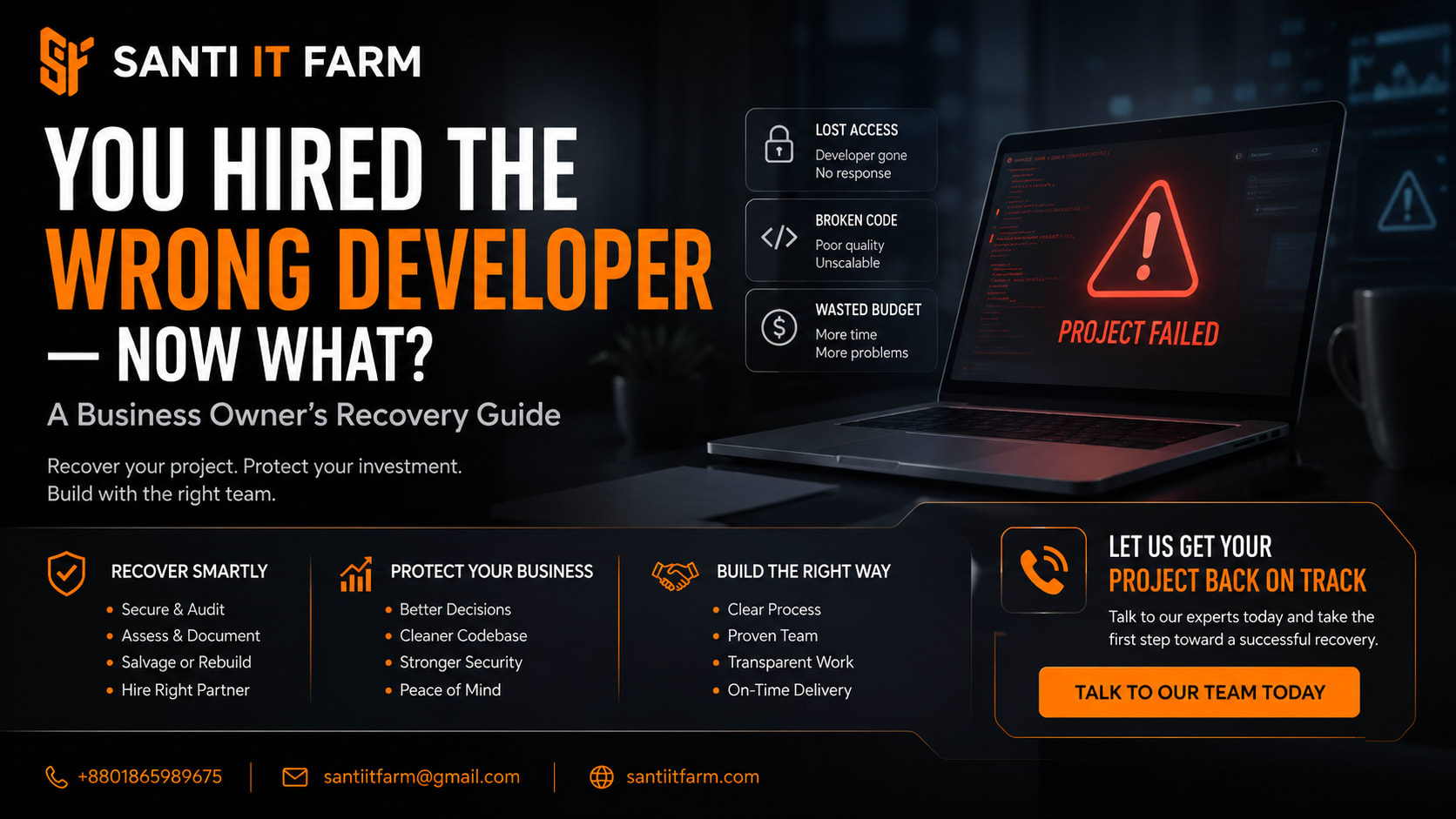
The Hidden Tax on Every Cheap Hire You've Ever Made
It starts innocently enough. You're launching your business — maybe an e-commerce store in Dhaka, a SaaS startup in Lahore, a service brand in London, or a local agency in Toronto. The budget is tight and the to-do list is long. Then you spot a freelancer offering a full website build for $80. Logo design for $15. A month of SEO for $30. It feels like a no-brainer.
Six months later, your website is broken on mobile, your Google rankings have nosedived thanks to black-hat SEO tactics, your brand looks indistinguishable from a template, and you're paying someone new to undo everything the first person did. The $80 website just cost you $800 — and that's before counting the customers you never converted because your online presence didn't build trust.
This isn't a rare story. It's one of the most common growth killers for small businesses, startups, and even established companies trying to scale on a tight budget. At Santi IT Farm, we've worked with clients from Bangladesh to the UK, India to Australia, and the pattern is nearly identical: the businesses that struggled the most were the ones that made the cheapest initial hires. This article is about why that happens — and what to do instead.
Why Do Cheap Freelancers Hurt Business Growth? (Quick Answer)
- Cheap freelancers often lack domain expertise, delivering work that needs constant revision or complete rework.
- Low-cost hires typically don't understand business strategy — they execute tasks without seeing the bigger picture.
- Poor quality output damages brand credibility, search rankings, and customer trust.
- Hidden costs — revisions, fixes, re-hires, and lost conversions — often make cheap freelancers the most expensive option.
- Missed deadlines and miscommunication create bottlenecks that slow your entire growth operation.
- One bad technical or SEO decision can take months to reverse — sometimes with permanent consequences.
The cheapest option at the start is almost never the cheapest option by the end. Business growth requires investment in quality — not just execution.
What Do We Actually Mean by 'Cheap Freelancers'?
To be clear: this article is not an attack on freelancers as a category. There are world-class independent professionals who charge premium rates and deliver exceptional results. Some of the best designers, developers, and strategists in the world work for themselves. The distinction we're drawing is between professional independent contractors and what we call 'low-cost execution vendors' — people who offer services at rates that simply cannot sustain quality work.
A cheap freelancer in this context is someone who prices their work so far below market rate that the economics of quality don't add up. To charge $50 for a full website, they either have to rush the project, reuse templates indiscriminately, skip critical steps like performance optimization or security hardening, or simply lack the expertise to know what they're missing. Sometimes all four.
This is especially prevalent in markets like Bangladesh, India, Pakistan, and parts of Southeast Asia, where labor arbitrage has created a race to the bottom on platforms like Fiverr and Upwork. The problem isn't geography — it's the pricing model. Many brilliant developers and designers from Bangladesh and India charge appropriately for their skills and deliver outstanding results. But the ultra-cheap tier — the $5, $10, $20 gigs — almost universally delivers work that costs more to fix than it saved.
Why This Decision Has Compounding Consequences for Your Business
- Your digital presence is your brand's handshake — a poorly built website or off-brand design signals incompetence before you even speak to a potential customer.
- SEO damage is cumulative and slow to reverse. A cheap SEO provider using black-hat tactics can result in a Google penalty that takes 6–18 months to recover from, during which your organic traffic flatlines.
- In e-commerce, conversion rate is everything. A poorly designed Shopify store or WooCommerce site built by someone unfamiliar with UX principles can mean a 1–2% conversion rate instead of 3–5% — the difference between a thriving store and a struggling one.
- Every week of downtime, every broken feature, every slow page load, and every confusing user journey translates directly into lost revenue. These aren't hypothetical risks — they're statistical certainties when quality is compromised.
- The opportunity cost is significant. While you're managing a cheap freelancer's mistakes, chasing revisions, and firefighting technical failures, your competitors with properly built systems are scaling and capturing the market share you should have.
The consequences of a bad hire don't stay contained to one project. They ripple across your entire growth trajectory — affecting SEO, brand perception, customer experience, and your team's time. Businesses that understand this early win faster.
What Businesses Actually Gain by Investing in Quality Partners
A Website That Works as a Sales Machine
A professionally built website isn't just visually appealing — it's engineered to convert. From page speed and mobile responsiveness to UX flows and clear calls-to-action, every element is intentional. Businesses that invest in professional web development consistently report higher average session durations, lower bounce rates, and stronger lead conversion. A $1,500 professionally built website that converts 4% of visitors will outperform a $100 website that converts 0.5% every single month for years.
SEO That Compounds Over Time
Good SEO work — built on ethical, strategy-led foundations — compounds. Every well-optimized page, every high-quality backlink, and every properly structured site architecture adds to a growing organic asset. Cheap SEO, by contrast, often borrows against your future — using shortcuts that provide a brief spike and then collapse, sometimes taking your entire domain authority down with them. For startups in Bangladesh, India, or Pakistan trying to build international visibility, this distinction is the difference between breakthrough and stagnation.
Brand Authority That Builds Trust
Premium branding — professional logos, consistent visual identity, well-crafted brand voice — signals to customers that you take your business seriously. In a global market where buyers are increasingly skeptical, visual trust signals are more important than ever. A brand that looks polished and coherent immediately reduces purchase friction. Cheap branding, on the other hand, activates exactly the wrong psychological triggers: doubt, hesitation, and the quiet decision to click away.
Digital Marketing That Generates Measurable ROI
When digital marketing is executed by someone who understands strategy — not just task completion — every campaign is built around outcomes. Proper audience segmentation, funnel design, ad creative quality, and conversion tracking turn your marketing budget into a revenue engine. Cheap digital marketers often focus on vanity metrics — impressions, follower counts, raw traffic — without connecting activity to actual business results.
Technical Stability That Scales With You
Custom software, business automation, and AI-powered systems built by experienced developers create infrastructure that grows with your business. They're secure, maintainable, and adaptable. Cheap technical work tends to be brittle — built fast, built fragile, and prone to failure at exactly the wrong moment: your peak season, your product launch, or your biggest campaign.
Real-World Business Impact: Before and After Making Better Hiring Decisions
Before
- — A Dhaka-based e-commerce brand hired a $60 Fiverr developer to build their Shopify store. The store launched but had broken mobile checkout, a 6.2-second load time, and no proper product schema. After three months, they had spent $800 in ads with a 0.4% conversion rate and nearly zero organic traffic.
- — A UK-based consultancy hired a cheap logo designer and brand kit creator for £30. The resulting brand used stock icons and a generic color palette indistinguishable from dozens of competitors. Sales calls regularly began with prospects saying they weren't sure they'd found the right company.
- — A Lahore startup invested in a $25/month SEO package from an unknown vendor. Within four months, the site had 300 spammy backlinks and had been penalized by Google. It took 14 months of professional recovery work to restore their organic performance.
After
- The same Dhaka e-commerce brand partnered with a professional development agency, rebuilt their Shopify store with proper UX architecture, reduced load time to 1.8 seconds, and fixed checkout flows. Conversion rate rose to 3.1% within 60 days, turning the same ad spend into 7x more revenue.
- The UK consultancy rebranded with a professional identity system — custom logomark, defined typography, and a cohesive brand voice. Prospects began arriving pre-sold, having identified the brand clearly from search results and social content. Close rates improved by over 35%.
- After recovering from the Google penalty, the Lahore startup invested in a white-hat SEO strategy with a professional agency. Within 10 months, they ranked on page one for six high-intent keywords and reduced their paid ad dependency by 60%.
These scenarios reflect the pattern we see consistently across clients from South Asia, the UK, North America, and Australia. The numbers vary — but the directional story is almost always the same.
How to Make Smarter Hiring Decisions for Digital Growth
Define What You Actually Need Before You Hire Anyone
- › Before posting a job or reaching out to a freelancer, document what success looks like — not just the deliverable, but the outcome. Do you need a website, or do you need leads? Do you need an SEO campaign, or do you need organic traffic that converts?
- › Having clarity on outcomes forces you to evaluate candidates on their ability to deliver results — not just their hourly rate.
- › Write a proper creative brief or project scope. This alone will weed out low-quality vendors who can't engage with strategic requirements.
Evaluate by Portfolio Quality and Business Impact — Not Price
- › Ask every candidate to show you examples of work that drove measurable business outcomes. Not just pretty designs — what did those designs achieve?
- › Ask a web developer for examples of sites with real performance metrics: load speed, mobile score, conversion data. Ask an SEO professional for rankings, traffic, and lead data — not just keyword lists.
- › If a candidate cannot speak to the business impact of their work, they are likely an executor, not a strategist. Executors have their place — but not in roles that shape your growth trajectory.
Understand the Full Cost of the Engagement
- › Get a clear scope of work that includes revisions, handover, and post-launch support. Many cheap freelancers quote only the initial build and charge separately for everything else.
- › Ask what happens if the project needs changes. What's their revision policy? Who owns the files and assets? Will they hand over source files or lock you into a dependency on them?
- › Calculate what a failure would cost you — in time, rework budget, and lost revenue. That calculation often makes the professional option look like the obvious financial choice.
Prioritize Strategic Alignment Over Tactical Execution
- › The best partners don't just complete tasks — they push back when your idea isn't aligned with your goal. They ask about your audience, your competitors, and your growth targets before they start designing or coding.
- › This kind of strategic input is almost never present in a cheap freelancer engagement. When someone is charging $50 for a website, they can't afford to spend two hours understanding your business.
- › Look for partners who ask more questions than they answer in the initial conversation. That's a strong signal that they care about outcomes, not just output.
Build a Long-Term Partnership, Not a Series of One-Off Transactions
- › The businesses that grow fastest digitally are those with consistent, trusted partners who understand their brand, their audience, and their goals over time.
- › One-off cheap hires mean you're always re-briefing, always re-educating, always starting from scratch. A long-term agency or senior freelancer relationship means every project builds on the last.
- › Think of it like a doctor-patient relationship. The doctor who knows your history delivers far better care than the cheapest clinic you can find on short notice.
Tools and Resources to Evaluate and Manage Digital Partners Effectively
Having the right tools doesn't replace the need for a quality partner — but they do give you the data to make smarter decisions and hold every partner accountable to real outcomes.
The Most Damaging Hiring Mistakes Business Owners Make (And How to Avoid Them)
- Hiring based solely on price: The #1 mistake. Price is a signal of value, not just cost. If someone can't explain why their price is what it is, that's a red flag — in either direction.
- Skipping the brief: Hiring someone without a written scope of work is an invitation to misalignment. Always document what you want, why you want it, and how you'll measure success.
- Ignoring red flags in communication: If a freelancer or agency is slow to respond, vague in their answers, or unable to explain their process clearly before the project starts — those behaviors will only get worse once money has exchanged hands.
- Assuming all markets produce the same quality: Some of the best digital professionals in the world work from Bangladesh, India, Pakistan, and other South Asian markets. But 'cheap from these markets' is not the same as 'affordable and excellent from these markets.' Vet based on evidence, not assumptions.
- Not asking about what happens after delivery: A good digital partner thinks about ongoing performance, not just project completion. Ask every potential hire what they'll do if results fall short.
- Optimizing for speed over quality: 'I need it by Friday' is one of the most expensive phrases in business. Rushing a qualified professional is sometimes necessary — rushing an unqualified one always creates problems.
- Hiring without checking references or case studies: Always ask for two or three client references and follow up. A five-minute call with a previous client is worth hours of evaluation and can save you thousands.
Frequently Asked Questions About Hiring Freelancers vs Agencies for Business Growth
The Smartest Investment You Can Make Right Now Is in Quality
Business growth in the digital era is not a mystery — it's a function of how well your digital infrastructure, brand, and marketing work together to attract, engage, and convert your target audience. Every element of that system matters, and every compromised element creates a drag on the whole.
Cheap hires feel like resourcefulness. In most cases, they're actually a form of expensive optimism — the belief that low-cost execution will somehow produce high-value results. It rarely does. And the businesses that learn this lesson early — by reading about it rather than experiencing it — are the ones that outpace their competitors with surprising speed.
You don't have to spend a fortune to work with quality partners. But you do have to stop treating price as the primary filter. Start asking what outcomes you need, find partners who can demonstrate they've delivered those outcomes before, and structure your engagements around results rather than just deliverables.
That shift in thinking — from cost minimization to outcome optimization — is what separates businesses that struggle from businesses that scale.
Ready to Build Digital Systems That Actually Drive Growth?
At Santi IT Farm, we work with businesses across Bangladesh, India, Pakistan, the USA, UK, Canada, and Australia to build digital infrastructure that performs — not just launches.
Whether you need a website that converts, an SEO strategy that compounds, a Shopify store that actually sells, or a brand identity that builds trust on sight — we bring the strategic depth, technical execution, and business understanding to make it happen.
We're not the cheapest option. We're the right one.
- Website Development
- Shopify & E-commerce Development
- WordPress Development
- SEO Services
- Branding & UI/UX Design
- Digital Marketing & Social Media
- Business Automation & AI-Powered Systems
- Custom Software Development
Stop paying twice for work done wrong. Let's build something that works from day one — and keeps working as you grow.
Get Started