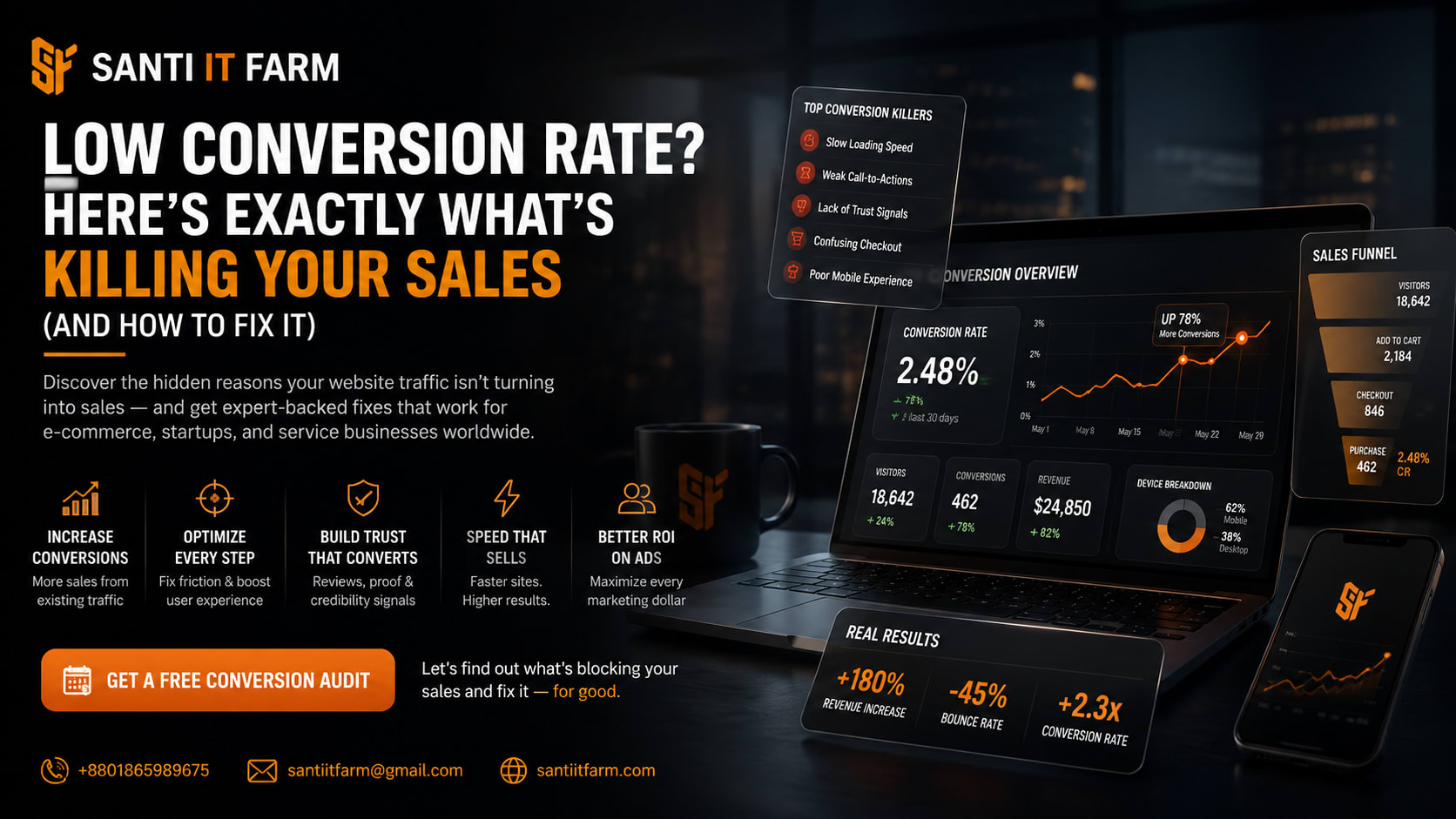
You're Getting Traffic. So Why Isn't Anyone Buying?
Here's a scenario that plays out in thousands of businesses every single day — from Dhaka to Dubai, from Toronto to Sydney. You've invested real money into ads, SEO, or social media. People are landing on your website. Sessions are up. Bounce rates look okay. And yet, at the end of the month, your sales numbers tell a completely different story.
This gap — between traffic and revenue — is one of the most frustrating problems a business owner can face. Because it's not obvious. Your marketing feels like it's working. But something, somewhere, is quietly killing your sales before they ever happen.
The average website converts at roughly 2–3% globally. That means for every 100 people who visit your site, 97 of them leave without taking any meaningful action. For most businesses, that number is even lower — and they don't even know it. The painful truth is that low conversion rates aren't usually caused by one big, obvious problem. They're caused by an accumulation of small, fixable failures — in design, messaging, trust, speed, and user experience.
This guide is for business owners, founders, and marketers who are tired of guessing. We're going to walk through every major conversion killer in plain language, explain exactly why it's costing you money, and show you what to do about it. Whether you run an e-commerce store, a service-based business, a SaaS product, or a local company trying to generate leads — this is the honest, strategic breakdown you've been looking for.
What's Killing Your Conversion Rate? (The Short Answer)
- Slow website loading speed — visitors leave before your page even loads
- Unclear or weak value proposition — visitors don't immediately understand what you do or why they should care
- Poor user experience and confusing navigation — people can't find what they need
- Weak or missing calls-to-action — visitors don't know what to do next
- Lack of trust signals — no reviews, no credentials, no social proof
- Targeting the wrong audience — paid traffic that was never going to buy
- Mobile experience is broken — over 60% of traffic is mobile, and bad mobile UX kills conversions
- Checkout friction for e-commerce — too many steps, unexpected costs, forced account creation
- Generic or unconvincing copywriting — words that don't connect with real buyer psychology
- No follow-up system — losing warm leads who needed one more nudge
Most businesses suffer from 3 to 5 of these simultaneously. The good news: each one is fixable, often without rebuilding your entire website.
What Is a Conversion Rate, and What's Actually Considered 'Good'?
Your conversion rate is the percentage of website visitors who complete a desired action — whether that's making a purchase, submitting a contact form, booking a call, signing up for a newsletter, or downloading a resource. It's calculated simply: divide the number of conversions by the total number of visitors, then multiply by 100.
A 'good' conversion rate varies dramatically by industry. E-commerce businesses typically see rates between 1–4%. Lead generation landing pages for B2B services can hit 5–15% when done well. High-ticket service businesses might convert at under 1% — but each conversion is worth thousands of dollars, so the math still works. The point isn't to chase a universal benchmark. The point is to understand your baseline and systematically improve it.
What most businesses underestimate is the compounding impact of conversion rate improvements. If you currently convert at 1% and you double that to 2%, you haven't just grown by a small amount — you've doubled your revenue from the same traffic. That's the power of CRO done right. It's not about spending more on ads. It's about making every visit count more.
For businesses operating in competitive markets — whether that's in Pakistan's growing e-commerce sector, India's booming startup ecosystem, or the cutthroat digital landscape of the US and UK — conversion rate optimization is often the single most overlooked growth lever available.
Why Your Conversion Rate Matters More Than Your Traffic Numbers
Conversion rate optimization isn't a nice-to-have for growth-focused businesses. It's the foundation that determines whether your entire digital strategy — SEO, paid ads, content, social media — actually generates a return.
What Happens When You Fix Your Conversion Rate
Revenue grows without increasing marketing budget
This is the most immediate and measurable benefit. An e-commerce store converting at 1.2% that improves to 2.5% can see revenue jump by over 100% with zero additional traffic spend. We've seen this happen for clients within 60 to 90 days of a proper CRO audit and implementation.
Customer acquisition cost drops significantly
When more of your existing traffic converts, your cost per acquired customer falls. That means more profit per sale and a healthier, more sustainable business model — especially critical for startups and SMEs operating on tighter margins.
You attract better-quality leads
Good CRO isn't just about getting more conversions — it's about getting the right conversions. When your messaging is clear and your targeting is sharp, the people who do convert are much more likely to be ready to buy, easier to close, and more loyal as customers.
Your SEO performance improves indirectly
Google pays attention to behavioral signals — dwell time, bounce rate, pages per session. A website that converts better almost always performs better on these metrics, which feeds back into improved organic rankings over time.
Business decisions become data-driven
The process of improving your conversion rate forces you to install proper analytics, run tests, and understand your audience deeply. That data doesn't just help one page — it informs your entire business strategy.
Brand trust and credibility increase
Many of the fixes that improve conversions — adding testimonials, improving design quality, clarifying your offer, speeding up your site — also make your brand look and feel more credible. Conversion optimization and brand building often happen simultaneously.
Real-World Example: Before and After a CRO Overhaul
Before
- — A Dhaka-based e-commerce brand selling premium skincare products was running consistent Facebook and Instagram ads with a monthly traffic volume of 18,000 sessions. Their average conversion rate sat at 0.8%, generating roughly 144 sales per month.
- — Their product pages had beautiful imagery but no customer reviews visible above the fold. The checkout process required account creation before purchase. Page load time on mobile was 6.4 seconds. Their CTA buttons said 'Learn More' instead of anything action-oriented. There was no urgency, no trust badges, and no clear return policy in sight.
- — Their ad spend was BDT 40,000 per month. Their revenue per month from the site was modest. They kept increasing ad spend thinking more traffic was the answer. It wasn't.
After
- After a full CRO audit, we implemented targeted changes: guest checkout was enabled, mobile load time was reduced to under 2.5 seconds through image optimization and hosting upgrades, product pages were restructured to show 5-star reviews above the fold, CTAs were rewritten to 'Add to Cart — Free Delivery Today', a trust bar was added showing secure checkout, return guarantee, and 10,000+ happy customers.
- Within 8 weeks, conversion rate climbed from 0.8% to 2.3%. Same traffic. Same ad budget. Monthly sales went from 144 to 414 — nearly tripling. Revenue increased by over 180% without spending an extra taka on advertising.
- The lesson wasn't that their ads were bad. Their ads were fine. The problem was that everything after the click was silently losing them business.
This pattern repeats across industries and markets — from SaaS startups in Bangalore to service agencies in Manchester. The traffic isn't always the problem. What happens after the click is where most businesses bleed.
How to Fix Your Conversion Rate: A Step-by-Step Action Plan
Step 1 — Audit Your Current Funnel With Real Data
- › Install Google Analytics 4 and set up conversion events if you haven't already — purchases, form submissions, call clicks, button clicks
- › Use heatmap and session recording tools like Hotjar or Microsoft Clarity to watch how real users interact with your pages
- › Identify the exact pages where users are dropping off — this tells you where to focus first
- › Check your Core Web Vitals in Google Search Console — page speed issues are often hidden killers
- › Segment your data by device type — mobile vs desktop conversion rates often tell completely different stories
Step 2 — Fix Your Page Speed and Technical Foundation
- › Compress and convert all images to WebP format — oversized images are the single most common cause of slow load times
- › Enable browser caching and use a Content Delivery Network (CDN) to serve assets faster across geographies
- › Reduce unused JavaScript and CSS — most website builders and themes load enormous amounts of code that never gets used
- › Aim for a Largest Contentful Paint (LCP) under 2.5 seconds on mobile — this is now a Google ranking factor and a direct conversion factor
- › Test your site on a real 4G mobile device, not just desktop — the experience is often shockingly different
Step 3 — Sharpen Your Value Proposition
- › A first-time visitor should understand what you do, who it's for, and why it's better within 5 seconds of landing on your page — if they have to scroll or think, you've already lost most of them
- › Rewrite your hero section headline to answer: what do you offer, for whom, and what's the outcome? Make it specific, not clever
- › Add a secondary line of supporting copy that addresses the main objection or pain point your target customer has
- › Test different value proposition angles — sometimes 'Save 3 hours a week' outperforms 'The best project management tool' even if both are true
- › Use language your customers actually use — mine reviews, testimonials, and sales call notes for the exact words real buyers use to describe their problems
Step 4 — Rebuild Trust Signals Throughout Your Site
- › Add genuine customer reviews and testimonials — video testimonials convert significantly better than text-only reviews
- › Display recognizable trust badges: secure checkout seals, money-back guarantees, payment provider logos, industry certifications
- › Show real social proof numbers where authentic — clients served, projects completed, countries reached, years in business
- › Make your 'About' page actually humanize your team — businesses that show real faces, real stories, and real expertise convert better than faceless brands
- › Ensure your contact information is easy to find — a phone number and physical address (where applicable) dramatically increase perceived credibility, especially in markets like Bangladesh, India, and Pakistan where trust in online businesses is still building
Step 5 — Optimize Your Calls-to-Action
- › Every page needs exactly one primary CTA that's visually prominent and crystal clear — if you have five equally visible buttons, visitors choose none
- › Use action-oriented, benefit-driven language: 'Start My Free Trial', 'Get My Custom Quote', 'Book a Free Strategy Call' — not 'Submit' or 'Click Here'
- › Make your primary CTA button a high-contrast color that stands out from the rest of the page design
- › Reduce the perceived risk of the CTA — phrases like 'No credit card required', 'Cancel anytime', or 'Free consultation, no obligation' dramatically reduce hesitation
- › Test the placement of your CTA — above the fold, mid-page, and end of page versions often perform differently depending on page type and audience
Step 6 — Eliminate Friction From Your Conversion Path
- › For e-commerce: enable guest checkout, show shipping costs early, reduce checkout to as few steps as possible, offer multiple payment methods including local options
- › For lead generation: reduce form fields to the absolute minimum needed — every additional field you add reduces submission rates
- › Remove distractions from landing pages — unnecessary navigation links, pop-ups, and irrelevant content pull attention away from the conversion goal
- › Address the most common objections directly on the page — if price is a concern, show the ROI or compare it to the cost of not solving the problem
- › Add live chat or a visible WhatsApp contact option — for high-consideration purchases, many buyers just need one quick question answered before they commit
Step 7 — Build a Follow-Up System for Warm Leads
- › Set up cart abandonment email sequences for e-commerce — the first email within 1 hour of abandonment recovers a significant portion of lost sales
- › Implement retargeting ads on Meta and Google for people who visited key pages but didn't convert — these audiences are far more likely to buy than cold traffic
- › Create a lead nurture email sequence for anyone who signs up or inquires — most B2B conversions happen after 5 to 8 touchpoints, not the first visit
- › Use exit-intent overlays strategically — a well-timed offer or lead magnet shown when someone is about to leave can save a meaningful percentage of otherwise lost traffic
- › Track and follow up on all inquiries within the same business day — response speed is a massive conversion factor for service businesses, especially when competing internationally
Best Tools for Diagnosing and Improving Conversion Rates
You don't need all of these at once. Start with Google Analytics 4, Microsoft Clarity (free), and Google PageSpeed Insights. These three alone will reveal more about your conversion problems than most businesses ever discover.
The Biggest Conversion Rate Mistakes Businesses Keep Making
- Assuming more traffic will solve a conversion problem — it won't. Sending more people to a broken funnel just costs you more money faster.
- Designing for yourself instead of your customer — what looks beautiful to you may be confusing or off-brand to your target audience. User testing always reveals surprises.
- Using vague, generic copywriting — phrases like 'We provide innovative solutions for modern businesses' mean nothing to a buyer who has a specific, urgent problem they need solved.
- Ignoring mobile completely — building a stunning desktop experience and neglecting mobile is a fatal mistake when 60–70% of your traffic comes from phones.
- Having too many options on a single page — decision paralysis is real. The more choices you give visitors, the less likely they are to choose any of them.
- Not having a clear return or refund policy — especially for e-commerce, the absence of a visible, simple return policy kills purchase confidence instantly.
- Running ads to your homepage — your homepage is for everyone, which means it's optimized for no one. Send paid traffic to dedicated landing pages built around specific offers.
- Neglecting page load time on shared or cheap hosting — a 5-second load time loses roughly half your mobile visitors before they've seen a single word of your content.
- Treating conversion optimization as a one-time project — CRO is a continuous process. Markets change, customer expectations evolve, and what works today may underperform in six months.
- Not following up with leads fast enough — research consistently shows that response time within the first hour of an inquiry is one of the strongest predictors of conversion in service businesses.
Frequently Asked Questions About Low Conversion Rates
Your Conversion Rate Is a Symptom — Fix the Root Causes
A low conversion rate is never just a number. It's the aggregate result of every small friction, every trust gap, every unclear message, and every missed follow-up in your entire customer journey. The businesses that grow fastest aren't necessarily the ones spending the most on marketing — they're the ones who've built systems where the traffic they already have converts predictably and profitably.
The good news is that most of the factors killing your conversions right now are entirely fixable. Page speed, trust signals, CTA clarity, checkout friction, follow-up automation — none of these require massive budgets. They require clear thinking, the right expertise, and a commitment to testing and improving continuously rather than guessing and hoping.
Whether you're running an e-commerce brand serving customers across South Asia, a service agency targeting clients in the UK or Canada, or a startup trying to break through in a competitive digital market — the principles of conversion optimization are universal. People want clarity, speed, trust, and value. Give them those things, and your numbers will change.
At Santi IT Farm, we've helped businesses across Bangladesh, India, Pakistan, the USA, the UK, Australia, and beyond diagnose exactly what's blocking their conversions — and rebuild their digital presence into a genuinely high-performing sales engine. The results speak for themselves: more leads, higher revenue, better ROI, without necessarily spending more on ads.
Ready to Turn Your Website Into a Real Revenue Machine?
Your website should be your hardest-working team member — converting visitors into leads and leads into clients every single hour of the day. If that's not happening right now, there's a specific, diagnosable reason. And we can find it.
At Santi IT Farm, our team of conversion strategists, UX designers, and SEO specialists works with businesses globally to audit, rebuild, and optimize every stage of the digital sales funnel. We don't guess — we use data, proven frameworks, and real-world experience to deliver measurable results.
- Conversion Rate Optimization (CRO) Audits
- Landing Page Design and Development
- E-commerce Funnel Optimization
- UX/UI Design for Higher Conversions
- Shopify and WordPress Development
- SEO and Content Strategy
- Marketing Automation and Lead Nurturing
- Full Digital Growth Strategy
Stop watching potential customers leave without buying. Let's fix your conversion rate and start turning your traffic into real, sustainable revenue. Book your free consultation with the Santi IT Farm team today — no pressure, no jargon, just honest advice.
Get Started

