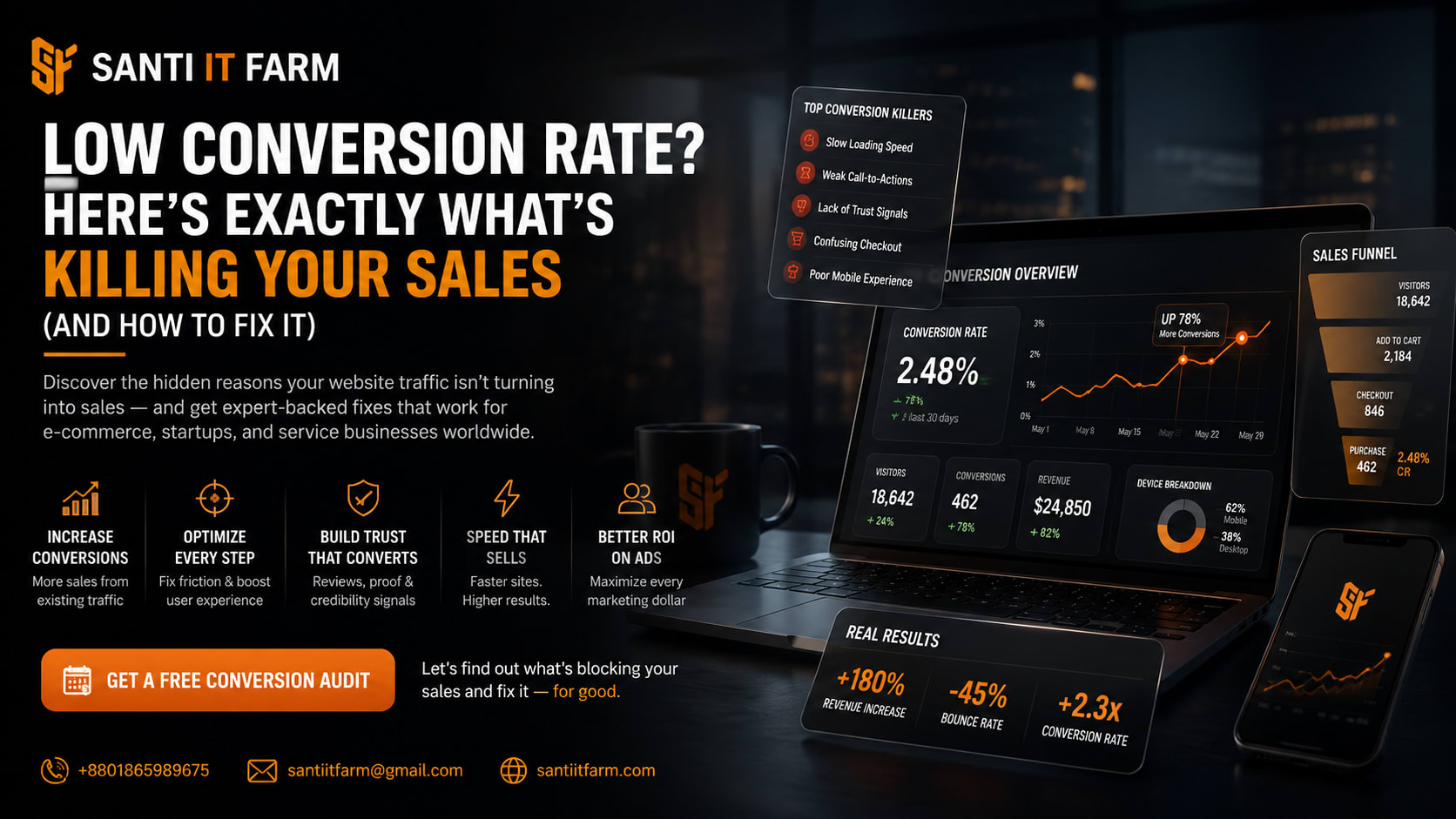
You Have Website Traffic. So Why Is Your Inbox Empty?
Here's a frustrating scenario that plays out in thousands of businesses every single day — in Dhaka, Delhi, Karachi, London, and Toronto alike: you check your analytics, and the numbers look decent. People are visiting your website. Sessions are up. Maybe you even spent real money on ads or SEO to get there. And yet, your phone isn't ringing. Your contact form is silent. Your revenue hasn't moved.
This is not a traffic problem. It's a conversion problem — and there's a critical difference between the two. Most business owners chase more traffic when the real issue is what happens after someone lands on their site. A leaky bucket doesn't need more water; it needs to stop leaking.
The hard truth is that a website that looks 'fine' to you often fails your visitors completely. It doesn't communicate clearly enough, doesn't build trust fast enough, and doesn't guide people toward taking action. Visitors leave within seconds — not because they don't need what you offer, but because your website didn't give them a compelling reason to stay.
In this guide, we're going to break down exactly why your website visitors aren't turning into clients — and give you a concrete roadmap to fix it. Whether you're a startup in Chittagong, an e-commerce brand targeting UK customers, or a service agency in Karachi trying to land international contracts, the principles here apply directly to your situation.
Why Your Website Gets Visitors But No Clients: The Short Answer
- Your value proposition isn't clear within the first 5 seconds of landing
- Your website design lacks professional credibility and trust signals
- Your calls-to-action (CTAs) are weak, buried, or entirely missing
- Your website loads too slowly and fails mobile users
- You're attracting the wrong traffic — visitors who were never going to buy
- Your content doesn't address your visitor's real fears and motivations
- There's no follow-up system — leads slip through without being captured
- Your contact or pricing process creates too much friction
Most websites suffer from at least 3–4 of these problems simultaneously. Each one alone can cut your conversions significantly. Together, they can reduce a promising business to digital invisibility.
What 'Conversion' Actually Means for a Business Website
Before we fix the problem, let's define it precisely. In the context of your business website, a 'conversion' doesn't just mean a sale. It means any meaningful action a visitor takes that moves them closer to becoming a client. That could be filling out a contact form, booking a discovery call, downloading a lead magnet, subscribing to your email list, requesting a quote, or making a direct purchase.
Your conversion rate is simply the percentage of your visitors who take that desired action. The global average website conversion rate across industries hovers around 2–3%. For well-optimized sites with strong positioning and a clear audience fit, it can reach 5–10% or higher. If your site converts at less than 1%, you have a serious problem that no amount of additional traffic will solve.
What makes this especially painful for businesses in competitive markets — whether you're a digital agency in Bangladesh targeting global clients, or a Shopify store in India selling to European customers — is that paid traffic costs money. Every visitor who leaves without converting is a small financial loss. Over hundreds of visitors a month, it becomes a significant one.
Understanding this reframes the entire conversation. You don't need to 'get more visitors.' You need to get more value from the visitors you already have. That's what conversion optimization is — and it's one of the highest-ROI investments any business can make.
Why Fixing Your Conversion Problem Matters More Than Getting More Traffic
- Doubling your conversion rate from 1% to 2% produces the same revenue impact as doubling your traffic — but at a fraction of the cost.
- In markets like South Asia and Southeast Asia, where digital ad costs are rising fast, poor conversion rates are directly eating into business profitability.
- B2B clients and corporate buyers make decisions based on perception of professionalism — a weak website immediately disqualifies you from consideration.
- For international clients in the USA, UK, Canada, and Australia, your website is your first impression. If it doesn't build trust in 5 seconds, they'll hire someone else.
- A high-converting website creates a compounding effect: better leads, better close rates, stronger client relationships, and higher lifetime customer value.
- Fixing conversion problems also improves your SEO indirectly — lower bounce rates and higher engagement signal to Google that your content is genuinely useful.
Conversion rate optimization is not a luxury. For any business that depends on its website to generate revenue — and in 2025, that's nearly every business — it's a survival strategy.
What Happens When You Fix Your Conversion Problem
Your existing traffic starts working for you
When your site is properly optimized, the same number of monthly visitors begins generating significantly more inquiries, quote requests, and sales. Businesses that fix core UX and messaging issues often see 2–4x more leads without spending a single extra dollar on ads.
You attract better-fit clients
A well-crafted website doesn't just convert more people — it converts the right people. Clear positioning, specific service descriptions, and targeted messaging naturally filter out bad-fit prospects and pull in clients who are ready to move and willing to pay your rates.
Your cost per acquisition drops dramatically
Whether you're running Google Ads, Facebook campaigns, or investing in SEO, every lead you generate now costs less because more of your traffic is converting. For agencies and e-commerce brands in Bangladesh, India, and Pakistan competing for international clients, this is a massive competitive edge.
You build a scalable lead generation machine
A high-converting website paired with a consistent traffic source becomes a predictable business asset — not a guessing game. You know roughly how many visitors you need to land a new client, and you can scale systematically.
Your brand authority grows faster
Websites that are visually sharp, load fast, communicate clearly, and prove expertise create a lasting impression. Visitors who don't convert immediately often return later or refer others. Reputation compounds — and it starts with your first impression.
You win more enterprise and international contracts
Companies in the USA, UK, Australia, and Canada often vet vendors exclusively through their websites before reaching out. A premium, conversion-optimized website makes you look like a serious player and removes the hesitation that stops global clients from clicking 'Contact Us.'
Real Business Scenario: Before and After Conversion Optimization
Before
- — A web development agency in Dhaka had a 3-year-old website with decent Google rankings for several local keywords. They were getting around 800 monthly visitors but averaging only 2–3 contact form submissions per month.
- — The homepage had a generic headline ('We Build Websites'), a large hero image with no clear CTA, and a navigation menu with 9 items including 'Blog', 'Team', 'Careers', and 'Gallery' — none of which converted visitors.
- — Their services page listed 14 different offerings in plain text with no pricing signal, no process explanation, and no proof of results. The contact page had a basic form with 8 required fields including 'Company Size' and 'Annual Revenue' — questions that made visitors uncomfortable before they'd even had a first conversation.
- — Trust signals were absent: no client logos, no testimonials, no case studies. The site loaded in 6.8 seconds on mobile. Bounce rate was 78%.
After
- After a full website redesign and conversion strategy overhaul by Santi IT Farm's team, the results shifted dramatically within 90 days.
- The homepage now opens with a sharp value proposition: 'We Help International Businesses Launch and Scale Digitally — From Strategy to Code.' A single, prominent CTA button — 'See Our Work & Get a Quote' — is visible above the fold on both desktop and mobile.
- Services were consolidated into 5 clear offerings with outcome-based descriptions, social proof micro-stats (e.g., '43 Shopify stores launched'), and a transparent starting price range that pre-qualified visitors.
- The contact form was reduced to 4 fields. Three client testimonials with photos and company names were added. Six recognizable partner logos appeared in the social proof bar. Page load time dropped to 1.9 seconds on mobile.
- Result: monthly contact form submissions went from 2–3 to 18–22 per month — a 7x improvement — with no increase in ad spend and only a 12% increase in organic traffic.
This scenario reflects a pattern we see repeatedly across markets — Bangladesh, India, Pakistan, and globally. The traffic was never the problem. The website was simply failing to do its job.
How to Fix Your Website's Conversion Problem: A Step-by-Step Framework
Step 1: Audit Your Website With Fresh Eyes (Or a Professional)
- › Use a tool like Google Analytics 4 or Hotjar to identify which pages have high traffic but high bounce rates — these are your biggest conversion leaks.
- › Ask someone outside your business to visit your site for 10 seconds and answer: 'What does this company do? Who is it for? Why should I trust them? What should I do next?' If they can't answer clearly, you have a messaging problem.
- › Check your Core Web Vitals in Google Search Console. If your Largest Contentful Paint (LCP) is above 2.5 seconds, especially on mobile, you're losing a significant percentage of visitors before they even read a word.
- › Review your contact form submissions vs. traffic volume to calculate your actual conversion rate. Benchmarking this number is the first step to improving it.
Step 2: Fix Your Value Proposition and Headline
- › Your homepage headline is your single most important piece of copy. It must answer: what you do, who you do it for, and what outcome you deliver — in under 10 words if possible.
- › Avoid vague, ego-driven headlines like 'We Are Passionate About Digital Excellence.' Instead, try: 'Custom Shopify Stores That Convert International Buyers' or 'SEO Services That Bring You Clients, Not Just Clicks.'
- › Place your strongest value statement above the fold — visible without scrolling on both desktop and mobile. Your visitor decides whether to stay or leave in the first 3–5 seconds. Win that moment.
- › Test your headline with real users. A simple LinkedIn poll, a message to 10 past clients, or a brief user-testing session can tell you whether your messaging lands the way you intend it to.
Step 3: Rebuild Your CTAs With Intent and Urgency
- › Every page of your website should have one clear, dominant call-to-action that guides the visitor toward the next step. Not three. Not zero. One primary CTA per page.
- › Use action-oriented, benefit-driven button text. 'Get a Free Website Audit' outperforms 'Contact Us' by a significant margin because it offers something specific and valuable.
- › Place your CTA above the fold on every important page, repeat it at the bottom of long content, and consider a sticky header CTA for desktop visitors on service pages.
- › For service businesses targeting international clients — particularly those in the UK, USA, or Canada — adding a 'Book a Free Call' option with a simple calendar embed (like Calendly) can increase conversions significantly by removing the friction of back-and-forth emails.
Step 4: Add Real Trust Signals Throughout Your Site
- › Trust is earned in milliseconds online. Client logos, testimonials, case study results, team photos, and partner badges all reduce the psychological risk a visitor feels when considering hiring you.
- › Video testimonials perform exceptionally well for service businesses — even a 30-second clip from a satisfied client explaining their results is more convincing than three paragraphs of written text.
- › Display specific, results-oriented case studies rather than generic portfolio items. '43% increase in organic traffic for a Karachi-based e-commerce brand in 90 days' is infinitely more persuasive than 'E-commerce SEO project.'
- › For agencies and freelancers in South Asia targeting Western markets, trust signals are especially critical. Clients in the USA and UK often carry biases about offshore providers that can only be overcome with demonstrated expertise and visible social proof.
Step 5: Optimize Your Website Speed and Mobile Experience
- › Use Google PageSpeed Insights to benchmark your mobile performance. Anything below a score of 70 on mobile is costing you conversions. Under 50 is a critical emergency.
- › Compress and properly format all images — WebP format typically reduces image size by 25–35% compared to JPEG without visible quality loss. Lazy loading images below the fold is a quick win.
- › Remove unnecessary scripts, plugins, and third-party tracking tools that are slowing your page load. Every additional second of load time reduces conversions by an estimated 4.42% on average.
- › Test your website on actual Android and iOS devices across multiple screen sizes. Many businesses in Bangladesh and India lose significant mobile traffic because their websites were designed only on desktop without mobile-first consideration.
Step 6: Align Your Traffic Sources With Your Target Client Profile
- › If you're getting 2,000 visitors a month but zero clients, ask: who exactly are these visitors? Use Google Analytics 4 to review the countries, devices, age groups, and channels they're coming from.
- › Traffic from irrelevant keywords, wrong geographies, or the wrong audience profile will never convert — no matter how good your website is. Your SEO strategy must target buyer-intent keywords, not just high-volume informational terms.
- › For example, if you offer Shopify development services and your top-traffic keyword is 'what is Shopify,' you're attracting researchers, not buyers. Pivot toward 'hire Shopify developer for e-commerce store' or 'Shopify development agency for fashion brands.'
- › Paid ads must target specific audience segments — job title, industry, geography, and purchase behavior — rather than broad demographic buckets. Every dollar of ad spend should be working toward reaching people who are genuinely ready to buy.
Step 7: Build a Lead Capture and Follow-Up System
- › Most first-time website visitors are not ready to buy immediately. They're researching, comparing, and building confidence. If you have no way to capture their contact details during this phase, you lose them forever.
- › Offer a valuable lead magnet — a free audit, a PDF guide, a checklist, or a short video — in exchange for an email address. This lets you begin nurturing the relationship before they're ready to commit.
- › Set up an automated email sequence that delivers value over 5–7 touchpoints before making a commercial ask. A visitor who downloads your free 'E-commerce SEO Checklist' and receives 5 genuinely useful follow-up emails is significantly more likely to become a client than one who visits once and leaves.
- › Use a CRM (even a simple free tool like HubSpot CRM) to track leads, follow up systematically, and ensure no potential client falls through the cracks because of a busy week.
Essential Tools to Diagnose and Fix Your Website's Conversion Problems
You don't need all of these tools at once. Start with Google Analytics 4, Hotjar, and Google PageSpeed Insights — these three will reveal 80% of your conversion problems and tell you exactly where to focus first.
7 Critical Mistakes That Kill Website Conversions (Even on 'Good' Websites)
- Using jargon-heavy or vague copy that speaks to your industry instead of your client's problems — visitors don't care what you call your process; they care whether you can solve their problem.
- Designing for aesthetics over clarity — a beautiful website that confuses visitors converts far worse than a simple website that communicates perfectly. Design should serve the message, not compete with it.
- Hiding your contact information or making it hard to find — if a motivated visitor can't quickly locate how to reach you, they will leave and hire the competitor who made it effortless.
- Sending paid traffic to your homepage instead of dedicated, conversion-optimized landing pages — homepage conversion rates average 2–3%, while targeted landing pages regularly achieve 5–15%.
- Asking for too much information too soon — every additional form field reduces submission rates. Ask only for what you absolutely need to start the conversation.
- Neglecting your 'About' page — this is consistently one of the highest-traffic pages on service business websites, and one of the most underoptimized. Your About page should build trust and lead to a conversion, not just tell your story.
- Ignoring returning visitors — many businesses focus all their optimization energy on first-time visitors, but returning visitors often have higher purchase intent. Retargeting ads, personalized content, and loyalty-oriented CTAs can unlock significant conversion value from this audience.
Frequently Asked Questions: Website Visitors With No Conversions
Traffic Is a Starting Point. Conversion Is the Finish Line.
Getting people to your website is only half the battle — and in 2025, it's arguably the easier half. The real work is what happens when they arrive. Your website needs to communicate value instantly, build trust quickly, guide visitors toward clear next steps, and capture leads that don't convert immediately.
The businesses that win in competitive digital markets — whether they're e-commerce brands in Dhaka competing globally, service agencies in Lahore pitching UK clients, or SaaS startups in Mumbai targeting North American enterprise buyers — are the ones that treat their website as a serious business asset, not a digital brochure.
Every section of your website should serve a purpose. Every word of your copy should earn its place. Every CTA should be tested and optimized. Every trust signal should reduce a real objection. This is the mindset shift that separates websites that generate consistent, predictable revenue from websites that generate traffic reports nobody profits from.
The good news? Most of the problems we've described in this article are fixable. And fixing them doesn't require reinventing your business — it requires applying strategic thinking and expert execution to the digital presence you already have. Start with a honest audit, fix the highest-impact issues first, and measure everything.
Ready to Turn Your Website Into a Client-Generating Machine?
At Santi IT Farm, we specialize in helping businesses exactly like yours — ones with real potential that their current website is failing to communicate. We've worked with small businesses, startups, e-commerce brands, and international agencies across Bangladesh, India, Pakistan, the USA, UK, Canada, and Australia to transform underperforming websites into consistent lead generation systems.
We don't just build websites. We build conversion-optimized, SEO-structured, strategically crafted digital presences that attract the right clients and persuade them to reach out. From website development and UI/UX design to SEO, branding, and business automation — we have the full-stack capability to fix every layer of your conversion problem.
Whether you need a complete website rebuild, a targeted conversion audit, or a strategic digital marketing partnership, we're ready to have an honest conversation about where you are and where you need to be.
- Website Development & Redesign
- Conversion Rate Optimization (CRO)
- SEO Services
- UI/UX Design
- E-commerce Development (Shopify & WooCommerce)
- Digital Marketing & Lead Generation
- Branding & Messaging Strategy
- Business Automation & AI-Powered Systems
Your competitors are winning clients that should be yours. Let's fix that — starting today. Book your free consultation with Santi IT Farm at https://santiitfarm.com/contact
Get Started