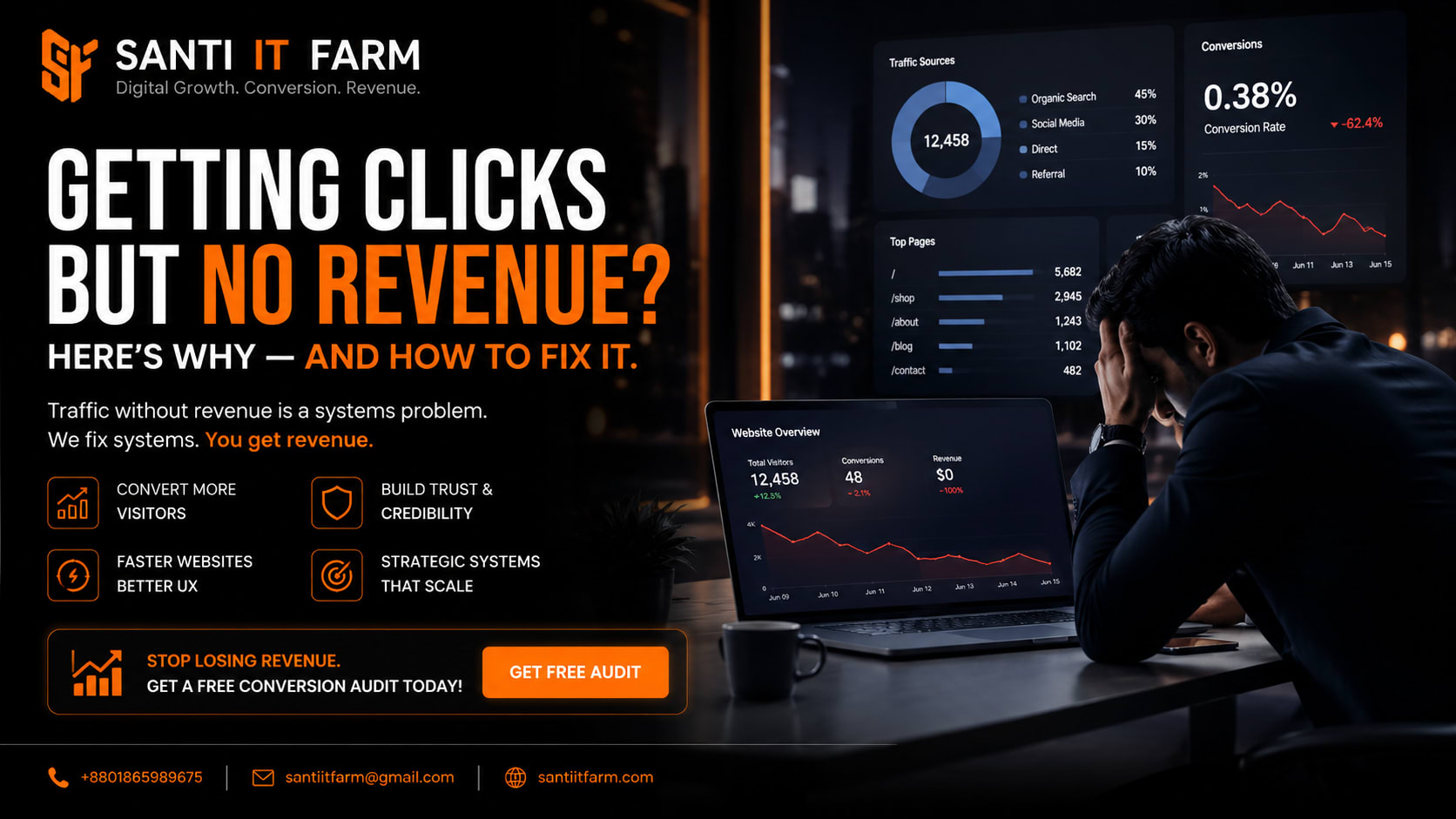
Your Analytics Look Great. Your Bank Account Doesn't. Here's Why.
You launched the website. You ran ads. You posted consistently on social media. Google Analytics shows hundreds — maybe thousands — of visitors coming through every week. But when you check your sales dashboard, the numbers tell a completely different story. Revenue is flat. Leads are near zero. And you're starting to wonder whether digital marketing actually works, or if you've been sold a dream.
Here's the uncomfortable truth: traffic without conversion is just expensive noise. And the gap between 'getting clicks' and 'making money' is where most online businesses quietly bleed out. The problem isn't that people aren't interested. The problem is that somewhere between the click and the checkout — or the click and the contact form — something is breaking down.
This breakdown is rarely obvious. It hides in your page load time, your call-to-action copy, your checkout flow, your trust signals, or the fundamental mismatch between who you're attracting and who actually buys. At Santi IT Farm, we've audited hundreds of business websites across Bangladesh, India, Pakistan, the USA, the UK, and beyond — and the patterns are strikingly consistent. In this guide, we're going to walk you through every major reason your online business gets clicks but no revenue, and give you a clear, actionable path to fix it.
Quick Answer: Why Does Your Website Get Traffic But No Sales?
- Your traffic is misaligned — you're attracting the wrong audience who were never going to buy
- Your website loads too slowly, causing visitors to leave before they engage
- Your value proposition is weak or unclear — visitors don't understand why they should choose you
- You lack trust signals like reviews, case studies, credentials, or security badges
- Your call-to-action is buried, vague, or missing entirely
- Your checkout or contact process has too much friction
- You're not following up with warm visitors through retargeting or email sequences
- Your mobile experience is broken or frustrating
- Your pricing page is confusing or doesn't address objections
- Your landing pages aren't designed to convert — they're designed to inform
Most businesses suffer from three to five of these simultaneously. Fixing one helps — fixing all of them transforms your revenue trajectory.
What 'Clicks Without Revenue' Actually Means for Your Business
In digital marketing, the conversion rate is the percentage of visitors who complete a desired action — a purchase, a sign-up, a form submission, a phone call. The global average e-commerce conversion rate sits between 1% and 4%, depending on your industry. B2B websites typically convert between 2% and 5% of visitors into leads. If your numbers are significantly below these benchmarks, you don't have a traffic problem. You have a conversion problem.
The distinction matters enormously because it changes the solution. A traffic problem means you need more visitors. A conversion problem means you need to work harder on the visitors you already have. Pouring more ad budget into a broken funnel is like filling a bucket with holes — it feels like progress, but the water never stays.
A conversion problem also tends to be a compounding loss. Every visitor who arrives and leaves without converting represents real money spent on acquisition — through ads, SEO effort, social media time, or content creation — that delivered zero return. When you multiply that cost-per-visitor by the thousands of monthly sessions that convert to nothing, the financial leak becomes staggering. The good news is that fixing conversion issues typically costs a fraction of what you're spending on traffic acquisition, and the returns are immediate.
Why Fixing Your Conversion Gap Is the Highest-ROI Move You Can Make Right Now
- Doubling your conversion rate from 1% to 2% effectively doubles your revenue — without spending a single extra dollar on ads or SEO.
- Every improvement to your conversion rate makes your ad spend more profitable, compounding the returns across all your traffic channels simultaneously.
- A well-converting website builds defensible competitive advantage — competitors can copy your ads, but they can't easily replicate your trust, UX, and messaging system.
- Better conversion data reveals what your customers actually value, making your product development, content strategy, and marketing far more precise.
- Solving conversion issues often reveals deeper business insights — about your ideal customer, your strongest offer, and your most powerful differentiators.
- For businesses in high-growth markets like Bangladesh, India, and Pakistan, where digital competition is intensifying rapidly, strong conversion infrastructure is quickly becoming a prerequisite for survival.
Traffic is rented attention. Conversion is owned revenue. The businesses that win long-term are the ones who build systems that reliably turn attention into action — not just once, but consistently and at scale.
What Changes When You Solve Your Conversion Problem
Revenue grows without proportionally increasing ad spend
When your conversion rate improves, every rupee, taka, or dollar you spend on traffic acquisition goes further. A Dhaka-based e-commerce brand we worked with increased their conversion rate by 2.3% and saw monthly revenue jump by 68% — with the same ad budget they'd been running for six months with flat results.
Customer acquisition cost drops significantly
Your CAC (customer acquisition cost) is directly tied to how efficiently you convert traffic. Better conversion means you're paying less per customer acquired, which dramatically improves your unit economics and makes growth more sustainable.
Your sales team (or yourself) closes deals faster
When your website does its job — educating, building trust, and pre-qualifying prospects — the leads who do reach out are warmer, more informed, and far easier to close. You spend less time explaining yourself and more time serving people who already believe in your value.
You gain clear data about what actually drives buying decisions
Conversion optimization is as much a research process as a design process. When you run structured tests and measure results, you accumulate real intelligence about your customer — what language resonates, what objections they have, what motivates action. This intelligence then flows into every other part of your business.
Your brand reputation strengthens organically
A website that converts well typically has strong trust signals, clear messaging, and an excellent user experience. These qualities don't just improve conversion — they create memorable brand experiences that generate referrals, positive reviews, and repeat business.
You break the feast-or-famine revenue cycle
Many small businesses and startups experience erratic revenue — good months followed by dry months — largely because their conversion systems are inconsistent. Building a reliable conversion engine creates revenue predictability, which makes planning, hiring, and growth possible.
Real-World Example: A Pakistani Clothing Brand That Turned 12,000 Monthly Visitors Into Revenue
Before
- — A ready-to-wear clothing brand based in Lahore was running consistent Facebook and Instagram ads, generating around 12,000 website visits per month with an ad spend of approximately PKR 180,000.
- — Their conversion rate was 0.4% — well below industry average — meaning only 48 people per month were making purchases.
- — Their average order value was PKR 2,800, giving them monthly e-commerce revenue of roughly PKR 134,400 — barely covering their ad spend.
- — The site looked visually decent but had a 7.2 second mobile load time, no customer reviews displayed on product pages, a six-step checkout process, and product descriptions that were copy-pasted from supplier catalogs.
- — When asked what made their brand different, their website gave no clear answer.
After
- After a structured conversion audit and rebuild, mobile load time dropped to under 2.5 seconds through image optimization and hosting improvements.
- Product pages were rewritten with customer-centric language, size guides, styling tips, and authentic user-generated photos from real buyers.
- A two-step checkout replaced the six-step process, with trust badges, a money-back guarantee, and local payment options prominently displayed.
- An exit-intent popup offered a 10% discount in exchange for an email address, feeding into a five-email welcome sequence that converted at 6.8%.
- Within 90 days, conversion rate climbed to 2.1%, monthly orders jumped to 252, and revenue exceeded PKR 705,600 — a 5.2x improvement on the same traffic volume.
The ad budget didn't change. The audience didn't change. What changed was the system that received that traffic and converted it into revenue. This is the power of treating conversion as a discipline, not an afterthought.
How to Fix Your Conversion Problem: A Step-by-Step Framework
Step 1 — Run a Traffic Quality Audit
- › Open Google Analytics (or GA4) and segment your traffic by source. Which channels bring visitors who spend more than 60 seconds on the site? Which bring visitors who bounce in under 10 seconds?
- › Check the demographics and interests data. Are the people visiting your site actually matching your target customer profile? Traffic from the wrong audience will never convert, regardless of how good your site is.
- › Review your top landing pages by traffic volume versus conversion rate. If a high-traffic page converts at near zero, that's your most urgent priority.
- › Look at search queries driving organic traffic via Google Search Console. Are visitors finding you through keywords that match buyer intent — or purely informational searches from people who'll never purchase?
Step 2 — Fix Your Page Speed (Non-Negotiable)
- › Run your website through Google PageSpeed Insights and GTmetrix. Mobile speed is the critical metric — over 60% of global web traffic is now mobile, and users in markets like Bangladesh, India, and Pakistan frequently access sites on mobile data connections.
- › Compress all images using WebP format. Unoptimized images are the single most common cause of slow load times on small business websites.
- › Eliminate render-blocking JavaScript and CSS. Ask your developer or use tools like WP Rocket (WordPress) or Shopify's built-in speed features to defer non-critical scripts.
- › Upgrade your hosting if necessary. Shared hosting plans from budget providers routinely cause 3-6 second delays that kill conversion before a visitor has even read a word of your content.
- › Aim for a Largest Contentful Paint (LCP) under 2.5 seconds on mobile. This is Google's benchmark for a 'good' user experience and directly correlates with conversion rate improvements.
Step 3 — Clarify Your Value Proposition
- › The most important text on your website is the headline on your homepage or primary landing page. It has approximately three seconds to communicate what you do, who you do it for, and why someone should care. Most business websites fail this test completely.
- › Your value proposition should answer four questions: What do you offer? Who is it for? What specific problem does it solve? Why should I choose you over alternatives?
- › Avoid vague language like 'premium quality,' 'best in class,' or 'comprehensive solutions.' These phrases mean nothing to a skeptical visitor. Replace them with specific, concrete claims: 'Hand-stitched leather bags delivered across Bangladesh in 48 hours' is infinitely stronger than 'Premium quality bags for every occasion.'
- › Run your headline through a simple test: would a first-time visitor understand exactly what you sell and who you serve in three seconds or less? If the honest answer is no, rewrite it.
Step 4 — Build Trust Systematically
- › Trust is not built with one element — it's built through a system of overlapping signals that together reduce the perceived risk of buying from you. Identify how many of these you currently have in place.
- › Customer reviews and testimonials are non-negotiable for any business selling online. Video testimonials are the most powerful format. Text testimonials with full names and photos are a strong second. Star ratings on product pages directly lift conversion rates — industry data consistently shows 15-25% increases.
- › Display trust badges relevant to your business: SSL certificate indicators, payment security logos (Visa, Mastercard, bKash, PayPal), money-back guarantees, satisfaction guarantees, and secure checkout indicators.
- › Show your face and your team. Businesses with a genuine 'About Us' page featuring real people consistently outperform faceless brand websites. This is especially powerful for service businesses in South Asian markets where personal trust drives buying decisions.
- › Case studies and portfolio work are trust multipliers for agencies, freelancers, and B2B service providers. A detailed case study showing before-and-after results for a real client is worth ten times any generic service description.
Step 5 — Optimize Your Calls-to-Action
- › Every page on your website should have one primary action you want visitors to take. Not two. Not five. One. If a visitor can't immediately answer 'what am I supposed to do next,' your CTA strategy is broken.
- › Use action-oriented, benefit-driven language. 'Get My Free Audit' outperforms 'Submit.' 'Start Growing My Sales' outperforms 'Contact Us.' 'Claim My Discount' outperforms 'Sign Up.' Test the specific language relentlessly.
- › Make your CTAs visually dominant. They should stand out from the surrounding content through color contrast, size, and white space. If your CTA button blends into your design, it will be missed by the majority of visitors.
- › Place CTAs strategically: above the fold on key pages, at the end of each major content section, and in the navigation for service or product businesses. Don't make people scroll to the footer to find out how to buy from you.
Step 6 — Reduce Friction in Your Conversion Process
- › Every field you add to a form, every page a user must click through, every piece of information they're asked to provide is friction. Friction kills conversion. Your job is to make the path to purchase or contact as smooth and as short as possible.
- › For e-commerce: enable guest checkout, pre-fill fields where possible, offer multiple payment options including local methods (bKash, Nagad, Paytm, UPI, EasyPaisa depending on your market), and display shipping costs early rather than revealing them at the final checkout step.
- › For service businesses: replace complex multi-field contact forms with a simple three-field inquiry form — name, email, and one qualifying question about their project. Follow up by phone or Zoom within the same business day.
- › For lead generation: offer a meaningful lead magnet that solves a specific problem your target customer has. A generic 'newsletter signup' converts at a fraction of the rate of a specific free resource — a checklist, a template, a mini-course, or a video training.
Step 7 — Implement a Follow-Up and Retargeting System
- › The harsh reality is that most first-time visitors to any website will not convert. The global average is that 96-98% of website visitors leave without taking action. The difference between successful businesses and struggling ones is often simply whether they have a system to re-engage those visitors.
- › Install the Facebook Pixel and Google Ads tag on your website immediately if you haven't already. These allow you to run retargeting campaigns to visitors who have already shown interest — at a far lower cost-per-click and far higher conversion rate than cold traffic campaigns.
- › Build an email capture and follow-up sequence for any visitor who opts in. A well-designed welcome sequence of five to seven emails sent over two weeks can convert 5-15% of your email list into paying customers — from people who visited your site and left without buying.
- › Use abandoned cart email sequences for e-commerce businesses. Globally, over 70% of shopping carts are abandoned before checkout. A three-email abandoned cart sequence (sent at one hour, 24 hours, and 72 hours after abandonment) typically recovers 5-15% of those lost sales.
Tools That Help You Identify and Fix Your Conversion Problems
You don't need all of these at once. Start with Google Analytics 4, Hotjar, and your email marketing platform. These three tools alone will reveal more about your conversion problem than most businesses discover in years of guesswork.
The Most Expensive Mistakes Businesses Make When They Have Traffic But No Sales
- Spending more on ads before fixing the conversion problem — This is the most common and most costly mistake. More traffic into a broken funnel accelerates your losses, not your revenue.
- Redesigning the entire website based on aesthetics instead of data — A pretty website is not the same as a converting website. Many businesses invest in expensive redesigns that make things look better but perform worse because the new design wasn't informed by actual user behavior data.
- Ignoring mobile users — If your mobile experience is poor and over 60% of your traffic is mobile (which is true for most businesses in Bangladesh, India, and Pakistan), you're functionally ignoring the majority of your potential customers.
- Treating all traffic sources the same — A visitor from a Google search for 'buy custom logo design' is in a completely different mindset than someone who clicked a general interest article from Facebook. Using the same landing page for both dramatically reduces your conversion potential.
- Making it hard to contact you or buy from you — Hidden phone numbers, complex forms, no live chat, no WhatsApp button, checkout processes that require account creation — each of these adds friction that costs you sales every single day.
- Not having a clear return or refund policy — For e-commerce businesses especially, the absence of a clear, fair return policy is a silent conversion killer. Customers who aren't sure what happens if something goes wrong will choose not to risk it.
- Lacking consistent follow-up after initial interest — Most businesses get an inquiry and respond within 24-48 hours. Top-performing businesses respond within the hour. The speed and quality of your follow-up has a massive impact on your close rate.
- Publishing generic content that attracts browsers instead of buyers — A blog that only attracts top-of-funnel 'how does this work' readers will never generate direct revenue. Your content strategy needs to include bottom-of-funnel content that addresses the specific questions buyers ask right before making a decision.
Frequently Asked Questions About Traffic Without Conversions
Traffic Is Just the Beginning — Revenue Is the Real Goal
If you've been watching your traffic numbers grow while your revenue stays flat, you now know what's actually happening — and more importantly, what to do about it. The gap between clicks and customers is a systems problem, and systems problems have systems solutions. They respond to structured auditing, deliberate improvement, and consistent testing.
The businesses we see win consistently online — whether they're e-commerce brands in Dhaka, service agencies in Karachi, SaaS startups in Bangalore, or professional firms in London — all share a common trait. They treat their website as a revenue asset, not just a digital brochure. They measure what matters, test what they build, and optimize relentlessly based on what the data tells them about their actual customers.
You don't need a perfect website. You need a website that converts better than it does today, and then keeps improving. Start with the audit. Fix the speed. Sharpen the messaging. Build the trust. Reduce the friction. Follow up with the visitors who showed interest but didn't act. These are not complicated ideas — but executing them with precision and consistency is what separates growing businesses from stagnant ones.
If you're ready to stop guessing and start growing, the team at Santi IT Farm is built for exactly this work. We combine technical excellence, conversion strategy, and digital marketing expertise to build online business engines that don't just attract clicks — they generate consistent, scalable revenue.
Ready to Turn Your Traffic Into Revenue? Let's Build Your Conversion System.
Your business is already investing in traffic. The next step is making sure that traffic has somewhere worthwhile to go — a website experience that converts curiosity into customers and clicks into revenue.
At Santi IT Farm, we work with startups, e-commerce brands, professional service firms, and international businesses to diagnose conversion problems and build the digital infrastructure that fixes them. From full website development and Shopify optimization to conversion-focused SEO, UI/UX redesign, and marketing automation — we bring every piece of the revenue puzzle together under one roof.
- Conversion-Focused Website Development
- Shopify & E-commerce Optimization
- WordPress Development & Redesign
- SEO Strategy & Content Optimization
- UI/UX Design for Conversion
- Digital Marketing & Paid Advertising
- Business Automation & AI-Powered Systems
- Branding & Messaging Strategy
Whether you're based in Bangladesh, India, Pakistan, the USA, the UK, Canada, or Australia — if your online business is getting clicks but not revenue, this is the conversation that changes that. Reach out to us at Santi IT Farm today, and let's build something that actually works.
Get Started

