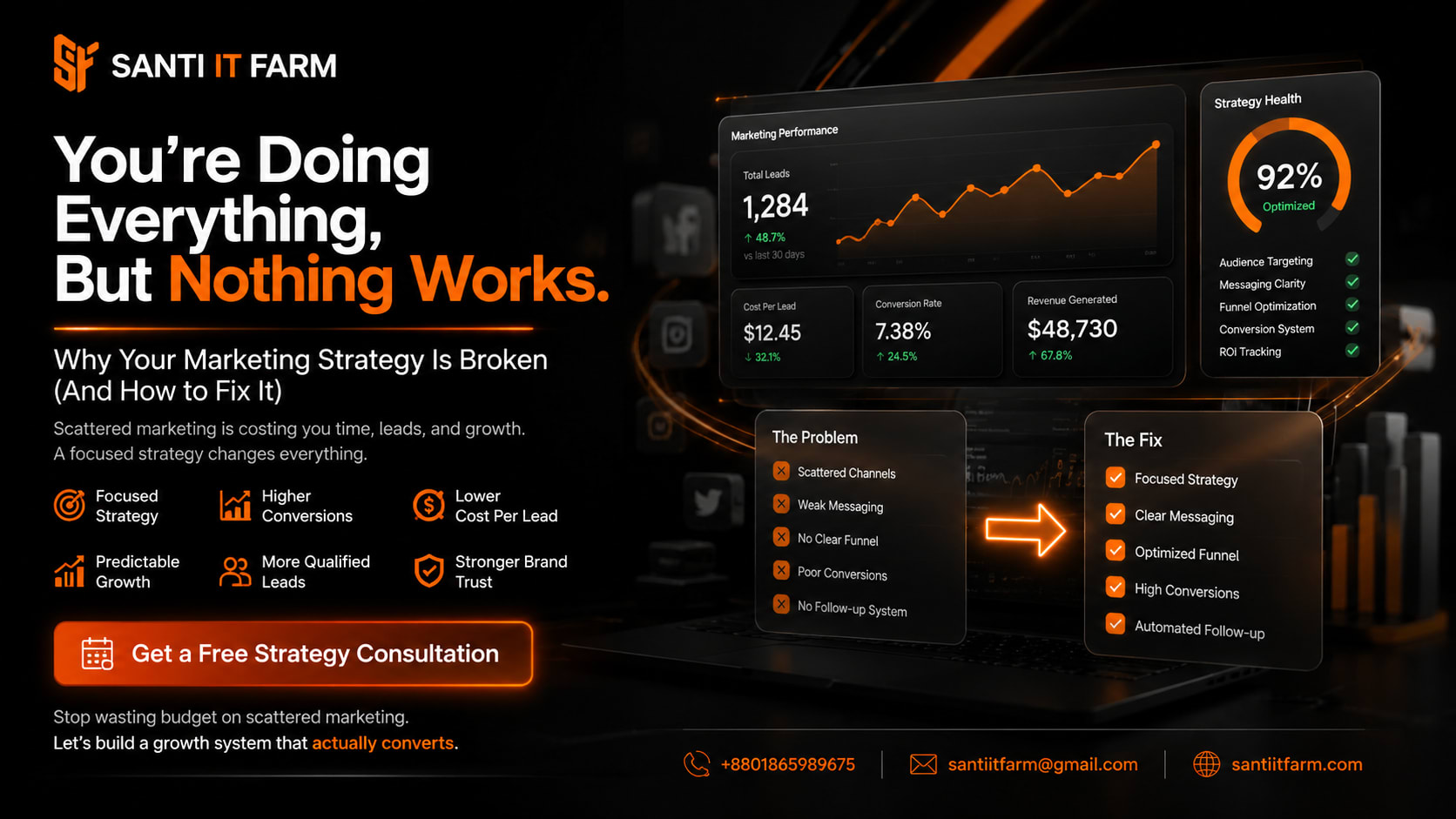
Your Business Deserves to Grow — So Why Isn't It?
You've built something real. You have a product or service people genuinely need. You're putting in long hours. Maybe you've even spent money on ads, a website, or a social media presence. And yet — growth is slower than it should be. Revenue plateaus. Leads dry up. You're busy, but not progressing.
Here's what most business owners do at this point: they assume the market is tough, the competition is too strong, or they just need more budget. They throw money at a new campaign, redesign their website again, or try yet another social media platform.
But none of that works — because it's treating symptoms, not the disease.
After working with hundreds of businesses across South Asia, the UK, the US, and beyond, we've seen the same pattern over and over: slow business growth is almost never about the product. It's almost always about a broken or missing strategy. And until that's fixed, no amount of ad spend or content creation will move the needle in a meaningful, sustained way.
This post is going to show you exactly what's going wrong — and more importantly, what to do about it.
Why Is My Business Growing Slowly? (Quick Answer)
- No clear ideal customer profile — you're marketing to everyone, converting no one
- Inconsistent or absent brand positioning — customers can't tell why they should choose you
- Weak or non-existent online presence — prospects can't find you when they're ready to buy
- Disconnected marketing channels — your website, social, and ads don't work together
- No conversion-focused strategy — you drive traffic but fail to turn visitors into paying customers
- Ignoring data and feedback — decisions are made on assumptions, not evidence
- Lack of trust-building content — your market doesn't feel confident enough to buy from you yet
If even two or three of these apply to your business right now, you're likely leaving significant revenue on the table every single month.
What 'Slow Business Growth' Really Means (And Why It's a Strategy Signal)
Slow business growth doesn't mean your business is failing. It means there's a gap between your potential and your current performance. That gap almost always has a root cause — and that cause is strategic, not circumstantial.
Think of your business like a pipeline. You need awareness at the top (people discovering you), engagement in the middle (people trusting you), and conversion at the bottom (people paying you). If any part of that pipeline is broken, cracked, or simply doesn't exist, growth stalls.
Many businesses in Bangladesh, India, Pakistan, and across global markets are sitting on incredible products and services — but their growth pipeline is either poorly built or completely disconnected. A great Shopify store with no SEO strategy. A service business with no clear brand message. A startup spending on Google Ads without a proper landing page. These aren't budget problems. They're strategy problems.
The moment you start treating slow growth as a signal to audit your strategy — rather than a reason to panic or spend more randomly — is the moment real progress becomes possible.
Why Fixing Your Growth Strategy Matters More Than Any Single Tactic
- A clear strategy multiplies the return on every marketing tactic you use — ads, SEO, social media, content all perform better when they serve a unified goal
- Without strategy, even a big budget gets wasted fast — the businesses that scale sustainably do so because their strategy compounds over time, not because they outspend competitors
- Strategy builds a defensible market position — once you're known for something specific and valuable, you stop competing on price and start competing on value
- A growth strategy aligned with your audience's actual behavior dramatically reduces customer acquisition cost over time
- Businesses with documented strategies are significantly more likely to hit their revenue goals — clarity drives execution, and execution drives results
- In competitive markets — whether you're running an e-commerce store in Dhaka, a SaaS startup in Karachi, or a consultancy in London — strategic clarity is the single biggest differentiator between businesses that grow and those that plateau
Strategy isn't a luxury for big companies. It's the foundation that makes everything else — your website, your ads, your content, your outreach — actually work. Without it, you're building on sand.
What Happens When You Actually Fix the Root Problem
You Start Attracting the Right Customers
When your positioning is clear and your messaging speaks directly to a defined audience, the leads that come in are better quality — people who actually need what you offer, are more likely to buy, and are more likely to stick around. You stop chasing and start attracting.
Your Marketing Budget Works Harder
Every dollar, taka, or rupee you spend on marketing goes further when it's backed by strategy. Instead of guessing which channel to try next, you know where your audience is, what they respond to, and how to reach them efficiently. That means lower acquisition costs and higher ROI.
Your Website Becomes a Lead Machine
A strategically built, SEO-optimized website doesn't just look good — it works around the clock to bring in qualified traffic and convert visitors into inquiries. For businesses in Bangladesh and across South Asia competing globally, this is often the single biggest untapped growth lever.
Your Brand Commands Trust and Premium Pricing
A strong, consistent brand identity signals professionalism and credibility. Customers are willing to pay more — and refer more — when they trust the brand they're buying from. Strategic branding removes price as the primary decision factor.
Growth Becomes Predictable and Scalable
Random acts of marketing create random results. A connected strategy — where your SEO feeds your content, your content builds trust, and your ads retarget warm audiences — creates compounding, predictable growth. This is how businesses go from stuck to scaling.
You Stop Losing to Competitors Who Aren't Better — Just More Strategic
Many businesses lose market share not because a competitor has a better product, but because that competitor has better positioning, better visibility, and a clearer message. Fixing your strategy levels the playing field immediately — and often flips it in your favor.
Real-World Example: From Stagnant to Scaling
Before
- — A garments accessories supplier based in Bangladesh had been in business for 8 years with steady but frustratingly flat revenue. They had a basic website, posted inconsistently on Facebook, and relied almost entirely on word-of-mouth referrals from existing clients.
- — When new orders slowed down, they assumed it was a market issue. In reality, they had no Google presence whatsoever, their website had no clear service messaging, and potential international buyers couldn't find them or trust them when they did stumble across the site.
- — They were invisible to the exact buyers they wanted to reach.
After
- After a full digital growth audit, the strategy shifted: a professionally redesigned website built with clear international buyer messaging, a targeted SEO campaign focused on high-intent global search terms, a LinkedIn content strategy positioning them as an industry authority, and a streamlined contact-to-quote conversion process.
- Within six months, organic search traffic increased by 340%. International buyer inquiries more than doubled. Three new long-term contracts were signed with overseas buyers who found them through Google.
- Nothing about their product changed. Everything about their strategy did.
This pattern repeats across industries — from e-commerce stores in Karachi to service agencies in the UK. The product is rarely the problem. The strategy almost always is.
How to Fix Your Business Growth Strategy: A Practical Step-by-Step
Step 1: Diagnose Before You Prescribe
- › Before changing anything, audit what you have — website performance, traffic sources, conversion rates, brand consistency, and customer acquisition data
- › Identify where your pipeline is leaking: is it awareness, trust, or conversion that's broken?
- › Use tools like Google Analytics 4, Google Search Console, and heat mapping tools to understand real user behavior — not assumptions
- › Talk to your best existing customers — find out how they found you, why they chose you, and what almost stopped them. That data is gold.
Step 2: Define Your Ideal Customer Profile with Precision
- › Go beyond demographics — understand the psychographics, business challenges, search behavior, and buying triggers of your ideal customer
- › Build a specific customer persona: what industry are they in, what problem are they urgently trying to solve, where do they spend time online, and what language do they use when describing their need?
- › If you serve both local and international markets, build separate personas — a Dhaka-based retail client has different triggers than a London-based e-commerce brand
- › This precision is what makes messaging resonate instead of just reaching
Step 3: Clarify and Sharpen Your Brand Positioning
- › Answer this honestly: if a potential customer lands on your website right now, can they understand in 5 seconds who you help, what you do, and why you're different?
- › Define your unique value proposition — not vague claims like 'quality service' but specific, evidence-backed differentiators
- › Ensure your positioning is consistent across your website, social profiles, proposals, and all marketing materials
- › Strong positioning eliminates price objections and increases conversion rates dramatically
Step 4: Build a Connected Digital Presence That Works 24/7
- › Invest in a professionally designed, conversion-optimized website — not just visually appealing, but strategically structured to guide visitors toward a specific action
- › Implement on-page and technical SEO so your ideal customers can find you when they search for solutions you offer
- › Set up Google Business Profile, especially if you serve local markets in Bangladesh, India, or Pakistan — local SEO is one of the most underutilized growth channels for regional businesses
- › Connect your social media presence to a coherent content strategy that builds trust and drives traffic back to your website
Step 5: Build a Content Engine That Earns Trust Before the Sale
- › Create content that answers the real questions your ideal customers are searching for — not generic posts, but genuinely useful resources
- › Publish blog posts, case studies, and service guides that demonstrate expertise and attract organic search traffic over time
- › Use video, testimonials, and behind-the-scenes content to humanize your brand and build authentic credibility
- › Content is the highest ROI long-term growth channel available to businesses at any size — it compounds while you sleep
Step 6: Create a Conversion Path That Doesn't Leak
- › Map the exact journey from awareness to purchase — every step should be intentional and frictionless
- › Ensure every page with traffic has a clear, compelling call to action aligned with where that visitor is in their buying journey
- › Use email sequences, retargeting ads, and follow-up systems to re-engage leads who showed interest but didn't convert immediately
- › Test, measure, and improve — conversion optimization is a continuous process, not a one-time task
Step 7: Measure What Matters and Iterate
- › Define your key growth metrics: traffic, conversion rate, customer acquisition cost, average revenue per customer, and monthly recurring revenue if applicable
- › Review performance monthly — not weekly in a panic, but monthly with enough data to see real patterns
- › Double down on what's working, cut what isn't, and test new approaches systematically rather than impulsively
- › The businesses that grow consistently are those that treat growth as a system to be optimized, not a dice roll to be taken
Tools That Help You Diagnose and Fix Slow Business Growth
Tools are only as powerful as the strategy behind them. The right tool used without a clear goal adds complexity, not growth. Always strategy first, tools second.
The Biggest Mistakes That Keep Businesses Stuck
- Trying to market to everyone — when you speak to everyone, you connect with no one. Vague marketing is invisible marketing.
- Prioritizing aesthetics over strategy — a beautiful website with no SEO, no clear messaging, and no conversion path is an expensive brochure that no one sees
- Chasing trending platforms before mastering core channels — being on every platform but excelling on none dilutes your effort and budget
- Treating SEO as optional — organic search is the highest-intent, most cost-effective long-term growth channel for almost every business. Ignoring it is leaving compounding growth on the table
- No follow-up system — most leads don't convert on the first touchpoint. Businesses with no email or retargeting strategy lose the majority of their warm prospects to inaction
- Making decisions without data — 'I think our audience wants this' is not a strategy. Real growth decisions are informed by analytics, customer feedback, and testing
- Underinvesting in brand trust — especially for businesses targeting international markets from Bangladesh, India, or Pakistan, professional branding and credible online presence are non-negotiable. Buyers from the US, UK, and Canada evaluate trust signals before they ever contact you
- Confusing activity with progress — posting every day, running ads, changing the logo, redesigning the website repeatedly — these are activities. Without a strategy connecting them to outcomes, they produce busywork, not growth
- Ignoring existing customers as a growth channel — your happiest clients are your best salespeople. A referral program, testimonial campaign, or upsell strategy costs far less than new customer acquisition
- Giving up too early on strategies that need time — SEO, content marketing, and brand building take 3–6 months to show significant results. Businesses that abandon these channels prematurely never see the compounding payoff
Frequently Asked Questions About Slow Business Growth
The Bottom Line: Growth Starts With Honesty and Strategy
If your business is growing slower than you know it should be, the most important thing you can do is resist the urge to keep doing more of the same — more posts, more ads, more redesigns — and instead step back to ask the harder question: do we actually have a clear, connected growth strategy?
Because here's the truth that nobody in your circle is probably telling you: most businesses aren't losing to better competitors. They're losing to more strategic ones. Companies that have invested in understanding their audience deeply, communicating their value clearly, showing up consistently where their customers search and scroll, and converting interest into revenue systematically.
That's not magic. It's not luck. And it's definitely not about having the biggest budget. It's about building the right foundations and executing with discipline.
Whether you're running an e-commerce store in Karachi, a software agency in Dhaka, a consulting firm in Bangalore, or a growing brand trying to break into international markets — the path to sustainable growth is the same. Clarity first. Strategy second. Execution third. And always, always measure.
You've already built something worth growing. Now it's time to build the strategy that grows it.
Ready to Turn Your Growth Around? Let's Build Your Strategy Together.
At Santi IT Farm, we work with businesses across Bangladesh, India, Pakistan, the USA, the UK, Canada, and Australia to solve exactly this problem. We don't sell services — we build growth systems tailored to your market, your goals, and your stage of business.
From brand strategy and conversion-focused web design to SEO, e-commerce development, and AI-powered business automation — we bring every piece of the growth puzzle together under one roof, with one goal: measurable results for your business.
Stop guessing. Stop wasting budget on disconnected tactics. Get a real strategy from a team that has helped businesses like yours break through plateaus and scale with confidence.
- Website Development & Design
- SEO Services
- E-commerce Development (Shopify & WooCommerce)
- Branding & Positioning
- Digital Marketing Strategy
- UI/UX Design
- Business Automation & AI Systems
- Social Media Marketing
- Custom Software Development
Book your free strategy consultation today — and let's find out exactly what's been holding your business back, and build the plan to fix it.
Get Started