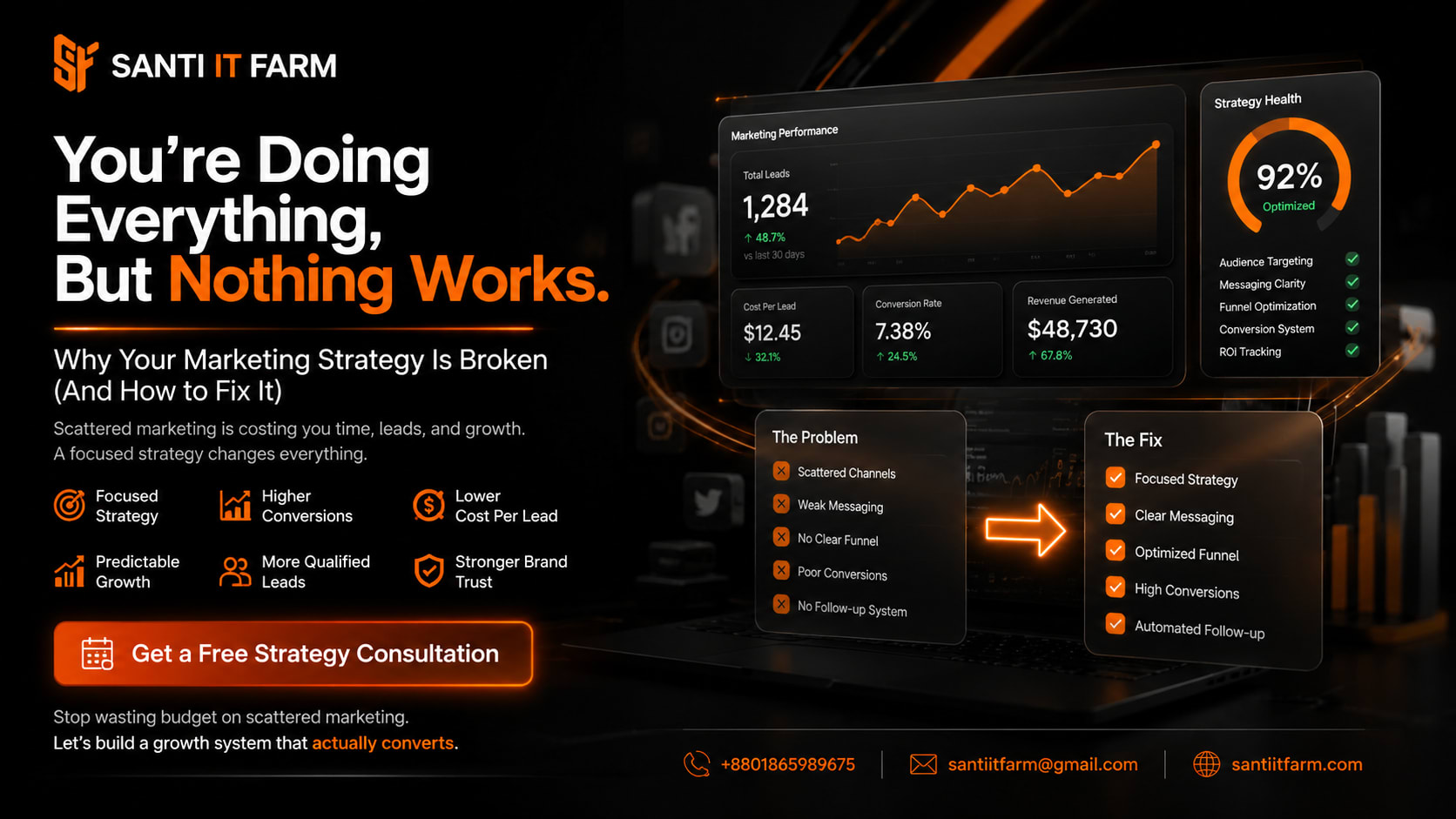
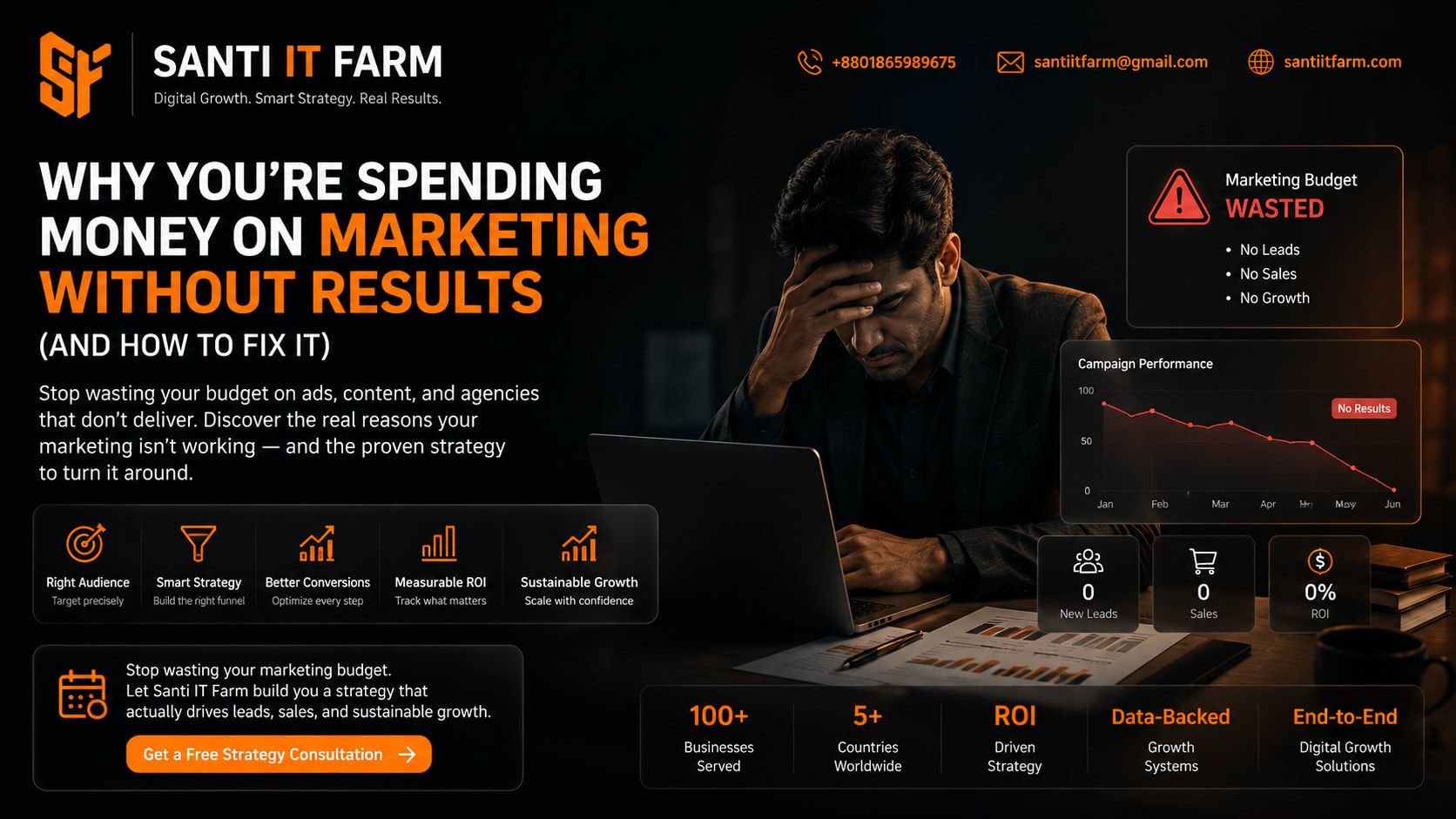
Your Marketing Isn't Failing Because Your Product Is Bad
There's a business owner in Dhaka running a promising e-commerce store. He posts on Facebook every day, boosts a few ads here and there, tries Instagram for a month, then switches to SEO, then wonders why Google Ads didn't work. Six months in, he's spent a significant amount of money and has almost nothing to show for it. Sound familiar?
This isn't a story about a bad business. It's a story about random marketing — and it's one of the most common and costly mistakes businesses make, whether you're a startup in Karachi, a growing agency in Mumbai, a Shopify store owner in Toronto, or a service business trying to break into the UK market.
Random marketing is exactly what it sounds like: trying different tactics with no coherent strategy, no defined audience, no measurable goals, and no consistent messaging. It feels like hustle. It feels productive. But without direction, all that activity is just noise — expensive, exhausting noise.
In this guide, we're going to break down exactly why scattered marketing kills business growth, what the symptoms look like, how successful businesses approach marketing strategy, and the practical steps you can take to stop wasting your budget and start building real, compounding momentum.
Why Does Random Marketing Kill Business Growth? (Quick Answer)
- It wastes budget across channels that don't connect or reinforce each other
- It confuses your audience with inconsistent messaging and brand voice
- It produces no compounding effect — every tactic starts from zero
- It makes it impossible to measure what's actually working
- It exhausts your team without building any lasting marketing asset
- It signals to customers that you don't have a clear value proposition
- It creates no authority or trust in any single channel or niche
Random marketing is not just ineffective — it actively damages your brand perception and depletes resources that could be used to build real, sustainable growth systems.
What Is Random Marketing — And Why Is It So Common?
Random marketing, sometimes called 'spray and pray' marketing, refers to the practice of using multiple marketing tactics without a coherent strategy connecting them. It's characterized by inconsistency, reactive decision-making, and a fundamental lack of clarity about who you're targeting, what problem you're solving, and what action you want people to take.
The reason it's so common is surprisingly human: when a business isn't growing fast enough, the instinct is to do more. Try more channels. Spend more on ads. Post more content. The logic feels sound — surely something will stick. But in reality, you're spreading your resources so thin that nothing gets the sustained attention it needs to actually work.
Another reason random marketing persists is the noise of the digital age itself. Every week there's a new platform, a new trend, a new 'growth hack' that supposedly changed some entrepreneur's business overnight. TikTok goes viral. LinkedIn becomes essential. AI content floods the internet. Without a clear strategic anchor, businesses get pulled in every direction at once.
For businesses in South Asia — particularly in Bangladesh, India, and Pakistan — this problem is compounded by aggressive competition in fast-growing digital markets. The temptation to copy competitors' tactics or chase whatever's trending on local social media is enormous. But copying tactics without understanding the strategy behind them is one of the fastest ways to waste your marketing budget.
Why a Focused Marketing Strategy Is Not Optional — It's Survival
- Marketing strategy determines how effectively every dollar, taka, or rupee you spend works toward a real business outcome.
- Without a strategy, you have no baseline to measure success — so you can never improve or optimize.
- A clear strategy creates brand consistency, which is one of the most powerful trust signals for both customers and search engines.
- Strategic marketing builds compounding assets — SEO rankings, email lists, brand authority — that get more valuable over time.
- Strategy allows you to allocate budget intelligently, doubling down on what works and cutting what doesn't.
- A focused strategy aligns your marketing, sales, and product messaging so customers experience a coherent journey.
- For international clients and investors, a clear marketing strategy signals business maturity and professionalism.
Businesses that commit to a strategic marketing approach don't just grow faster — they grow in ways that are sustainable, scalable, and much harder for competitors to replicate. That's not a theory; it's what separates the businesses still around five years from now from the ones that burned out trying everything at once.
What Happens When You Replace Random Tactics with a Real Strategy
Every Marketing Action Builds on the Last
Strategic marketing creates compounding momentum. When your SEO content, social media, email marketing, and paid ads all work together under one coherent message, each channel amplifies the others. A blog post drives search traffic that joins your email list that converts through a targeted campaign. Random marketing never achieves this because there's nothing connecting the dots.
Your Budget Goes Further
When you know which channels are actually reaching your target audience and generating leads, you stop wasting money on the ones that don't. A focused strategy lets you spend less and earn more — not by being cheap, but by being precise. Businesses that shift from random to strategic marketing typically see dramatic improvements in cost-per-acquisition within the first 90 days.
You Build Real Brand Authority
Consistent, high-quality presence in the right channels builds authority in a way that scattered activity never can. Whether it's becoming the go-to resource on LinkedIn for B2B decision-makers, dominating local SEO in your city, or building a highly engaged Instagram community for your e-commerce store — authority comes from depth, not breadth.
Sales Cycles Shorten Dramatically
When your marketing has a clear message targeted to the right people, prospects enter your sales process already educated, already trusting, and already sold on your category of solution. Strategic marketing warms your leads before your sales team ever speaks to them, which means shorter conversations, fewer objections, and higher close rates.
You Can Finally Measure and Improve
Strategy gives you a framework for measurement. When every campaign is tied to a specific objective, a defined audience, and a measurable KPI, you can finally answer the question every business owner asks: 'Is our marketing working?' Without strategy, that question is unanswerable. With it, it's the foundation of continuous improvement.
Your Team Stops Burning Out
Random marketing is exhausting. When your team is constantly chasing the next tactic, there's no rhythm, no momentum, and no satisfaction from seeing things work. A focused strategy creates routines, predictable workflows, and the kind of results that keep talented people engaged and motivated — which matters more than most business owners realize.
Real-World Comparison: Random Marketing vs. Strategic Marketing
Before
- — A Dhaka-based fashion e-commerce business posts on Facebook 3–4 times a week with product photos, no consistent theme, no clear target demographic.
- — They run Google Ads for 2 weeks, see no immediate sales, and stop — without giving the algorithm enough time to optimize.
- — They hire a freelancer to write 5 blog posts, then abandon the blog because 'it's not bringing traffic' after one month.
- — They try influencer marketing once, pick the wrong creator based on follower count alone, and get poor results.
- — After 8 months, they've spent over $3,000 and have no idea what's working. They're considering quitting digital marketing entirely.
After
- The same business defines their ideal customer: women aged 22–35 in urban Bangladesh who care about sustainable fashion and shop online regularly.
- They choose two channels: Instagram (visual platform, right audience) and SEO-focused blog content (long-term organic traffic for fashion and style queries).
- They create a consistent Instagram aesthetic, post 4 times a week with intentional captions, use relevant local and trending hashtags, and engage with their audience daily.
- Their blog targets specific long-tail keywords like 'sustainable fashion for women in Dhaka' and drives traffic to product pages through internal linking.
- After 6 months on this focused strategy, organic traffic is up 320%, Instagram engagement has tripled, and monthly revenue has grown by 65% — from the same budget.
The difference isn't talent, budget, or luck. The difference is strategy. The second version of this business didn't do more — they did less, but with clarity and consistency.
How to Stop Random Marketing and Build a Strategy That Actually Works
Step 1: Conduct an Honest Marketing Audit
- › List every marketing activity you're currently doing or have done in the past 12 months.
- › For each activity, document: How much did it cost (time and money)? What was the measurable result? Is it tied to a specific business goal?
- › Be brutally honest. Most businesses find that 70–80% of their marketing activities have no clear ROI data attached to them.
- › Identify any activities that ARE producing results — even small ones. These are your starting points for doubling down.
- › Categorize everything as: Keep and optimize, Test with proper measurement, or Eliminate entirely.
Step 2: Define Your Ideal Customer with Surgical Precision
- › Go beyond basic demographics. Understand your customer's actual problems, daily frustrations, aspirations, and decision-making triggers.
- › Create a detailed buyer persona: Who are they? What do they search for? Where do they spend time online? What objections do they have?
- › For businesses in Bangladesh, India, and Pakistan, consider the nuances of local consumer behavior — preferred platforms, language considerations, cultural buying triggers.
- › Interview your best existing customers. Ask them why they chose you, what almost stopped them, and what they'd tell a friend about your business.
- › Every marketing decision from this point forward should be filtered through one question: Does this reach and resonate with my ideal customer?
Step 3: Choose Two or Three Channels — Not Ten
- › Select channels based on where your ideal customer actually spends time, not where you're most comfortable or where you've seen competitors.
- › For B2B businesses: LinkedIn, SEO content, and email marketing tend to perform best.
- › For e-commerce and consumer brands: Instagram or TikTok (depending on age demographic), SEO, and Google Shopping ads are typically the most effective combination.
- › For local service businesses: Google Business Profile optimization, local SEO, and Facebook are usually the core three.
- › Commit to your chosen channels for at least 90 days before evaluating. Most businesses abandon channels before they've given them enough time to show results.
Step 4: Build Your Core Messaging Framework
- › Define your unique value proposition in one clear sentence: Who you help, what problem you solve, and what makes you different.
- › Create a consistent brand voice guide: What tone does your brand use? What words and phrases define you? What do you never say?
- › Develop 3–5 core content themes that connect your expertise to your audience's interests — these become the backbone of all content creation.
- › Ensure your messaging is consistent across your website, social media, ads, and email. Brand consistency is one of the most powerful trust signals in any market.
- › Test your messaging with real customers. If they can't explain what you do and why it matters after seeing your content, it needs to be clearer.
Step 5: Set Clear, Measurable Goals for Each Channel
- › Replace vague goals like 'grow our social media' with specific ones: 'Increase Instagram followers by 500 in 90 days, with a target engagement rate of 3% or higher.'
- › Define your funnel metrics: Awareness (impressions, reach), Interest (click-through rate, time on page), Conversion (leads, sales, sign-ups).
- › Assign a monthly budget to each channel and tie it to expected outputs based on industry benchmarks.
- › Track weekly, review monthly, and make strategic adjustments quarterly — not daily. Daily optimization leads to reactive decision-making, which is random marketing in disguise.
- › Use UTM parameters on all links so you know exactly which marketing activities are driving website traffic and conversions.
Step 6: Create a Content and Campaign Calendar
- › Plan your marketing activity 4–6 weeks in advance. This forces strategic thinking instead of reactive posting.
- › Map content to your buyer's journey: Awareness content attracts new audiences, consideration content educates and builds trust, decision content converts.
- › Schedule your content creation time in blocks — writing one week's worth of content in a single session is far more efficient than writing something new every day.
- › Build campaign themes around your business goals: launches, seasonal events, industry trends, and customer milestones.
- › Leave 20% of your calendar flexible for timely, reactive content — but keep 80% planned and strategic.
Step 7: Invest in Your Foundation Before Paid Ads
- › Many businesses run paid ads to a broken website, unclear offer, or non-existent organic presence — and wonder why ads don't work.
- › Before scaling paid traffic, ensure your website is fast, mobile-optimized, and has clear conversion paths.
- › Build a basic SEO foundation: properly structured pages, targeted keywords, local optimization if relevant, and regular content publishing.
- › Establish your email list from day one. Email marketing consistently delivers the highest ROI of any digital channel — often 40:1 or better.
- › Paid ads amplify what's already working. They're not a replacement for strategy — they're an accelerant.
Step 8: Review, Learn, and Iterate Systematically
- › Conduct a monthly marketing review meeting — even if you're a solopreneur, block time for this.
- › Ask: What worked this month? What didn't? What's one thing we'll do differently next month?
- › Look at your data with context, not in isolation. A drop in website traffic during a national holiday isn't a signal to change strategy.
- › Document your experiments and their results. Over time, this becomes an invaluable institutional knowledge base.
- › Celebrate wins — even small ones. Marketing is a long game, and recognizing progress keeps teams motivated and strategies on track.
Essential Tools for Building a Focused Marketing Strategy
You don't need all of these tools to start. Pick one tool per function, learn it well, and add others as your strategy matures. Over-investing in tools while under-investing in strategy is itself a form of random marketing.
The 10 Biggest Random Marketing Mistakes Businesses Make
- Chasing every new platform the moment it gains popularity, without evaluating whether your audience is actually there.
- Stopping SEO or content marketing after 30–60 days because results weren't immediate — organic channels typically take 90–180 days to show meaningful traction.
- Running paid ads to a website with no clear value proposition, slow load times, or non-functional mobile experience.
- Posting content daily with no defined purpose, target audience, or call to action — vanity activity disguised as marketing.
- Measuring success by vanity metrics like followers, likes, and impressions instead of business metrics like leads, cost-per-acquisition, and revenue.
- Copying a competitor's marketing tactics without understanding the strategy, audience, and positioning behind them.
- Ignoring email marketing in favor of social media — social platforms own your audience; your email list is an asset you actually control.
- Hiring different freelancers for every marketing task with no strategic oversight — resulting in disconnected brand voice and fragmented efforts.
- Changing strategy every month based on what's trending rather than what the data is showing about your specific audience.
- Treating marketing as an expense rather than an investment — cutting budget at the first sign of revenue pressure instead of protecting the channels that are working.
Frequently Asked Questions About Marketing Strategy and Business Growth
The Most Expensive Marketing Mistake Is the One You Keep Making
Here's the uncomfortable truth that most marketing gurus won't say plainly: the reason your business isn't growing the way it should isn't because you haven't found the right hack, the right platform, or the right influencer. It's because you haven't committed to a clear strategy — and without that commitment, every tactic you try is just another experiment that starts from zero.
Random marketing is seductive because it feels like action. It looks like productivity. You're posting, running ads, attending webinars about the latest algorithm updates, trying new tools. But activity without direction isn't marketing — it's managed anxiety.
The businesses that win in competitive digital markets — whether in Dhaka, Delhi, Lahore, London, or Los Angeles — are the ones that pick a lane and go deep. They understand their customer better than anyone else. They show up consistently in the right places with the right message. They build assets that compound over time. And they measure everything against real business outcomes, not vanity metrics.
Building a focused marketing strategy isn't complicated. It requires clarity, discipline, and patience — three things that are genuinely hard but not complicated. It means saying no to distractions. It means trusting the process even when early results are slow. And it means investing in the channels and relationships that build long-term equity for your brand.
If you're still doing random marketing, the good news is that the bar for focused competitors in most markets is surprisingly low. Most of your competition is just as scattered as you've been. Committing to a real strategy — even a simple one executed consistently — puts you ahead of the majority of businesses in your space. The cost of changing is far lower than the cost of continuing.
Ready to Replace Guesswork with a Marketing Strategy That Actually Grows Your Business?
At Santi IT Farm, we work with small businesses, startups, e-commerce brands, and corporate clients across Bangladesh, India, Pakistan, the UK, the USA, Canada, and Australia to build focused, data-driven digital marketing strategies that generate real results.
We don't sell tactics. We build systems. From strategic website development and SEO to conversion-focused content marketing, social media strategy, paid advertising, and marketing automation — we connect every piece of your digital presence to a single, coherent growth goal.
If you're tired of spending money on marketing that goes nowhere, it's time to have a different kind of conversation. Let's talk about where your business is, where you want it to go, and exactly what it will take to get there.
- Digital Marketing Strategy
- SEO Services
- Website Development & Optimization
- Content Marketing
- Social Media Marketing
- E-commerce Marketing
- Branding & Positioning
- Marketing Automation
- UI/UX Design
- Business Growth Consulting
Stop spending on marketing that doesn't work. Start investing in a strategy that does. Contact Santi IT Farm today and let's build something worth measuring.
Get Started