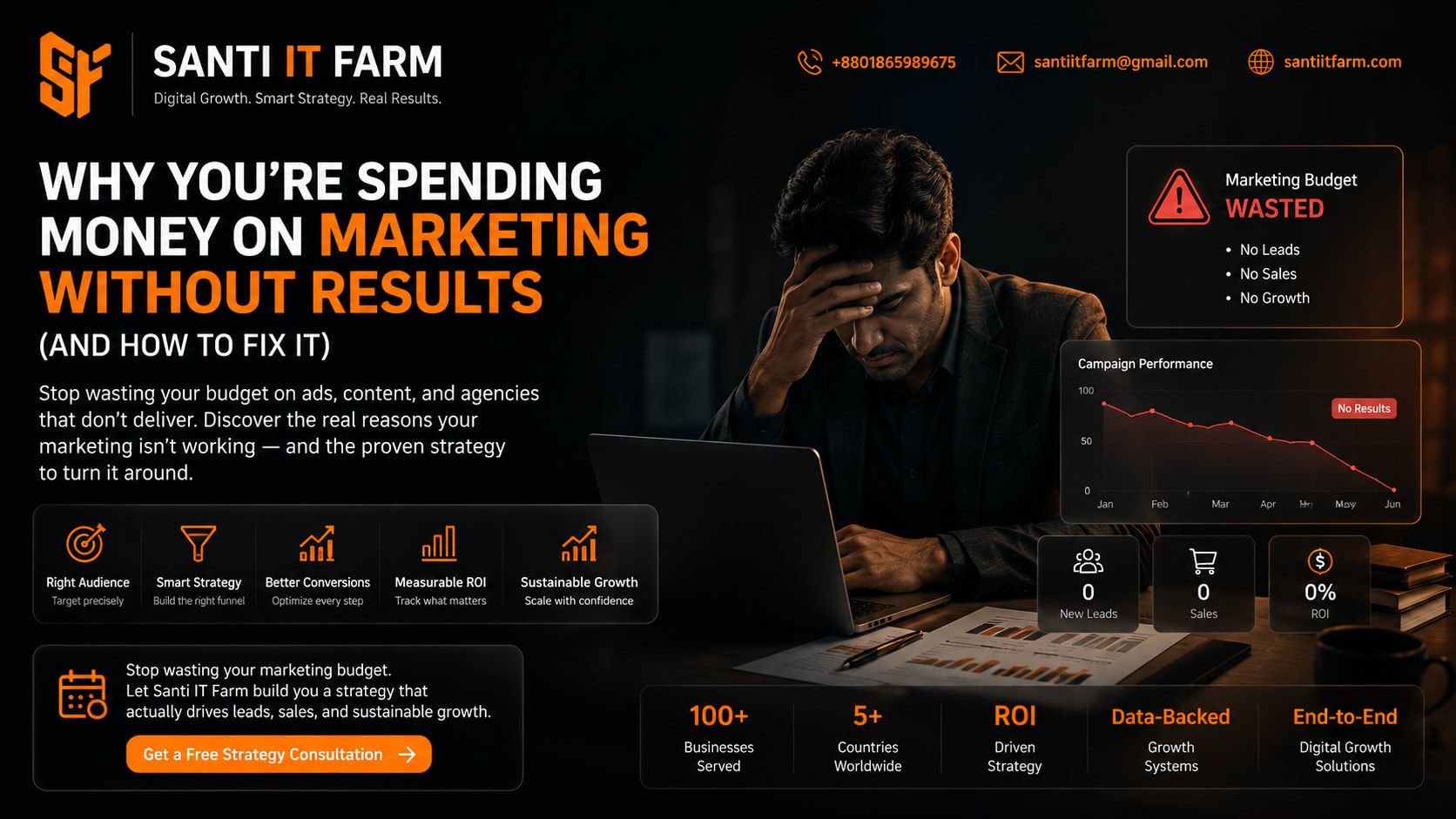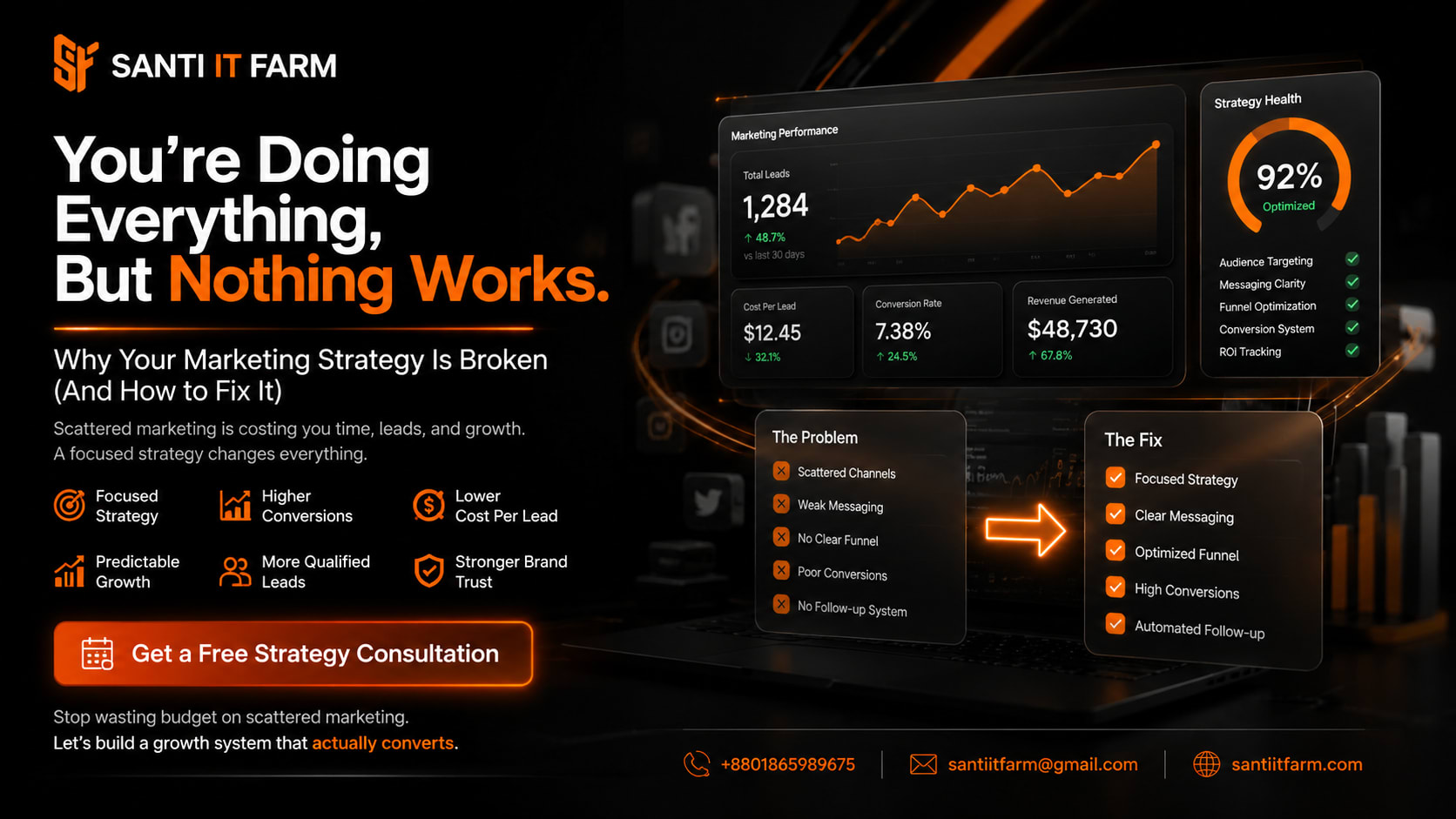
You're Busy, But Are You Building? The Marketing Trap Most Businesses Fall Into
You wake up, post something on Instagram. You check your Google Ads dashboard — impressions are up, but sales aren't. You publish a blog post your competitor probably copied already. You send an email campaign that gets a 12% open rate and zero replies. You spend the evening editing a Reel because someone told you video is the future. And at the end of the week, you ask yourself: why is nothing actually working?
This isn't a story about laziness. You're clearly not lazy. This is a story about one of the most common and costly mistakes businesses make — mistaking activity for strategy. In markets like Bangladesh, India, Pakistan, and even among startups in the US, UK, and Canada, we see this pattern constantly. Business owners who are working harder than ever but growing slower than they should be.
The brutal truth? Doing ten things at 20% effort will almost always lose to doing two things at 100% focus. Marketing isn't about volume — it's about precision. And if no one has ever sat down with you to map out exactly where your customers come from, what moves them to buy, and which channels deserve your energy, then you're not running a marketing strategy. You're running a marketing experiment — without a control group.
At Santi IT Farm, we've worked with small businesses, e-commerce brands, and growing startups across South Asia and globally. The most common thing we see isn't bad creative or poor writing — it's a complete absence of strategic clarity. This post is our attempt to fix that, clearly and practically, for you.
Quick Answer: Why Is Your Marketing Not Working?
- You're spreading effort across too many channels without mastering any single one
- Your messaging doesn't speak directly to a specific customer's specific pain
- You have no documented funnel — awareness, consideration, and conversion are disconnected
- You're measuring vanity metrics (likes, impressions) instead of business metrics (leads, sales)
- Your website or landing page isn't converting the traffic you're already paying for
- You're copying competitors instead of differentiating your brand
- You have no retargeting or follow-up system — you're only fishing, never catching
- Your content educates but never sells — or sells without first building trust
- You don't have a consistent content cadence — you post in bursts and disappear
- Strategy decisions are based on trends, not on your actual audience data
Most businesses suffer from three or more of these simultaneously. The good news: identifying the core problem usually unlocks rapid, compounding improvement.
What Does 'Doing Everything' Actually Mean — And Why It Backfires
When we say 'doing everything,' we mean businesses that run paid ads AND organic SEO AND social media AND email marketing AND influencer outreach AND content marketing — all at the same time, all with shallow investment in each. It sounds comprehensive. It's actually fragmentation.
Think of it like watering ten plants with one cup of water every day. None of them get enough. A focused gardener would identify which plants are most valuable, water those deeply, and let the others wait. Marketing works the same way. Every channel requires a minimum level of sustained, intelligent effort before it yields results. Dropping below that threshold — as most scattered strategies do — means you're spending money and time without ever crossing the threshold where returns begin.
In South Asian business contexts especially, there's a widespread belief that 'being everywhere' equals credibility. This belief is reinforced by big brand behavior — you see Coca-Cola on billboards, on TV, on social media, on search. But Coca-Cola has a $4 billion marketing budget and teams of hundreds. For an SME with a team of five and a monthly marketing budget under $2,000, trying to replicate that omnichannel presence is not ambitious — it's counterproductive.
The businesses that break through — whether it's a Dhaka-based software agency, a Lahore fashion brand, or a Toronto immigrant entrepreneur — are almost always the ones who got ruthlessly focused on one or two channels, mastered them, and only then expanded. Discipline beats distribution at every stage of early growth.
Why Having a Focused Marketing Strategy Is No Longer Optional
A focused marketing strategy isn't a luxury for businesses with time and resources. It's a survival requirement for any business that needs marketing to actually produce revenue.
What Happens When You Replace Scattered Tactics With a Real Strategy
Your cost per acquisition drops — sometimes dramatically
When you stop wasting ad spend across five channels and focus on one optimized funnel, your cost per lead typically falls by 30–60% within 90 days. Every dollar works harder because it's part of a connected system instead of an isolated experiment.
Your message becomes recognizable and memorable
A focused strategy forces you to define your positioning — who you serve, what problem you solve, and why you're the best choice. Once that's clear and communicated consistently, customers start to recognize your brand. Recognition creates preference. Preference closes deals without heavy discounting.
You start making data-driven decisions instead of gut-feel gambles
With one or two focused channels, you can actually measure what's working. You see which headline drives clicks, which offer converts, which audience segment is most valuable. That data feeds better decisions, which produce better results, which compound over time.
Your team stops burning out on meaningless tasks
Scattered marketing is exhausting. Your team is always producing content, managing platforms, and running campaigns — but rarely seeing meaningful results. A focused strategy gives them fewer things to do exceptionally well. That clarity reduces friction, improves morale, and produces better output.
Organic growth begins to compound
SEO, thought leadership, and community-building are all long-term compounding channels. When you consistently invest in them with focus, results don't grow linearly — they grow exponentially. A business that spends 12 months building focused SEO content doesn't get 12 months of results. They get a searchable, traffic-generating asset that produces leads for years.
You can finally predict and plan revenue
Scattered marketing produces unpredictable results. Focused strategy, backed by consistent effort and measurement, eventually produces a predictable lead volume — which means predictable revenue. That predictability is what transforms a struggling business into a scalable one.
Real-World Example: Before and After a Focused Strategy
Before
- — A Dhaka-based web design agency was posting daily on Facebook, Instagram, and LinkedIn, running two Google Ads campaigns, publishing one blog post per month, and sending a monthly newsletter.
- — Monthly marketing spend: approximately $1,800. Monthly leads generated: 3–5. Average client value: $800. Monthly revenue from marketing: roughly $2,400–$4,000. Return on marketing spend: barely breaking even.
- — The team was spending 60% of their week on content creation across platforms. The founder was manually responding to every social comment. No one was monitoring which channel was actually generating the leads. The blog posts were not optimized for any specific search intent. The ads were targeting broad interest categories with no retargeting in place.
After
- After a full strategy audit, we identified that 80% of their actual clients came from Google Search or direct referrals. We paused all social media advertising, cut posting to 2x per week on LinkedIn only (targeting marketing managers and startup founders), and redirected 70% of the budget to Google Search Ads with tightly focused ad groups targeting high-intent keywords.
- We rebuilt their website landing pages with conversion-focused copy and added a lead magnet (a free website audit offer). We implemented a 5-email nurture sequence for every inquiry. We published four deeply researched, SEO-optimized blog posts targeting service-specific queries with buying intent.
- Results after 90 days: Leads per month rose from 4 to 18. Cost per lead dropped from $360 to $85. Team content creation time dropped by 40%. The founder reclaimed 10 hours per week previously spent on scattered social media management. Monthly revenue attributable to digital marketing more than tripled.
This outcome isn't rare — it's what happens when strategy replaces scattered activity. The business didn't spend more. It spent smarter, on fewer things, with better execution.
How to Build a Focused Marketing Strategy That Actually Produces Results
Step 1: Audit Everything You're Currently Doing
- › List every marketing activity you currently run — ads, social posts, emails, SEO, content, influencer, events, etc.
- › For each activity, ask: Can I directly trace revenue or leads back to this? If not, you're likely operating on assumption.
- › Use Google Analytics, your CRM, or even a simple spreadsheet to map which activities generated actual inquiries or sales in the last 6 months.
- › Most businesses discover that 1–2 channels produce 80% of their results. Everything else is noise masquerading as effort.
Step 2: Define Your Ideal Customer With Surgical Precision
- › Stop targeting 'everyone who needs our service.' Start targeting the specific type of customer who has the highest value and the highest urgency.
- › Ask: What is their primary business pain? What have they already tried? What words do they use to describe their problem? Where do they spend time online?
- › For a B2B agency serving Bangladeshi businesses, that might be: 'Mid-size garment exporters in Dhaka who are losing international clients because their website looks outdated and doesn't communicate quality.' That's a target. 'Businesses that need websites' is not.
- › Your messaging, channel selection, and offer should all be derived directly from this customer profile.
Step 3: Choose One Primary Channel and Master It
- › Based on your audit and customer profile, select the one channel where your ideal customer has the highest purchase intent and where you have the clearest path to generating leads.
- › For B2B services: LinkedIn organic + Google Search Ads is usually the most effective combination. For e-commerce: Google Shopping + Meta retargeting. For local services: Google Business Profile + Local SEO.
- › Commit to this channel for 90 days with serious effort and budget before evaluating performance. Switching too early is how businesses abandon channels that were about to work.
- › Master means: testing copy, testing audiences, testing offers, building retargeting audiences, creating follow-up sequences. Not just 'being present.'
Step 4: Build a Conversion Funnel, Not Just Campaigns
- › Every marketing channel needs a destination. That destination needs to be designed to convert.
- › Map your funnel: Awareness (how do they find you?) → Interest (what makes them want to learn more?) → Consideration (what builds trust and handles objections?) → Decision (what makes them contact or buy?) → Retention (how do you keep them and generate referrals?).
- › Most businesses only work on the awareness layer. They drive traffic to a website that was never designed to convert. Fix the conversion rate before scaling spend.
- › Add a lead magnet, a clear offer, a strong call to action, and a follow-up email sequence. These four elements alone can double or triple your conversion rate from existing traffic.
Step 5: Set the Right Metrics and Review Weekly
- › Stop measuring likes, impressions, and follower counts as success indicators. Start measuring: Cost per lead, Lead-to-close rate, Revenue per channel, Customer acquisition cost, and Return on ad spend.
- › Set a weekly 30-minute review ritual. Look at what moved the needle. Ask why. Make one change. Test it next week.
- › Over time, this discipline produces a data-driven marketing system that improves automatically. It's the difference between a business that hopes marketing works and one that knows exactly how to scale.
Step 6: Add a Second Channel Only After Mastering the First
- › Once your primary channel is generating consistent, measurable, profitable leads — and only then — introduce a second channel.
- › The second channel should serve a different stage of the funnel. If your primary channel is Google Search (capturing active demand), your second channel might be LinkedIn content (building awareness and authority with people who aren't searching yet).
- › This sequenced approach to channel expansion is how businesses build sustainable, multi-channel marketing systems without ever feeling scattered or overwhelmed.
Tools That Support a Focused, Strategic Marketing Operation
You do not need all of these. Pick one tool per category that matches your current stage. Tools don't fix strategy — but the right tools dramatically amplify a good strategy. Start with Google Analytics 4, one SEO tool, and one email platform. That's enough to start making decisions based on real data.
The 10 Marketing Mistakes That Are Silently Killing Your Business Growth
- Running ads to a homepage instead of a dedicated, conversion-optimized landing page — your homepage is designed for exploration, not conversion. Every campaign needs its own destination.
- Treating social media as a sales channel instead of a trust-building channel — people don't open Instagram to buy software. They open it to learn and be entertained. Sell softly, build authority loudly.
- Stopping campaigns after two weeks because 'they're not working' — most digital marketing channels need 60–90 days of data before optimization becomes meaningful. Patience is strategic.
- Writing content for search engines instead of humans — keyword-stuffed articles that answer questions no real person ever asked rank poorly and convert even worse. Write for your customer first, then optimize.
- Ignoring existing customers as a growth channel — acquiring a new customer costs 5–7x more than retaining or upselling an existing one. Your best leads are already in your CRM.
- Having no unique positioning — if your website says 'we deliver quality solutions at affordable prices,' you sound exactly like every other agency on earth. Differentiation is a marketing strategy in itself.
- Measuring success weekly when the channel operates on a monthly or quarterly cycle — SEO results take months. Judging it weekly creates panic, causes premature pivots, and destroys what could have been compounding growth.
- Using the same message for every stage of the buyer journey — someone who just discovered you needs education. Someone who's evaluated you needs reassurance. Someone ready to buy needs a clear, frictionless offer. Same message kills conversion at every stage.
- Outsourcing strategy to people who only execute tactics — a freelancer running your ads is not a strategist. A social media manager is not a CMO. Separating strategic thinking from tactical execution is one of the most expensive mistakes in marketing.
- Never asking customers how they found you or why they chose you — this single question, asked consistently, is worth more than any analytics platform. Direct customer feedback reveals which channels are actually working and what messaging is resonating — information no algorithm can give you.
Frequently Asked Questions About Marketing Strategy and Why Nothing Is Working
The Hard Truth — And the Path Forward
Here's the difficult reality most marketing consultants won't tell you: you've probably been working hard enough. The missing ingredient isn't effort. It's clarity — clarity about who you're targeting, what channel reaches them best, what message resonates, and what offer converts.
The businesses that struggle most with marketing are almost never the laziest ones. They're the ones who've been trying everything without stopping to ask which things actually work. They've built a habit of marketing activity without ever building a system of marketing strategy.
In Bangladesh, India, Pakistan, and across global markets, the competitive landscape is getting harder every year. More businesses are online. Ads are more expensive. Organic reach is declining. Attention is shorter. In this environment, scattered effort doesn't just underperform — it actively loses ground.
But here's what's also true: the businesses that have clarity have a profound advantage. Because most of their competitors are still scattered. A focused strategy — even a simple, well-executed one — will consistently outperform a complicated, unfocused one. You don't need to do more. You need to do the right things, deeply and consistently.
That starts with knowing what's actually broken. And now you do. The next step is deciding what to do about it.
Ready to Stop Guessing and Start Growing? Let's Build Your Strategy Together.
At Santi IT Farm, we don't just run campaigns. We diagnose the real problem, build the strategy that fits your business, and execute with the precision your marketing has been missing. From Dhaka to Dubai, Karachi to Toronto — we've helped businesses across South Asia and globally stop spinning their wheels and start generating real, measurable growth.
Whether you need a complete digital strategy audit, a conversion-focused website rebuild, a performance marketing system, or a content and SEO engine built for long-term organic growth — we've built all of it, for businesses exactly like yours.
This isn't about spending more money on marketing. It's about finally making your marketing work.
- Digital Marketing Strategy & Audit
- SEO Services & Content Marketing
- Website Development & Conversion Optimization
- Google Ads & Meta Ads Management
- E-commerce Marketing (Shopify, WooCommerce)
- Branding & Positioning Strategy
- UI/UX Design for Better Conversion
- Social Media Marketing with ROI Focus
- Business Automation & AI-Powered Systems
- Custom Software Development for Growth
Book a free strategy consultation with the Santi IT Farm team. No pitch. No fluff. Just a clear diagnosis of what's broken and a practical roadmap to fix it.
Get Started