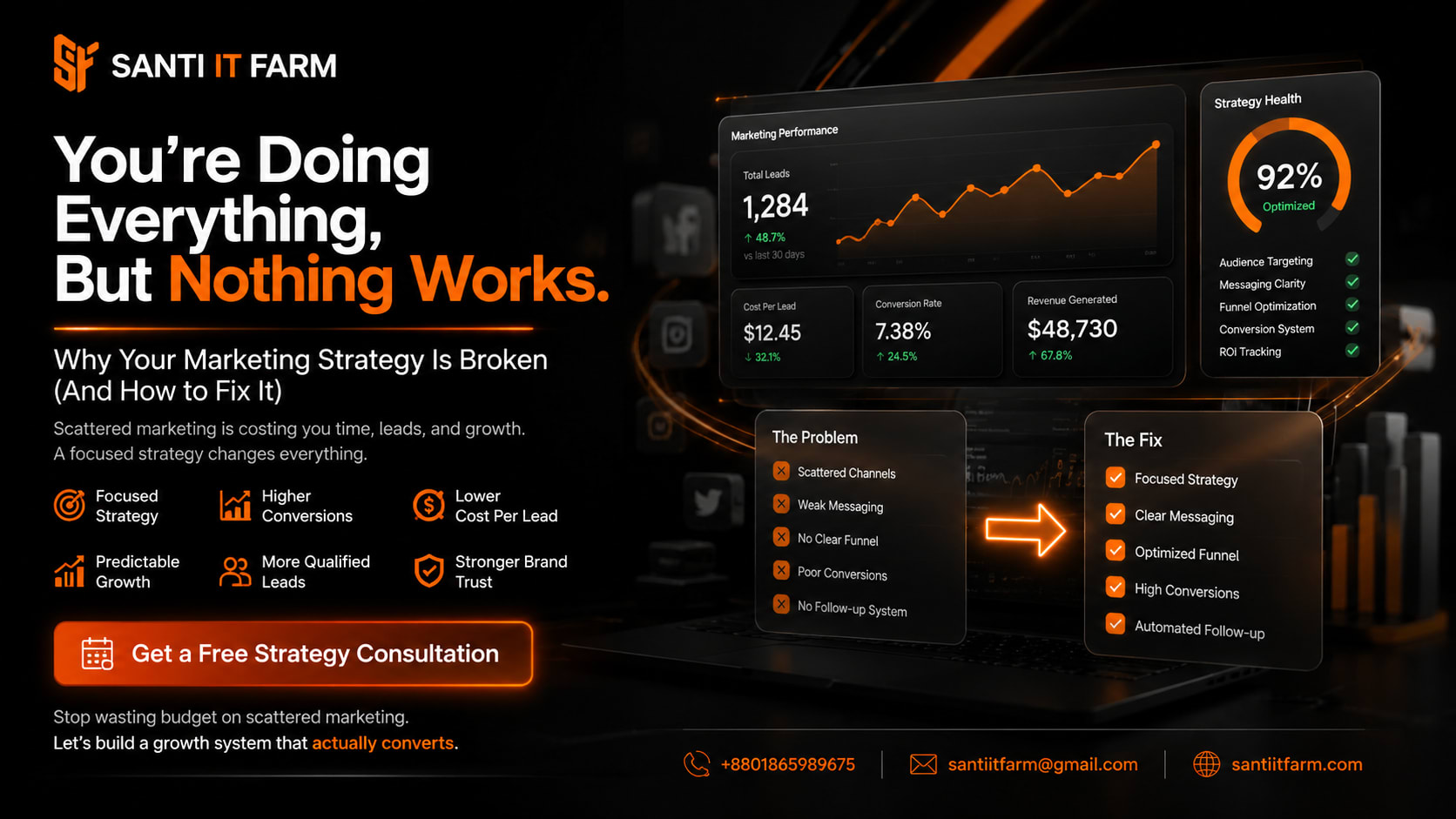
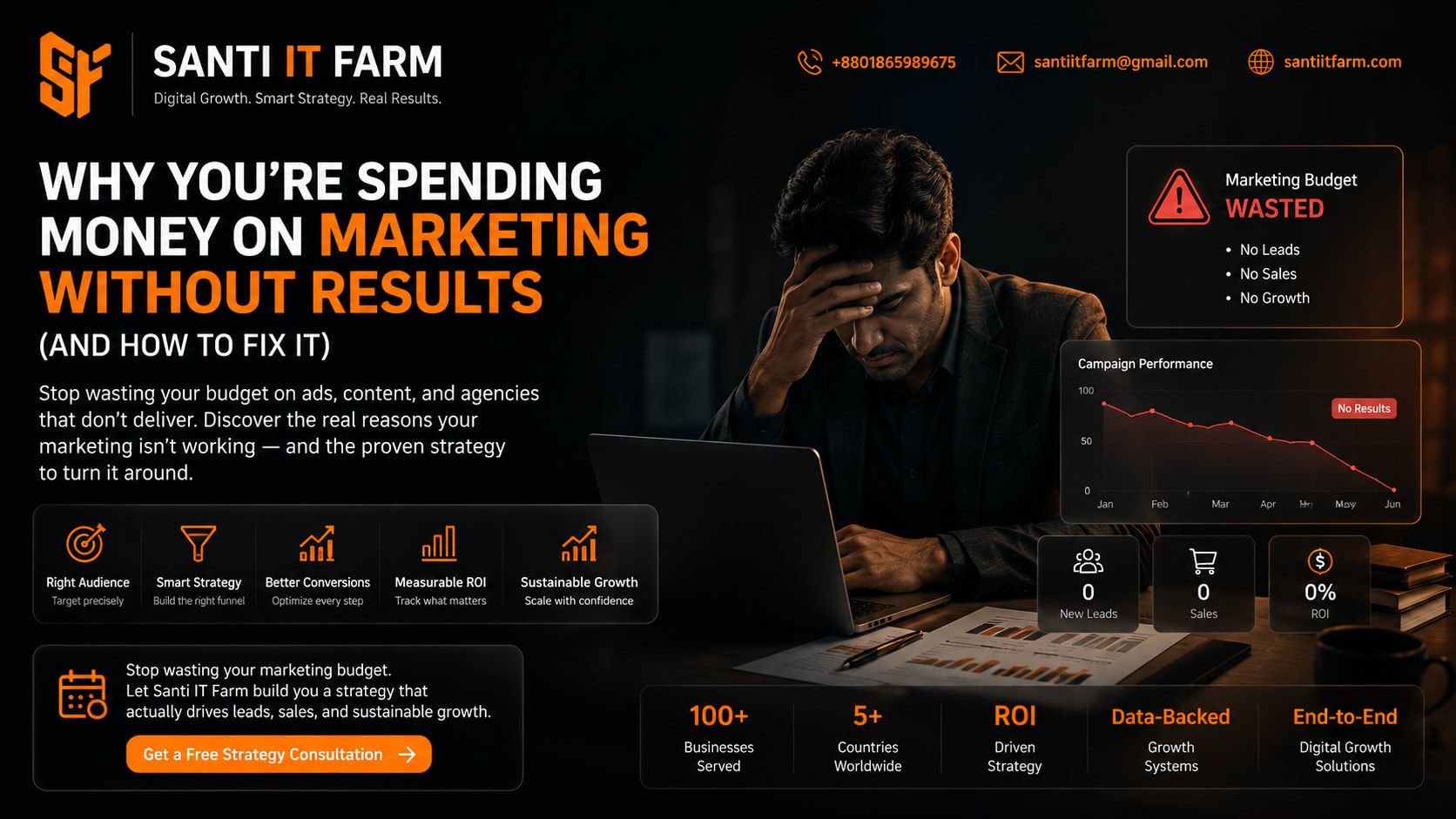
The Real Reason Your Online Marketing Isn't Working
There's a quiet frustration that lives inside almost every small business owner. You post on social media regularly. You have a website. You've maybe even run a few ads. But the customers aren't coming — or at least not the way you hoped. You start wondering if digital marketing is just for big companies with massive budgets.
It isn't. But that frustration is real and it's common — and it's almost never caused by what business owners think it's caused by.
The problem isn't effort. Most small business owners work incredibly hard at marketing. The problem is that online marketing without a clear strategy is essentially shouting into a crowded room and hoping the right person hears you. That's not a model that scales.
Across Bangladesh, India, Pakistan, the UK, the US, Canada, and Australia — small businesses are wrestling with the same core challenges: limited resources, unclear positioning, platform overwhelm, and no consistent system for turning strangers into paying customers. This isn't a geography problem. It's a strategy problem.
In this guide, we'll break down exactly why small businesses struggle with online marketing — not in theory, but in the real ways we've seen it play out with hundreds of businesses. More importantly, we'll walk you through what actually works.
Why Do Small Businesses Struggle With Online Marketing? (Quick Answer)
- No clear target audience definition — marketing to everyone means reaching no one
- Treating tactics as strategy — posting without purpose doesn't build a business
- Skipping the foundation — a weak website or unclear brand kills conversions
- Platform paralysis — being on too many channels and mastering none
- Ignoring data — guessing instead of making decisions based on actual performance
- Inconsistency — stopping and starting marketing based on short-term results
- Expecting immediate ROI — digital marketing is a compounding asset, not a vending machine
Most small businesses struggle not because digital marketing doesn't work, but because they're missing one or more of these foundational pillars. Fix the foundation first — then scale.
What Online Marketing Actually Means for a Small Business
Online marketing for a small business isn't about going viral or spending millions on ads. At its core, it means creating a reliable, repeatable system that gets your business in front of the right people, earns their trust, and converts that trust into revenue.
This system typically involves several layers working together: a strong brand identity, a well-optimized website, a content strategy that answers real customer questions, a presence on the platforms your customers actually use, and a way to capture and nurture leads over time.
The mistake most small businesses make is treating these as separate, optional activities rather than one connected system. You can't expect your Instagram to drive sales if your website can't close. You can't expect SEO to work if your content isn't built around what your customers are searching for. Every piece feeds the next.
Small businesses in competitive markets — whether you're a boutique in Dhaka, a law firm in Toronto, an e-commerce shop in London, or a service provider in Sydney — all need the same thing: a digital presence that builds trust at scale, even when the owner is asleep.
Why Getting Online Marketing Right Is More Critical Than Ever
- Over 70% of buyer journeys begin online — if you're not visible in search, you're invisible to most prospects
- Digital marketing runs 24/7, compounding your reach without compounding your working hours
- Small businesses that invest in strategic digital marketing grow 2–3x faster than those relying on word-of-mouth alone
- Your competitors — even the local ones — are already building digital audiences while you wait
- Consumer trust is now built online before the first conversation even happens
- In emerging markets like Bangladesh and India, mobile internet adoption means your audience is digital even if your business hasn't caught up yet
Online marketing isn't optional for small businesses anymore. But doing it wrong — without strategy, without understanding your audience, without measuring results — costs more than not doing it at all. That's why diagnosing the real problems matters so much.
What Changes When Small Businesses Get Their Marketing Right
Predictable Lead Flow
Instead of relying on referrals and hoping for business, a well-built marketing system generates consistent inquiries week over week. You stop chasing and start choosing your clients.
Lower Customer Acquisition Cost Over Time
SEO content, email lists, and organic social presence compound in value. Unlike paid ads, they don't stop working the moment you stop paying. The cost per lead drops significantly as your digital assets mature.
Brand Authority in Your Niche
When your content consistently answers the questions your target clients are asking, you become the obvious expert. That authority means shorter sales cycles and less price resistance.
Scalable Growth Without Proportional Cost Increases
Digital infrastructure scales in ways physical marketing can't. One well-ranked blog post can bring in leads for years. An optimized product page can sell globally without a larger team.
Data That Tells You What's Working
When marketing is set up correctly, every campaign teaches you something. You know which content drives traffic, which pages convert, which audiences respond — and you get smarter with every dollar you spend.
Stronger Customer Retention
Strategic email marketing, retargeting, and community-building keep your existing customers engaged, reduce churn, and turn one-time buyers into loyal advocates who refer others.
Real Business Scenario: Before and After Strategic Marketing
Before
- — A local clothing brand in Dhaka was posting daily on Facebook and Instagram but seeing almost no sales from social media
- — Their website had no clear product categories, slow mobile loading, and no way to purchase online
- — They were running boosted posts to 'everyone in Bangladesh' with no audience targeting
- — No email list, no retargeting, no way to bring back visitors who didn't buy on first visit
- — The owner felt exhausted and was about to give up on digital entirely
After
- We rebuilt their Shopify store with mobile-first design, fast loading, and clear product navigation
- Audience research identified their core buyer: women aged 22–38 in urban areas interested in modest fashion
- Social content was redesigned around storytelling and product styling, not just product photos
- A simple email capture and welcome series was set up — within 90 days, their list had over 1,200 subscribers
- Targeted Facebook and Instagram ads were launched to warm audiences, cutting cost per purchase by 60%
- Monthly revenue grew by 3.4x within six months — same product, same team, smarter strategy
This isn't an exceptional case — it's what happens when the foundation is fixed and strategy replaces guesswork. The same principles apply whether you're selling fashion, software, legal services, or food.
How to Fix Your Online Marketing: A Step-by-Step Framework
Step 1: Define Your Audience With Precision
- › Stop marketing to 'everyone' — your best customers share specific traits: age, location, problems, aspirations
- › Create a clear buyer persona: who they are, what keeps them up at night, what they value most
- › Research where they actually spend time online — not where you think they do
- › In markets like Bangladesh, India, and Pakistan, mobile-first behavior and platform preferences vary by city and age group — factor this in
Step 2: Build a Website That Works as a Sales Tool
- › Your website is your digital storefront — if it loads slowly, looks dated, or confuses visitors, they leave
- › Optimize for mobile first: over 65% of small business web traffic comes from phones globally
- › Make your value proposition crystal clear within 5 seconds of landing on your homepage
- › Include clear calls-to-action, social proof (testimonials, case studies), and easy contact options
- › If you're selling products, your e-commerce UX needs to remove every possible friction between browsing and buying
Step 3: Choose the Right Channels — Not All of Them
- › You don't need to be on every platform — you need to dominate one or two where your audience lives
- › B2B businesses and professional service providers often see better ROI from LinkedIn and SEO than Instagram
- › E-commerce and consumer brands generally benefit most from Instagram, Facebook, and Google Shopping
- › Local service businesses should prioritize Google Business Profile, local SEO, and community Facebook groups
- › Pick your channels based on audience data, not personal preference or what competitors are doing
Step 4: Create Content That Earns Trust Before Asking for the Sale
- › Buyers research before they buy — your content should answer their questions at every stage of that process
- › Educational blog posts, how-to videos, and case studies build credibility far better than promotional posts alone
- › SEO-optimized content brings in people who are already searching for what you offer — high-intent traffic that converts
- › Consistency matters more than perfection — publishing regularly signals authority to both search engines and readers
Step 5: Capture and Nurture Leads Systematically
- › Not everyone is ready to buy today — an email list lets you stay in touch until they are
- › Offer something genuinely valuable in exchange for contact details: a free guide, checklist, consultation, or discount
- › Set up an automated email welcome sequence that introduces your brand, shares value, and naturally leads to an offer
- › Segment your list as it grows so messages stay relevant — a new subscriber and a repeat customer need different conversations
Step 6: Measure, Learn, and Improve Continuously
- › Set up Google Analytics 4 and Search Console from day one — you can't improve what you don't measure
- › Track the metrics that matter for your stage: traffic, leads, conversion rate, cost per acquisition
- › Run A/B tests on your highest-traffic pages and ad creatives — small improvements compound significantly
- › Schedule monthly marketing reviews to assess what's working and cut what isn't — ruthless prioritization beats random effort
Essential Tools Small Businesses Should Be Using
You don't need all of these on day one. Start with Google Search Console, Google Analytics 4, one email tool, and whichever social platform your audience uses most. Add tools as your strategy matures. The goal is visibility into what's working — not tool overload.
The 10 Biggest Online Marketing Mistakes Small Businesses Make
- Marketing without a defined target audience — 'everyone' is not an audience
- Expecting results in 30 days from channels that take 6–12 months to mature, especially SEO
- Building a website for aesthetics instead of conversion — pretty doesn't mean effective
- Chasing trends instead of building fundamentals — TikTok won't save a business with no email list
- Running ads to a weak website — paid traffic amplifies what's already there, good or bad
- Ignoring mobile experience — most of your visitors are on phones, and most small business websites fail mobile users
- No clear call-to-action — visitors who don't know what to do next will do nothing
- Copying competitor strategy without understanding why it works for them — context matters
- Stopping marketing during slow seasons — that's exactly when you should increase it
- Treating marketing as an expense rather than an investment — the businesses that win are the ones that keep going
Frequently Asked Questions About Small Business Online Marketing
The Bottom Line: Strategy Beats Effort Every Time
Small businesses don't struggle with online marketing because digital doesn't work for them. They struggle because the gap between 'being online' and 'marketing strategically online' is enormous — and most businesses never get a clear map of how to bridge it.
The good news is that the fundamentals aren't complicated. Know your audience. Build a website that converts. Show up consistently on the channels that matter. Create content that earns trust. Capture leads and nurture them. Measure everything and keep improving.
What makes this hard isn't the knowledge — it's execution, consistency, and having the right systems in place. That's where the businesses that grow separate themselves from the ones that stagnate.
Whether you're running a startup in Islamabad, a retail brand in London, a consultancy in Sydney, or an e-commerce business in Dhaka, the principles are the same. The execution adapts to your market. The strategy scales with your ambition.
You built something worth selling. Now it's time to build the digital engine that helps more of the right people find it.
Ready to Stop Guessing and Start Growing?
At Santi IT Farm, we work with small businesses, startups, and growing brands across Bangladesh, India, Pakistan, the UK, the USA, Canada, and Australia to build digital marketing systems that actually convert.
We don't sell templates or one-size-fits-all packages. We build strategy-first solutions tailored to your market, your audience, and your growth goals — from a website that closes deals, to SEO that builds long-term authority, to social campaigns that generate real revenue.
If you're tired of putting effort into marketing that doesn't produce results, let's talk. We'll diagnose exactly where your system is breaking down and show you what a smarter path forward looks like.
- Website Development & Conversion Optimization
- SEO Strategy & Content Marketing
- Shopify & E-commerce Development
- Social Media Marketing & Management
- Branding & UI/UX Design
- Digital Marketing Strategy Consulting
- Business Automation & AI-powered Growth Systems
Your next stage of growth starts with one conversation. Book your free consultation today and let's build something that actually works — https://www.santiitfarm.com/contact
Get Started