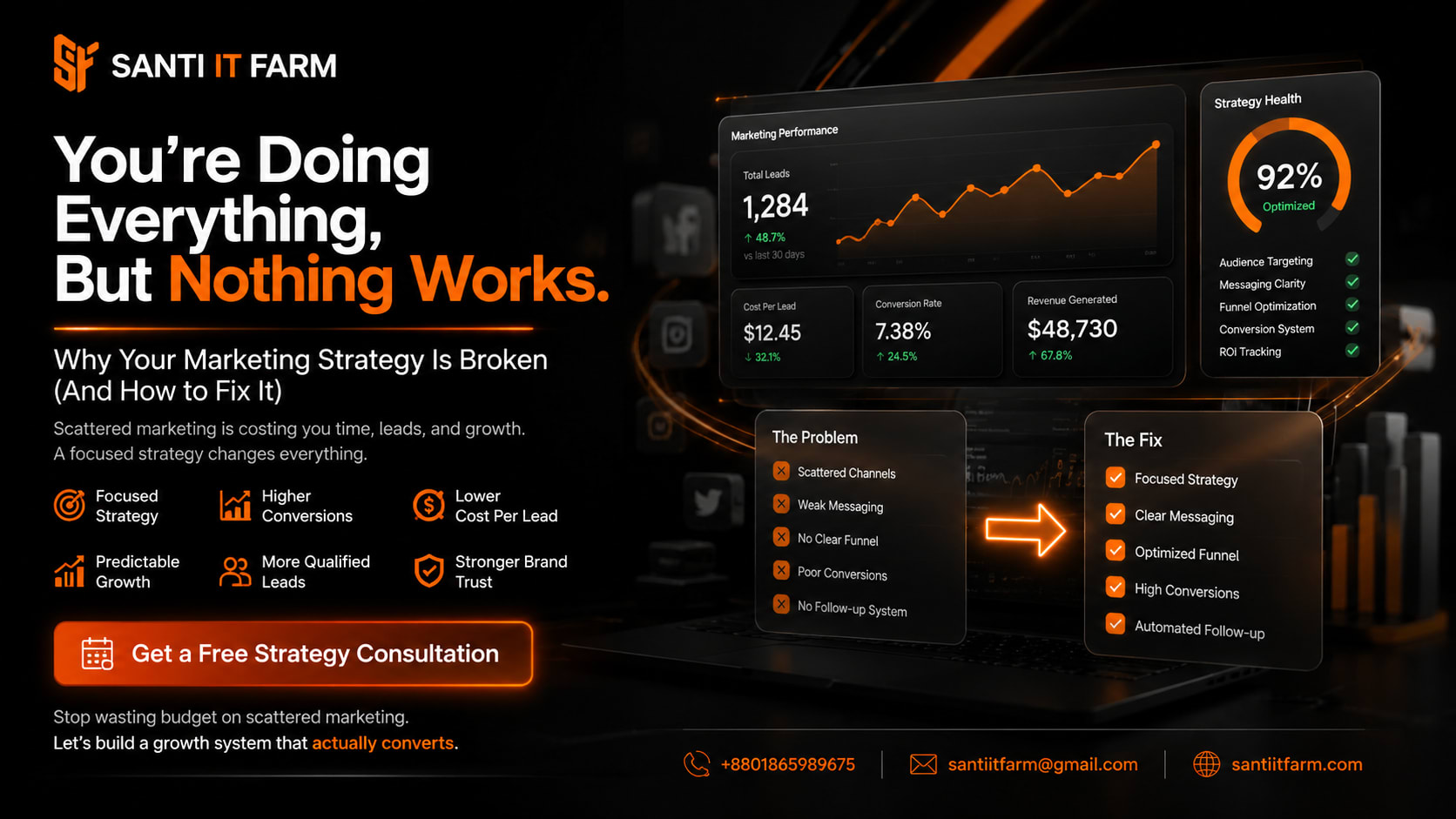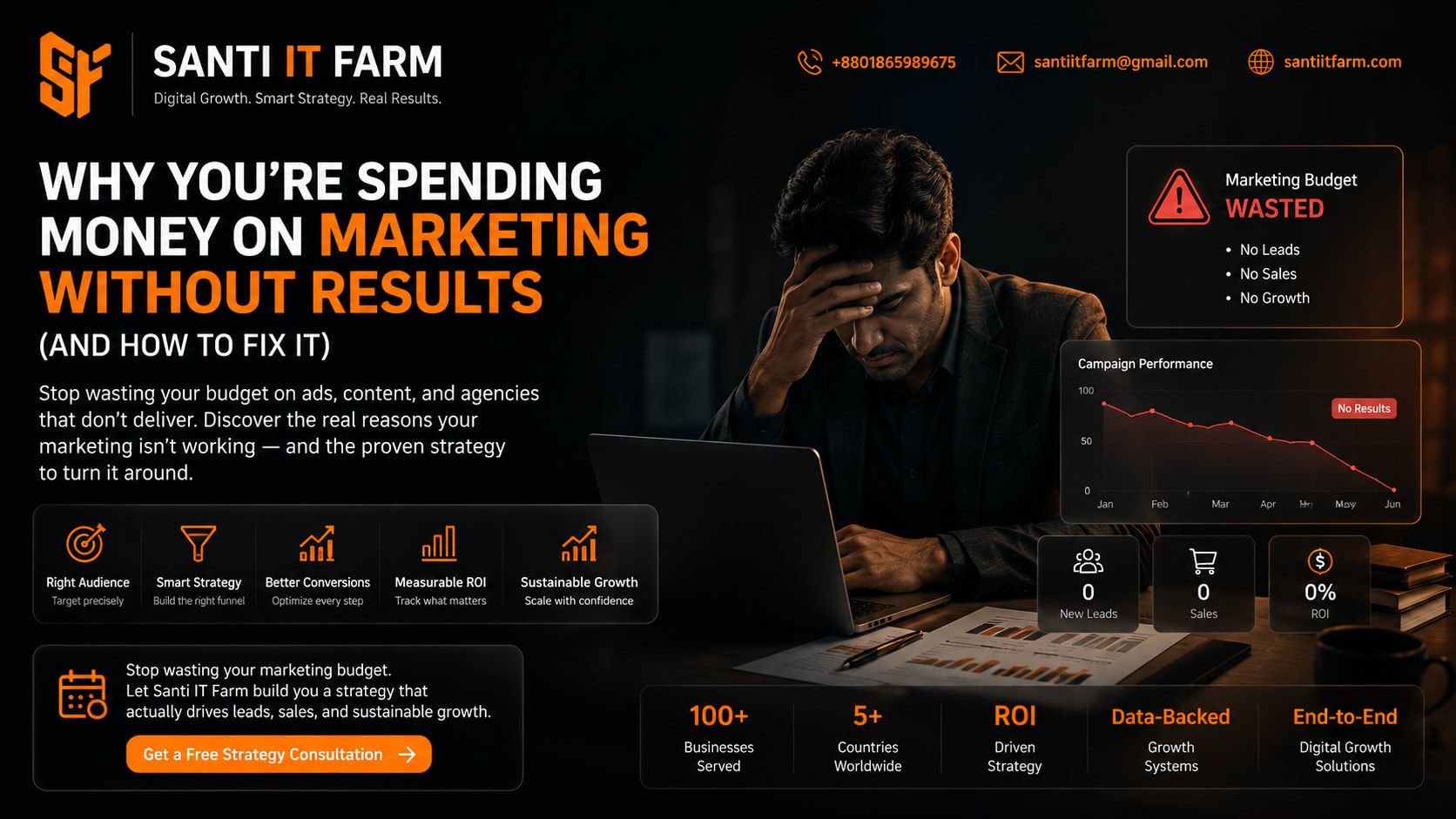
You're Paying for Marketing. So Why Isn't Anything Happening?
You've hired a freelancer, maybe even an agency. You've run Facebook ads, boosted Instagram posts, maybe dabbled in Google Ads. You've paid for SEO articles and social media management. The invoices arrive on time. The results don't.
This is one of the most painful and common experiences business owners face — especially small businesses, startups, and growing e-commerce brands across Bangladesh, India, Pakistan, and global markets. You're spending real money. You're doing what everyone says you should do. And yet your phone isn't ringing, your website traffic is flat, and your sales haven't budged.
Here's the hard truth: the problem is almost never your budget. It's your strategy — or the complete absence of one. Most businesses are running marketing activities without a coherent marketing strategy, and that gap between activity and strategy is exactly where money goes to die.
In this guide, we'll break down the real reasons your marketing isn't working, what smart businesses do differently, and how you can fix it — systematically, sustainably, and without throwing more money at the wrong things.
Why Is My Marketing Not Producing Results? (Quick Answer)
- You're targeting the wrong audience or using the wrong platforms for your market
- Your messaging doesn't clearly communicate value or solve a real pain point
- Your website or landing page can't convert the traffic you're paying to bring in
- You have no defined marketing funnel — just isolated, disconnected campaigns
- You're measuring vanity metrics (likes, impressions) instead of business outcomes (leads, sales)
- You haven't defined what success looks like, so you can't optimize toward it
- Your marketing and your business positioning are misaligned
Most of these problems are fixable within 60 to 90 days with the right strategy, the right team, and clarity on your actual business goals.
What Does 'Marketing Without Results' Actually Mean?
Marketing without results doesn't always mean zero activity. In fact, the most dangerous version of this problem looks busy. You have content going out. Ads running. An agency sending reports full of impressions and reach numbers. But at the end of the month, you can't point to a single customer, lead, or sale that came directly from your marketing spend.
This is what we call activity-based marketing — a lot of motion with very little direction. It feels productive, but it's the business equivalent of running on a treadmill while telling yourself you're going somewhere.
Results-driven marketing, by contrast, is built around outcomes. Every campaign, every content piece, every ad dollar is tied back to a defined business goal — whether that's generating qualified leads, increasing product sales, growing email subscribers, or building brand authority in a specific market. The difference between the two isn't talent or budget. It's intention, clarity, and measurement.
Why This Problem Is More Expensive Than Most Businesses Realize
- Every month of ineffective marketing is compounding cost — you're not just losing the budget, you're losing the market opportunity that budget should have captured
- Competitors with smarter strategies are capturing your potential customers while your campaigns idle
- Inconsistent or unfocused marketing damages brand perception — potential clients see scattered messaging and assume the business itself is scattered
- Continued failure erodes internal confidence, making teams and owners risk-averse at exactly the moment when bold, focused investment is what's needed
- Poor data habits formed during bad campaigns make future strategy harder — you end up with no baseline, no benchmark, and no direction
The cost of ineffective marketing isn't just financial. It's strategic. Every month spent running the wrong campaigns is a month your competitors spend building real authority, real customer relationships, and real revenue pipelines.
What Changes When You Fix Your Marketing Strategy
You stop bleeding budget and start generating measurable ROI
When campaigns are built around defined goals and the right audience, every dollar becomes accountable. You can track what's working, cut what's not, and scale what drives results — instead of hoping something sticks.
You attract customers who actually want what you sell
Strategic targeting means your message reaches people who have the problem you solve. This improves lead quality, reduces sales friction, and increases conversion rates at every stage of the funnel.
Your brand becomes recognizable and trusted in your market
Consistent, well-positioned messaging builds brand authority over time. Customers who aren't ready to buy today remember you when they are — and that's when organic growth starts compounding.
Your website becomes a business asset, not a brochure
A strategy-led approach ensures your website is optimized for conversion, not just aesthetics. Traffic that arrives from SEO, ads, or social media actually converts into leads and sales.
You make better business decisions faster
When marketing is connected to real data and business goals, leadership can make informed decisions about where to invest, what to cut, and where the next growth opportunity lies.
Real Business Scenario: Before and After a Strategy Fix
Before
- — A Dhaka-based e-commerce brand selling handmade clothing ran Facebook ads for 6 months with a monthly budget of BDT 50,000. They boosted posts and ran generic interest-based ads. Their agency sent monthly reports showing strong reach and impressions.
- — Website traffic increased slightly. But sales remained almost flat. The owner couldn't understand why people were clicking but not buying.
- — The real problem: the ads were driving cold traffic to a homepage with no clear value proposition, no urgency, and a checkout process that had four unnecessary steps. The audience targeting was too broad, and the creative didn't speak to the buyer's specific desire — wanting unique, locally made fashion that wasn't mass-produced.
After
- After a full strategy audit, campaigns were rebuilt around a specific audience: urban women aged 22–40 in Dhaka and Chittagong who followed lifestyle and fashion accounts.
- Ad creative was redesigned to show the handmade process, real customer photos, and a clear offer. Traffic was sent to a dedicated landing page — not the homepage — with a single call to action and a streamlined two-step checkout.
- Within 45 days, conversion rate increased by 3.4x. Cost per acquisition dropped by 58%. The same budget that previously generated almost nothing was now producing 60 to 80 orders per month.
The budget didn't change. The strategy did. This is the difference between spending on marketing and investing in marketing.
How to Fix Your Marketing Strategy: A Step-by-Step Framework
Step 1 — Audit What You're Currently Doing
- › List every active marketing channel: ads, SEO, social, email, content
- › Identify what metrics you're currently tracking — and whether those metrics connect to revenue
- › Review your last 6 months of campaigns and find any correlation between spend and actual leads or sales
- › Document your current targeting, messaging, and offer for each channel
Step 2 — Define Your Ideal Customer Profile (ICP) Precisely
- › Go beyond demographics — understand psychographics, pain points, buying triggers, and objections
- › Identify where your best existing customers came from and what made them convert
- › Build 1 to 3 specific buyer personas with real language from real customer conversations or reviews
- › Map your ICP to the platforms they actually use — not just the platforms your competitors use
Step 3 — Clarify Your Offer and Positioning
- › Define your value proposition in a single sentence: who you help, what problem you solve, and why you're different
- › Audit your website, ad copy, and social content — does every touchpoint reflect this positioning clearly?
- › Identify the primary objection your target customer has before buying, and address it directly in your messaging
- › Compare your messaging to competitors — are you saying the same thing, or something meaningfully different?
Step 4 — Build a Conversion-Ready Marketing Funnel
- › Map the customer journey from first awareness to purchase decision
- › Assign specific channels and content types to each funnel stage: awareness, consideration, and decision
- › Ensure your website or landing page is optimized to convert traffic at the decision stage
- › Create nurture sequences for leads who aren't ready to buy immediately — email, retargeting, or content
Step 5 — Set Up Proper Tracking and Measurement
- › Install and verify Google Analytics 4 and Meta Pixel (or equivalent tracking for your platforms)
- › Set up conversion events — not just page views, but actual form fills, purchases, and phone calls
- › Define your key performance indicators: cost per lead, cost per acquisition, return on ad spend, and organic traffic growth
- › Create a simple monthly reporting framework that connects marketing activity to business outcomes
Step 6 — Test, Learn, and Iterate Systematically
- › Run structured A/B tests on ad creative, landing page copy, and calls to action — one variable at a time
- › Allow enough time and budget for statistical significance before making decisions — at least 2 weeks per test
- › Double down on what's working; cut or restructure what isn't showing clear ROI within 60 days
- › Review and adjust your strategy quarterly, not annually — markets shift, and your strategy should too
Tools That Help You Build and Measure a Real Marketing Strategy
Tools are amplifiers, not solutions. The right tool used without a clear strategy produces noise. The same tool inside a solid framework produces results. Start with strategy. Then add tools.
The 10 Most Common Reasons Marketing Budgets Are Wasted
- Running campaigns without a defined target audience — broad targeting wastes budget on people who will never buy from you
- Sending paid traffic to a homepage instead of a dedicated, conversion-optimized landing page
- Measuring impressions and reach instead of leads, cost per acquisition, and revenue contribution
- Changing campaigns too quickly before gathering statistically meaningful data
- Hiring the cheapest option — low-cost agencies often deliver low-cost results, not high-value outcomes
- Ignoring existing customers as a growth lever — retention and upselling are often 5x more cost-efficient than acquisition
- Skipping SEO entirely in favor of paid ads — short-term spikes without sustainable organic traffic foundations
- Inconsistent brand messaging across channels — customers see a different brand on every platform and trust none of them
- Not having a clear and compelling offer — driving traffic to a mediocre or confusing offer is the fastest way to burn budget
- Treating all channels the same — LinkedIn, Facebook, Google, and TikTok require entirely different strategies and content types
Frequently Asked Questions About Marketing That Doesn't Work
Marketing Should Build Your Business, Not Drain It
If you've been spending on marketing without seeing results, the answer isn't to spend more — and it certainly isn't to give up. It's to step back, diagnose the real problem, and build a strategy that connects your investment to outcomes your business actually cares about.
The businesses that grow consistently aren't the ones with the biggest budgets. They're the ones that understand their customer deeply, communicate a clear and compelling value proposition, and measure what actually matters. They treat marketing as a system, not a series of one-off experiments.
Whether you're running a small business in Dhaka, launching a startup in Karachi, scaling an e-commerce brand from Mumbai, or building a service business in the UK or Canada — the fundamentals are the same. Audience clarity. Offer strength. Channel alignment. Conversion optimization. Measurement discipline.
These aren't complicated concepts. But they require intention, expertise, and consistent execution. That's exactly where having the right strategic partner makes the difference between another wasted quarter and a breakthrough in growth.
Ready to Stop Guessing and Start Growing?
At Santi IT Farm, we don't just run campaigns — we build complete digital growth systems. From strategy development and brand positioning to SEO, paid advertising, conversion-optimized web design, and AI-powered business automation, we work with businesses across Bangladesh, India, Pakistan, USA, UK, Canada, and Australia to turn marketing spend into measurable business results.
Whether you need a full-scale digital strategy, a new website that actually converts, or a complete rebrand that positions you as the premium choice in your market — our team brings the strategic depth and technical execution to make it happen.
- Digital Marketing Strategy
- SEO Services
- Paid Advertising Management
- Website Development & Conversion Optimization
- Branding & Positioning
- Social Media Marketing
- E-commerce Growth Systems
- Business Automation & AI Integration
Your marketing budget deserves results. Let's build a strategy that delivers them. Book your free consultation with Santi IT Farm today — https://www.santiitfarm.com/contact
Get Started